
Demandsage reports that “on average, 86% of students in schools and higher education utilize AI.” This is an eye-opening number if you consider how impactful AI can be.
But here’s the thing: it has now evolved beyond chatbots or writing assistants. At this point, it’s the AI agents shaping the conversation around education. Our teachers or students no longer guide AI every step of the way. Instead, they are building a framework where AI is leading, but with purpose.
Read along as we discuss the extent of this shift with AI Agents in Education Latest Statistics 2026 and how it is impacting the market. We will see the gradual transition and how it has now changed everything. But, don’t worry, it will be a fun-to-read guide that guides with real-time numbers and basics, and not generic facts. 🤪
What Are AI Agents in Education?
The moment we say AI, we automatically assume it to be someone typing in ChatGPT or Claude, and so on. But now in 2026, things have massively changed. It is not only about relying on generative or research tools. It is the era of AI agents stepping in and taking action on our behalf.
Simply put, AI agents in education are AI-powered automated bots that help with various important tasks like grading, checking, submissions, and admission processes without any human intervention.
In other words, it is the same generative AI tools, but with an automated agent that guides it throughout. This way, it frees teachers, students, and other administrators from additional tasks and allows them to focus more on learning and development.
Key AI Agents in Education Statistics (2026 Snapshot)
- 86% of students already use AI tools in education,
- 77% of students are open to using AI agents for academic processes.
- 83% of administrators are willing to adopt AI agents in their roles.
- 40% of enterprise applications are expected to include AI agents by 2026.
- AI agents can reduce administrative workload by up to 75% through automation.
- 48% of students say AI improves their academic performance.
- 85% of teachers feel unprepared to manage AI in classrooms.
- Only 6% of organizations fully trust agentic AI despite rising investment.
- The AI in education market is projected to grow at a CAGR of 31.2% through 2030.
How Students and Educators Feel About AI Agents in 2026
To begin with, it is not a scattered trend or specific to certain districts themselves. AI agents are being used in the education sector, have now evolved, and the numbers are nothing less than impressive. A research published by Salesforce, done on 500 students and 200 administrators in higher ed, showed some interesting opinions:
- 77% of students believed AI agents could help with various school processes.
- 83% of administrators said they would welcome AI agent support in their roles.
- The research further highlighted how 25% of students sometimes question the value of their degree and need assistance beyond graduation.
- 62% of students feel admissions would be easier with AI assistance.
- 77% of students would use AI agents to help with school processes.
- 83% of administrators will happily welcome AI agents to lend a hand in the admission process.
- 56% of students report not having 24/7 access to answers for common questions, and 63% would love an alternative.
- Shockingly enough, only 27% of administrator time is spent on direct student support.
The AI against situation in our schools is very different than our workforce. There is no looming fear that AI will replace us or that agents will eventually lead to mass layoffs. At this point, it is all about ease of access, helping the students, and continuous assistance. But is that really it? Or, there is another layer to this story let us deep dive further.
How Many Students and Teachers Use AI Agents in 2026? (Adoption Statistics)
Gartner projects that 40% of the enterprise apps will now have AI agents by 2026. In simple terms, every AI setup will now be more about how you control or lead the AI agent. The same goes for our schools as well. We have come a long way in that regard.
From AI is bad to relying on AI chatbots, and now discussing AI agents, our schools are also seeing a significant trend. This is exactly what Allocate further highlights and says:
- It says that by 2027, around 70% of multi-agent systems will consist of specialized agents.
- Around 84% of college students already use AI tools in coursework, yet only 18% are prepared professionally to use them. Instantly highlighting how there is a huge gap that can be filled with the involvement of AI agents.
- Another critical point that came up in this discussion was how around 86% of organizations plan to increase investment in agentic AI, yet only 6% currently trust it. Which once again highlights that we are still navigating our approach towards the entire thing.
Where Are AI Agents Actually Being Deployed in Schools? (Real-World Adoption)
The reason why measuring the adoption rates of AI agents is such a challenge is that they are still in the deployment phase. As we know, many schools rely on AI tools. But the specific number of people opting for a dedicated agentic option is still ongoing and forever expanding.
However, the numbers by Gartner paint the overall picture well. Let us dive in a bit deeper and see what it looks like from a real-world perspective:
- Northeastern University partnered with Anthropic to deploy Claude AI across all campuses ( Source 8allocate.com).
- Duke University gave every single undergraduate student secure GPT-4 access under a university-managed license. ( Source 8allocate.com).
HEM5 reports a more detailed analysis and says:
- Georgia State University’s “Pounce” chatbot texts reminded students of critical formalities like completing financial aid. The result? Summer loss dropped from 19% to 9%.
- Since agents perform multiple functions like sending deadline reminders, tracking document submissions, and streamlining follow-up, they save upto 75% time.
- At Bethel University, an AI chatbot called “Riley” helps guide prospective students to the right resources and answers their questions in real time. This reduces drop-offs during the application process.
(In real time, even a 1% increase in enrollment can bring in hundreds of thousands in tuition revenue.)
- When the University of Pretoria launched its chatbot, it handled 30,000+ queries in just months.
- Nearly 48% of students say chatbots actually help improve their academic performance. And for routine questions, many of them would much rather ask AI than deal with slow and confusing administrative processes.
- At Arizona State University, AI-powered digital assistants are already part of student life. The university introduced a voice-based chatbot using Amazon Alexa and even gave Echo Dot devices to students in a smart dorm setup.
- At the University of British Columbia, AI agents are being used to improve student advising and support. One example is “AskCali,” an AI-powered academic assistant that helps students with course requirements.
- The University of Sydney has developed an AI platform called “Cogniti,” which acts like an AI version of the instructor. It allows teachers to turn their knowledge into custom AI agents for their courses. (More than 800 Sydney faculty are already using Cogniti to support their teaching.)
- Deakin University introduced “Deakin Genie,” a digital assistant that helps students manage everyday university tasks. It answers common questions, tracks schedules, etc. Since its launch, Genie has seen massive adoption, with over 25,000 student downloads and handling up to 12,000 conversations per day during peak times. ( Over time, it has now become that supportive friend they can rely on anytime)
The Trust Gap: Why Adoption Is Outrunning Readiness
Earlier, we had discussed how there is less fear and confusion about AI replacing us in education. But, here’s the thing: the real challenge with AI agents in education is about something completely different.
Grand View Research reports that “The global AI in education market size was estimated at USD 5.88 billion in 2024 and is projected to reach USD 32.27 billion by 2030, growing at a CAGR of 31.2% from 2025 to 2030.
But the problem is, we are not ready to keep up with the change that AI agents are bringing to education. Here’s a quick look at the numbers:
- 85% of teachers feel unprepared to manage AI in their classrooms. (Source)
- 14% of secondary school teachers have used GenAI, compared to 9% of primary school teachers and 23% of college educators. (Source)
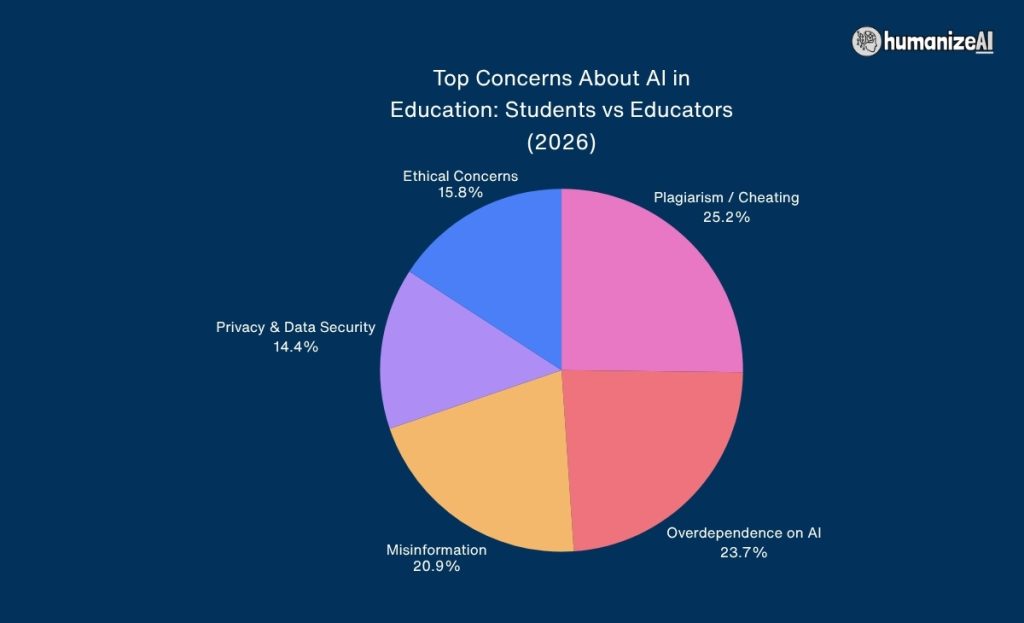
A survey published by Microsoft highlights this concern on a deeper level. It says that students are not scared of AI replacing them, but they are scared of something more profound:
- 35% → Fear of being accused of cheating or plagiarism.
- 33% → Becoming too dependent on AI
- 29% → Misinformation from AI-generated content
- 22% → Ethical concerns (AI responsibility, autonomy, etc.)
The report further highlights:
- 29% of academic leaders → worried about data privacy.
- 22% educators → fear over-reliance on AI.
From the perspective of the academic leaders, 26% of them are worried about ethics when it comes to AI usage, especially with agents. The concerning part is that only 6% of them are okay with the overall structure.
If you want to know about this further, check our detailed study on AI in School Statistics 2026: Students, Teachers, and Future Growth and understand how teachers, educators, and academic leaders think about AI, and its growing impact.
Conclusion: The Rise of AI Agents in Education
Research by Precedence Report suggests that, in terms of revenue, the AI in education market is valued at $7.05 billion in 2025. This means our dependency on AI and its genetic roles will be more intense and involved. It will become a core part of our education.
If you look at the numbers, Georgia State's Pounce cut summer melt in half. Deakin's Genie handles 12,000 conversations a day. The University of Sydney has 800 faculty members building their own AI agents. Now these are not just good to know facts anymore. But the new normal, where our teachers, students, and the entire staff are getting more involved with AI in the long run.
Yes, it is also true that 85% teachers are unprepared, or many students fear there will be wrongful accusations and questions about their ethics. But this is exactly the gap that we are trying to bridge. This is where the experts believe the opportunity lies to integrate AI with a more sustainable setup.
If you think about it, this is an exciting venture. Students starting their journey today will one day graduate into a workforce where AI agents are the core of their identity. That’s why institutes preparing them for reality are the ones who will stand the test of time.