
You are always ranking on the first page for most of your blogs. But there is one big confusion! Somehow, you never get any clicks; they have magically disappeared. Before you start spiralling or think it is some kind of glitch, here’s a quick update.
No, it is not some kind of penalty, but Artificial Intelligence Optimization, or in simple terms, Google’s AI Overviews. The new update that sums up the answer to the query with all the available options.
At this point, a report from ALMCorp says that AI Overviews are showing up way more often than before. In fact, they now appear in nearly half of all search queries, which is a 58% increase compared to last year.
Therefore, there’s no need to scour multiple links or do research. In other words? No more clicks for you. Before you panic, read along as we discuss how this is impacting business globally. And how you can manage your strategy accordingly.
We will look into AI or AIO's impact on traffic in 2026 and what the statistics point to for the coming future. Especially for online businesses that are still struggling. Don’t worry, we have it all discussed, analyzed, and listed for you.☺️
What Are Google AI Overviews (AIOs)?
Google’s AI Overviews are its new search integration, where a user gets an instant answer to their query. In other words, they do not have to go through multiple links; instead, Google does it for them. It scans through all the available content and presents a well-structured answer in seconds. Here’s a quick look:
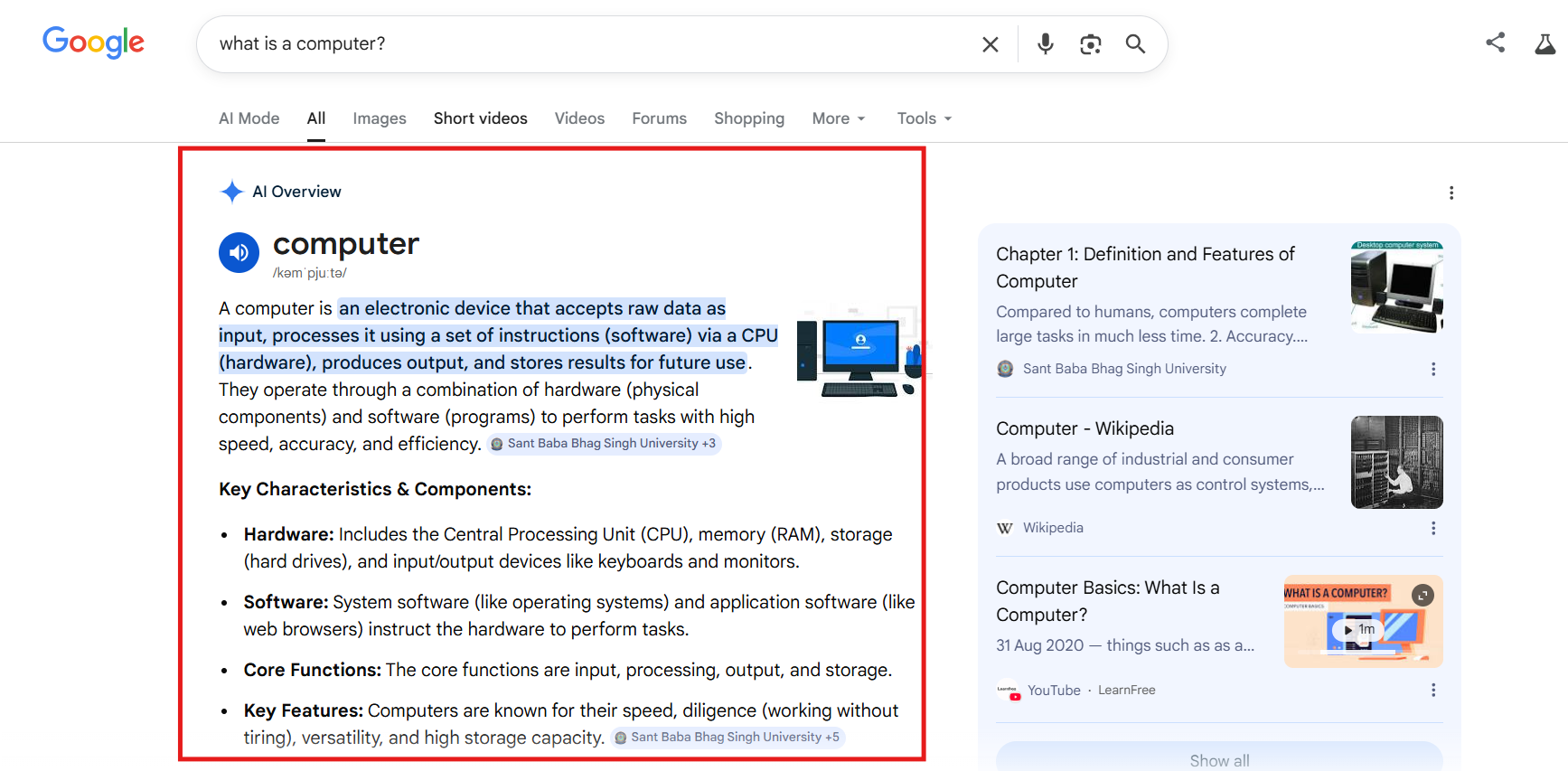
As you can see here, there is no longer a need to click on the top-ranking links. The answer is all there in one simple format. Making it easier, faster, and more satisfying with your search. However, as a business owner, this means trouble. People are no longer clicking on your website but getting an answer on the search page itself.
This is why Google AI Overviews have now completely changed how we look at search and sustain a business online. Let us understand this with the help of numbers and insights around the world.
Key Takeaways:
- AI Overviews now appear in nearly half of all searches, marking a 58% increase year over year.
- Click-through rates drop by 34% to 46% when AI summaries appear in search results.
- Search still contributes 20% to 40% of total traffic for most publishers.
- Educational platforms like Chegg have reported a 49% drop in traffic.
- Users click only 8% of the time when AI summaries appear, compared to 15% without them.
- Around 26% of users leave immediately after seeing an AI summary, compared to 16% on regular results.
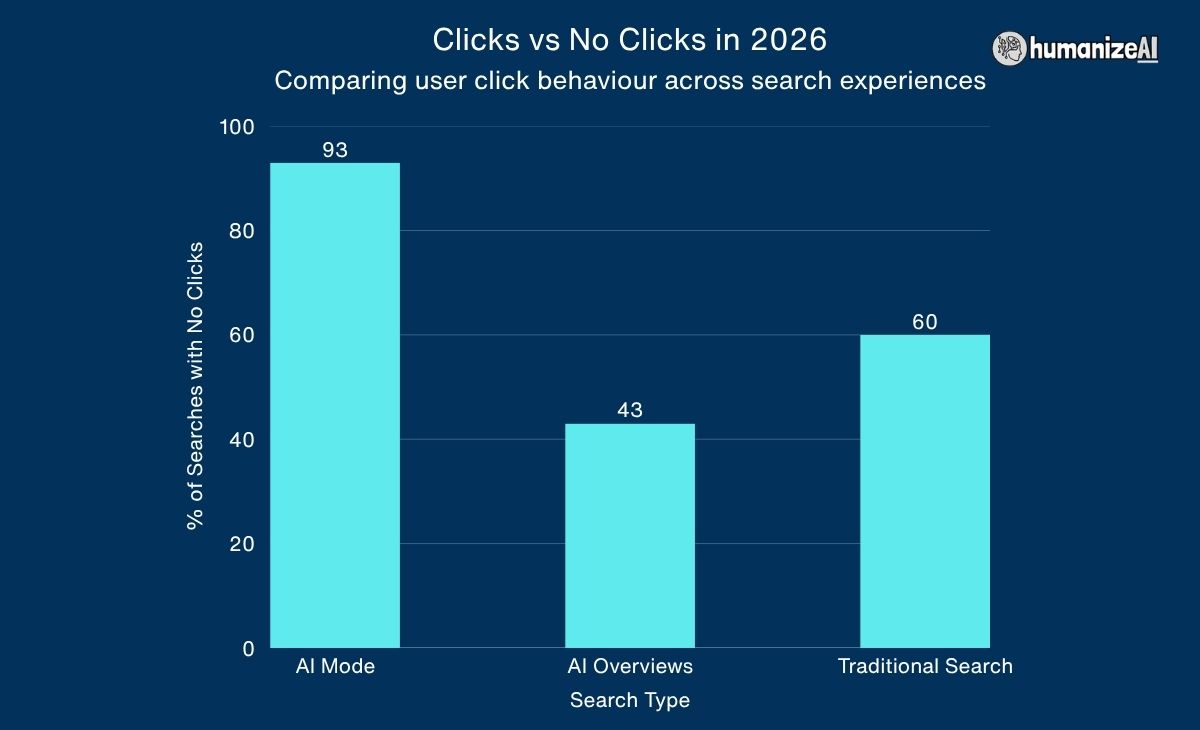
- 93% of AI Mode searches end without clicks.
- 43% of AI Overview searches end without clicks.
- 88% users accept the AI shortlist without verification.
- 74% users choose AI’s top recommendation.
- 60% of searches end without a click.
- 88% of high-intent queries still drive action.
The Big Shift: How AIOs Are Changing Click Behavior
As we have seen, search is no longer about going around and clicking every link. With AI Overviews, things get done in seconds. Ever since Google launched its AI Overviews in May 2024, there have been some alarming changes, reports Search Engine Journal. Here’s a quick look:
- In some areas, traffic has dropped as much as 89%.
- This impact is serious and is creating panic because search (including Google Search and Discover) usually brings in 20% to 40% of total traffic for most publishers.
- A perfect example will be DMG Media, the mind behind MailOnline and Metro, which reported around 90% drops in clicks for some searches.
- Infact the educational platforms have also taken a big hit, with Chegg reporting a 49% drop in traffic.
- Independent studies from 2024 and 2025 show that when AI summaries appear in search results, click-through rates (CTR) drop by 34% to 46%.
👉 Simply put, when Google puts the answers on the first page, not many people feel the urge to click on websites.
Traffic Impact: Winners vs Losers
At this point, Google’s AI Overviews appear in 40 languages and in 200 countries. Therefore, needless to say, it is creating a major global impact. Before we dive into the actual numbers, let us look at research by the Pew Research Center on the psychology behind the present dynamic. To begin with, it says that:
🚨 When Google shows an AI-generated summary, fewer users click on website links.
It analyzed the search behaviour of 900 US adults with their consent and realized a few important things:
- Users who see an AI summary click on regular search results only 8% of the time, compared to 15% for those who don’t.
- Users are more likely to stop browsing after seeing an AI summary. (26% leave the search page, compared to 16% without one.)
- The most commonly cited sources in both AI summaries and regular search results are Wikipedia, YouTube, and Reddit. They make up for 15% of sources in AI summaries and around 17% in standard search results.
- Back in March 2025, 1 in 5 Google searches showed AI summaries.
- Most of these summaries use multiple sources. About 88% included three or more sources, while only 1% used just one source.
But things have now changed. AI Overviews have now become the norm for Google search, and they pull from multiple details. So, how does it impact traffic? Let us find out.
To begin with, Google had initially raised concerns about the findings by the Pew Research Center and said AIO is never going to impact the CTR or the Click Through Rate.
| Click-through rate CTR is the percentage of people who click on a link, ad, or email after seeing it. It is calculated as: CTR = (Number of clicks ÷ Number of impressions) × 100 |
However, things started to crumble and soon. A detailed report by Ahrefs from April 2025 highlights a few interesting insights:
- AI Overviews reduced clicks to top-ranking content by 34.5%, despite Google claiming otherwise.
- In December 2023, the average CTR for position one on informational keywords was 0.076. By December 2025, it had reduced to 0.039.
- In December 2023, the average CTR for position one on AI Overview keywords was 0.073. By December 2025, it dropped to 0.016.
Another major bleak finding that initially had everyone worried for their online business highlights an alarming trend. It says that “AI Overviews reduce the organic click-through rate for position one content by 58%.”
Ahrefs concludes its report by dropping a simple fact. It says, regardless of what we feel about the AI Overviews, it has now changed what search was all about. Therefore, to sum it all up:
Before AIO, position 1 meant visibility. In 2026, it means you might still be ignored, never clicked, and have an ever-declining CTR.
The Citation Divide: Visibility Without Clicks
You must be wondering whether this means online content is dying? Is this another LinkedIn debate waiting to happen? Well, not really. AI Overviews are only a problem if you are not in it. Here’s a quick look at a study by Seer Interactive:
- Brands that were cited in AI Overviews saw 35% more organic clicks and 91% more paid clicks compared to those that were not cited.
- However, the study also highlighted that click-through rates still drop sharply when AI Overviews are present. Organic CTR falls from around 1.76% to 0.61%, while paid CTR drops from nearly 19.7% to 6.34%.
But the real twist lies in who gets cited. To begin with, AI Overviews have dismantled the concept of domain authority. And this is exactly where an online business struggling with CTR or visibility enters the picture.
- According to Ahrefs, only 38% of AI-cited pages actually rank in Google's top 10. Meaning a page sitting on, say, position 15 or 20, can be cited by AI Overviews, and you, in position 2, get nothing!
Even though it might sound or feel brutal, it is a blessing in disguise. With AI Overviews, Google has made sure that only great content deserves the spotlight! Regardless of its positioning, authority and etc. However, there is one other thing!😅
The Zero Click Economy: Is It Really That Bad?
Actually, Google didn’t stop at summarizing your content for your users. It also made sure to help your potential customer decide what they feel about you. This is where things get a bit trickier, and some people even like to call it a hurdle if not anything else.
It is not only the AI Overviews but Google’s AI mode that is reshaping your potential customers’ perception, even before you can make an impression.

Semrush presents a detailed report and helps you understand how exactly to feel about this. Here’s a quick look:
- In AI Mode, 93% of searches end without a single click.
- In AI Overviews, it’s already high at 43%.
In other words, people do not even bother to open the websites anymore. They read the answer on Google and leave.
- Users spend 49 seconds inside AI Mode
- Compared to 21 seconds in AI Overviews
It means that people are actually reading content that helps them make a decision, but on Google itself. Now this is alarming because people are no longer shortlisting options before a purchase. Initially, during the less chaotic times, 56% of users curated their own shortlist by visiting multiple sources. But now?
🚨88% of users simply accepted the AI's shortlist without any further verification.
🚨The AI's top pick becomes the user's top pick almost 74% of the time.
So What Do You Actually Do Now? The 2026 Survival Stats
There is no better way to say this than that AI Overviews has impacted us all. Even the brand value of the bigshot names couldn’t withstand its impact. But here’s one thing that we have a habit of forgetting when we talk about AI Overviews. There is no AI overview or AI Mode without you and your content.
As Sparktoro reports that 60% of searches now end in zero clicks, you have to start reshaping and assessing your content accordingly. This is also where the “SEO is dead debate” comes into the picture. But, you have to shut down this noise and understand a few quick things:
- If you match your content with the search intent, it will still drive clicks. Searches where users want to buy, compare, or take action continue to perform better (88%) no matter what. (Semrush)
- Secondly, useful content still gets rewarded. Ahrefs reports that the Google useful content framework is not just a guideline. But, a structured way for you to feature on AI Overviews and AI mode.
👉 In simple terms, Google wants users to see trusted, experience-led information. Thus, giving you a direct ticket to visibility in Google’s AIO environment.
Therefore, the answer is simple: even if you feel like the situation is against you, it is really not. At this point, you have to go beyond generic content and give the users what they really want. Or else AI is there to replace you with your competitor instantly.
Therefore, instead of worrying about the numbers or AI citations, you genuinely need to focus on shaping good content. Nothing can actually replace content that adds value, and Google doesn’t want that either.
Quick Nudge: Do not forget, when it comes to creating, writing, and shaping human-first content, HumanizeAI.io is always there to help! With our top AI Humanizer and dedicated writing tools, ranking on AI Overviews is no longer a challenge.
You can think of it as a scenario where it is about getting rid of generic content and fighting a fair battle to capture your audience's search intent. Because at the end of the day, yours and Google’s perspectives are the same: the user must be satisfied at all times.