
When it comes to AI in software developer jobs, there is a major gap in the conversation. The experienced developers are happy with AI and its takeover. But things are not that assuring when it comes to the entry level.
Thus follows the basic question: Is AI good or bad for software developers? Read along as we figure this out, but with updated numbers from research and studies across the world.
We will look into the present automation, productivity, and hiring trends that will help us understand what exactly is happening.
What the Job Numbers Actually Say Right Now
The numbers currently tell a convincing story. The U.S. had 1,895,500 software developers, QA analysts, and testers employed in 2024. Here’s a quick look at how the job situation looks right now:
- Software developer jobs are set to grow 15% between 2024 and 2034.
- What does that look like in real numbers? Well, about 287,900 new jobs over the decade.
- Add the openings created every single year, and employers are looking at roughly 129,200 jobs annually through 2034.
- Now let us talk money. Software developers took home a median salary of $133,080 in 2024.
- QA analysts and testers earned a bit less. Their median came in at $102,610 the same year.
- Computer programmer jobs tell a different story, though. That role is actually expected to shrink 6% by 2034, and there were only around 121,200 of these jobs to begin with in 2024.
Sources
- Bureau of Labor Statistics: Software Developers, Quality Assurance Analysts, and Testers
- Bureau of Labor Statistics: Computer Programmers
The Entry-Level Developer Market Is Showing Signs Of Stress
The numbers we saw up until now tell a promising story. It assures that AI in software development is a good idea and is helping build a more sustainable work culture. So, what exactly seems to be the tension or disruption? Here’s the thing, Stanford researchers found that junior developers aged 22 to 25 saw a nearly 20% drop in employment from late 2022 to July 2025. A quick look:
- Since late 2022, workers with AI-dependent jobs have seen a 13% relative employment decline.
- For workers aged 22 to 25 in the most AI-exposed roles, that number gets worse. The employment dropped to 16%.
However, if you flip the script and look at professionals having experience with AI, it once again highlights something important:
- Workers aged 30 and above in highly AI-oriented jobs actually saw employment grow from 6% to 12%.
- And then come the big techs that cut entry-level hiring by more than 50% in three years.
Sources
Software Developer Job Openings Remain Below Previous Levels
Indeed Hiring Lab reported software development job postings were 36.4% below February 2020 levels as of October 2025. As in, there was a visible dent or change in the hiring process:
- Job openings were down 6.7% year over year as of October 2025.
- Earlier in 2025, that gap was even wider. Job postings were down 9.5% compared to the year before.
- From a bird’s eye view, it looks even worse. Software development openings through Q3 2025 were still 33% below February 2020 levels.
- If you look at the numbers, the junior tech roles took the biggest hit. It went down 34% compared to five years ago.
- Senior tech was no good either. They dropped 19% in the same window.
Sources
- Indeed Hirinh Lab
- Stanford AI Index
Generative AI Adoption Is Happening Faster Than Earlier Technologies
The reason for this entire reshuffle lies in the fact that people are gobbling up GenAI in the workplace. It has now reached a point where GenAI has become a non-negotiable part of our work culture. And where is the lie? If you look at the numbers, generative AI has reached 53% adoption in just three years.
- Stanford's AI Index says that it is faster than both the personal computer and internet adoption.
- Singapore is leading this change with 61% adoption. The UAE is right behind at 54%, whereas the US holds the 24th position globally with 28.3% adoption.
- The value of generative AI tools to U.S. consumers alone reached $172 billion annually by early 2026.
- That is up from $112 billion the year before.
Sources
AI Adoption Is Expanding Across Organizations
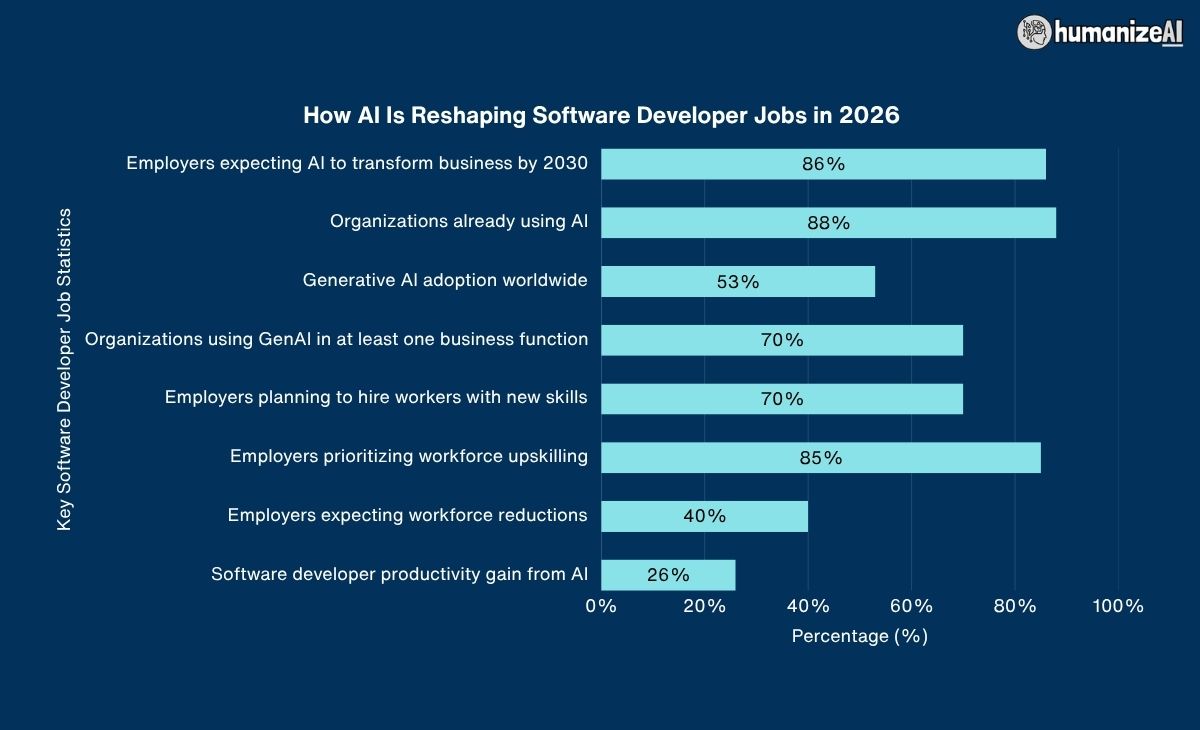
The interesting thing is that currently, every other organisation is leaning into AI adoption. The numbers say that 88% of surveyed organizations reported using AI in 2025.
- In other words, AI is making its space in workplaces and is being used in at least one business function at 70% of organizations.
- However, not many companies are actually using AI agents yet. It is still in the single digits across nearly all business functions.
Therefore, AI taking over the workspace is an organized yet scattered trend. Organizations, leadership, and business expansion now include conversations that are built and nurtured with AI. And software development jobs are no different.
Sources
The AI Revolution In Software Development: A Mckinsey Report
McKinsey breaks software development support into four levels, from traditional coding all the way up to AI agent factories:
| Level | Description | Status |
| Level 1 | Developing without GenAI | This is the baseline |
| Level 2 | Speeding up individual tasks | Where most companies are today |
| Level 3 | Automating entire workflow steps | Adoption is slowly picking up |
| Level 4 | Delivering entire applications with AI agent | Largely experimental, but offers 20x leverage. |
- Level 4 is where this entire conversation is now happening. Since it is now allowing small teams to deliver work that previously required much larger departments.
AI Is Delivering Measurable Productivity Gains For Developers
Now comes the most important question: how’s all this helping? Is AI actually doing its job, or are we seeing employment displacement as a part of a trend? Here are the numbers:
- Stanford's AI Index puts software development productivity gains at 26% in studies measuring AI-assisted work.
- Customer support came in lower, with gains between 14% and 15%. Marketing output jumped the most at 50%.
- McKinsey found that the best-performing companies got 16% to 30% better at producing work, shipping it faster, and keeping customers happy once they started using AI in how they build software.
- Those same companies also reported 31% to 45% improvements in software quality.
- One large financial services firm went further with an AI agent factory model and reported productivity gains between 40% and 70%.
- LATAM Airlines saw a 50% increase in productivity while actually running with smaller teams.
- McKinsey pointed to one large global bank that got software development running 10 times faster and at roughly half the cost using an AI agent factory model.
- In this setup, coordinated AI agents handle the coding, testing, quality checks, security, documentation, and performance reviews.
However, for now, humans still own the important calls. For example, what needs to be built, reviewing outputs, and stepping up when things need real judgment.
AI And Workforce Reduction Statistics
We know now that AI has now made its place in our daily workflow. Yes, we do rely on human oversight but maybe in the future it can also be replaced by AI as well. However, right now it is a long shot of a statement. Right now what we need to discuss is how the hiring process actually looks. A quick look:
Tech Layoffs by the Numbers
- The World Economic Forum found that 40% of employers expect to cut jobs wherever AI can take over the task.
- Layoffs.fyi tracked 429,608 tech layoffs across 1,193 companies in 2023.
- That number dropped in 2024, but it was still high. Over 152,000 layoffs across 551 companies.
- In 2025, tracked layoffs landed around 122,549 employees across 257 companies.
- Add it all up across 2023, 2024, and 2025, and the tech sector lost more than 700,000 jobs.
- Just the first quarter of 2025 accounted for 22,692 layoffs across 81 companies.
- And the part that stings the most: employment among young software developers fell nearly 20% from their late 2022 peak, according to Stanford research.
What Employers Say They Want Next
- The good news first. Software developer employment overall is still projected to grow 15% through 2034.
- The World Economic Forum found that 86% of employers expect AI and information processing to reshape their business by 2030.
- Another 58% expect robotics and automation to make a major impact too.
- On the hiring side, 70% of employers plan to bring in workers with new skills.
- 85% say upskilling their current teams is now a priority.
- About two thirds of employers plan to specifically go after talent with AI skills.
- And that skill is already paying off. AI specialists are earning salary premiums of up to 43%.
Sources
So, What Happens After 2026
Here’s the thing: the World Economic Forum estimates that labor market transformation will affect 22% of today's jobs by 2030. But at the same time, global employers are expected to create 170 million new jobs by 2030.
On the other hand, the World Economic Forum Future of Jobs Report 2025 says that technology-related roles, including AI specialists and software developers, are among the fastest-growing occupations.
So where does that leave us? The contradiction we opened with is the actual reality. AI is making experienced developers faster, and it is making it harder for new ones to even start with their journey. The thing is both are true at the same time. The 78 million net new jobs by 2030 are real, and so is the 20% drop in employment for developers in their early 20s.
Therefore, to sum it all up, you and I both know that the companies are not slowing down on AI. So, if you wish to survive in the industry, the message is simple. One needs to learn to work with AI or get left behind by someone who already has. Because that is what decides who gets to be a software developer next.