Ever since we started to understand and rely on AI, there has been a lot of panic. People fear that it will replace humans, take away our jobs, and, most importantly, wipe us from our own creative space.
To be honest, all these are true to an extent. But to make it the only truth about AI is unfair to thousands of people whose lives have been uplifted because of it. Then there are dedicated sectors that have seen a new light with AI and so on.
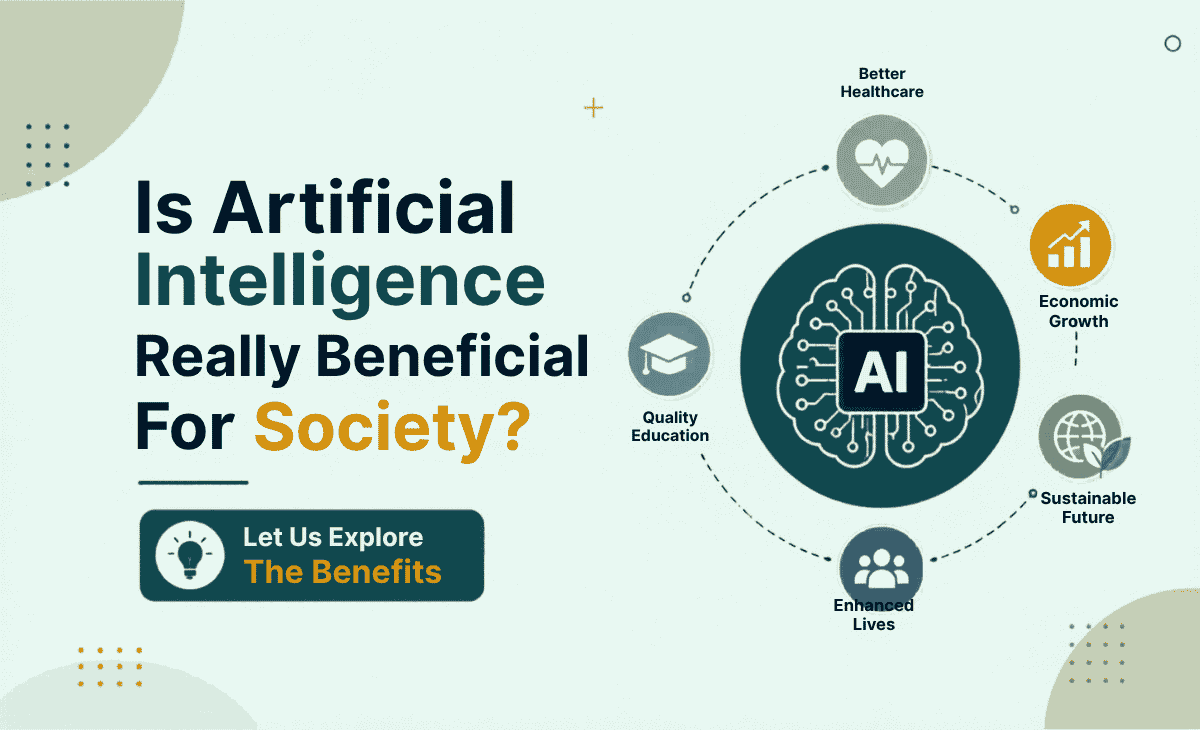
Hop on as we have an open discussion on whether artificial intelligence is really beneficial for society. As AI becomes increasingly embedded in our everyday lives, it is important to pause and assess what is actually happening. Let us look into the benefits while navigating through all the pitfalls and repercussions.
Don’t worry, we will not reduce this article to a few bullet points. We will look into it with facts, perspectives, and layered viewpoints to form an opinion.
What Do We Actually Mean by “Artificial Intelligence”?
We usually think AI is just the writing tools like ChatGPT, Gemini, or Perplexity that we rely on. However, it has expanded its role by doing things we never thought were possible. At this point, AI can be identified into two broad spectrums:
- Narrow AI (Artificial Narrow Intelligence): This is your day-to-day, humble AI that helps you with your daily tasks. Be it Siri on your phone, face recognition, writing with ChatGPT, suggesting movies on Netflix, shopping recommendations, voice search, automated healthcare assistants, and so on.
- General AI (Artificial General Intelligence): Now, this is where all your sci-fi dreams come true. It is the possibility of exploring the chances of AI to understand, learn, perceive knowledge, and so on.
At this point, fortunately or unfortunately, AGI is just a concept that exists more in theory and research. Or in words, whenever we say AI in real life or in this blog, we shall refer only to Narrow AI (for now 👀).
With AI, it is all about borrowed intelligence, and that is why it gets its intriguing name. You might think that your favorite AI tool knows everything, which is true, but it's only because it can process a huge set of data, per se.
In other words, it doesn’t understand what words like “earth” or “moon” mean, but it can give an elaborate explanation on why the moon revolves around it, etc. In other words, modern AI is built on:
- Machine learning
- Large datasets
- Pattern recognition
- Probabilistic outputs (not “thinking”),
Which means when it comes to AI, you must understand that
➡️AI does not understand context like humans.
➡️It predicts outcomes based on patterns.
➡️ The main benefits of AI include scale + speed, + consistency, not intelligence.(Which is both a good and bad thing, as we will explore later here in the blog.)
The Societal Problem AI Is Actually Solving
AI gets a bad name with a few because we fail to assess its overall contribution to society. It is no denying that the concerns with AI are valid and call for a detailed discussion, but so are its contributions. We have to take a break from this polarized space and break everything down with logic and facts.
To begin with, AI doesn’t solve our problems by taking control of the situation but by helping us with a more logical approach.
- With artificial intelligence, there are no time constraints; you get everything done instantly with absolute precision and care.
- We are no longer stretched for manpower as AI alone takes up all the load, be it in an intellectual or labor scenario.
- It is a saving grace for small businesses that are in desperate need of expertise or data analytics.
- More than anything else, it helps doctors, nurses, and other emergency professionals to move past their overwhelmingness with diagnostics.
- Artificial Intelligence is also a massive aid for the governments that are dealing with massive citizen data and crafting policies accordingly.
Let us look into these aspects in a more detailed way before we make a judgment on AI and its authenticity and importance.
AI in Healthcare — Optimizing Care, Not Replacing Doctors
To begin with, AI is seeing a massive acceptance when it comes to saving lives. In fact, a survey published by Vogue says that“ 22% of healthcare organizations have already implemented domain-specific AI tools, a 7× increase over 2024 and 10× over 2023.” Or, in other words, we are getting more dependent and relying on AI when it comes to the criticalities of health care.
So, does this mean that with time, we won’t need doctors anymore? Not quite possible. What AI is actually doing in healthcare is really more about making it more lucid and accessible. It is trying to make healthcare stress-free, and it is not about replacing the people behind it. Or, to put it in simpler terms, it cannot take independent or urgent medical decisions, but it can assist with:
- Medical imaging and diagnostics
- Analyzing a patient’s history to help flag potential health risks and symptoms
- AI reduces administrative workload by assisting with documentation, scheduling, and data management.
The thing most people tend to misunderstand is that AI is not here to replace doctors. It has no idea about physiology, its intricacy, urgency, or the emotional context. If AI ever replaces a human medical expert, our entire setup will eventually crumble. However, it can surely reduce error, improve access to quality care, etc.
AI and Education: Accessibility & Personalization Not Deception
AI in education is still a very sensitive topic because everyone sees it differently. As we keep on debating whether relying on AI is cheating or not, sometimes we miss out on the greater good.
It is only wise to acknowledge how it has changed our entire setup of learning and education itself. Now each student gets the same attention in class with AI and its insights.
More than anything else, with dedicated AI tools, there is no thing as a language barrier. Any student in the world with an internet connection can learn and perceive anything they want.
Not to mention the countless number of high-end tools that help with research, thesis, and so on. It has reduced the workload from months to seconds, that too for niche topics as well.
AI and Employment! Job Loss or Job Evolution?
The most obvious fear when it comes to AI is the fear of losing our jobs. We think AI is going to replace us all. To be honest, it somehow does make sense because automation has historically disrupted industries.
This is where AI takes a back seat because it is equipped to take away the ground-level jobs. Moreover, it is slowly evolving to be able to make major decisions that might reshape the future of a business. But does this mean do we give up on AI? That becomes another problem. Here is what AI has done so far:
- Reduced repetitive workload across industries
- Helped small businesses scale operations with limited resources
- Enabled fast and accurate decisions through data analysis
- Created new roles focused on AI oversight, training, and ethical use
However, these benefits do not erase the risks. To be honest, AI does replace certain jobs. Especially at the ground level, where it is more of a task-driven process. But like any other scientific miracle, like the television or the internet, we have to think of the greater good.
It is something like we know the internet is a terrible place for teenagers, but at the same time, it gives them access to all the information in the world.
For example, according to the World Economic Forum’s Future of Jobs Report, automation and AI are expected to create 170 million new roles by 2027, while displacing about 92 million job roles. However, this resulted in a net gain of 78 million jobs worldwide.
AI in Governance and Public Services: A New Era Of Efficiency
Needless to say, our government sector handles a massive amount of data each day. From citizen records and taxation to infrastructure planning and disaster response, etc. This is where AI comes in as exceptionally handy and can:
- Spot unusual activity and fraud in financial systems before it causes damage
- Make traffic flow smoother and help cities plan better for growing populations
- Predict resource needs during emergencies instead of reacting too late.
- Respond faster and more effectively during disasters, when every minute counts.
But these life-saving techniques also come with a few pressing questions. As we are in the process of identifying a middle ground with all the data, citizenship safety, there are still a few lingering questions. For example, AI in the government sector raises concerns like surveillance, bias, and transparency. In other words, a poorly designed setup with no accountability can actually lead to loss of highly sensitive data.
AI and Creativity: Expansion, Not Erasure
Writers, artists, musicians, and filmmakers around the world are scared of AI’s looming presence in the creative field. More than job acceptance, it is about the space and perception to tell original human stories.
AI lacks experience, emotion, feelings, and conciseness to depict true human emotion. This is why many people are dead against AI’s seat in the creative space. However, it will only be unfair if we do not acknowledge that:
- AI does offer speed, accessibility, and experimentation.
- It enables creators to brainstorm faster, overcome creative blocks.
- The real risk lies in over-automation when AI is used to mass-produce content.
In fact, this is exactly what prompted us to start the journey of HumanizeAI.io, where we wanted to have the best of both worlds. Unlike any other AI tools, we didn’t only want scalability or grammar accuracy. But a setup that relies on human perspective and narratives backed by AI’s swiftness. The best way to understand this is by knowing that when used as a collaborative tool, AI becomes an amplifier of human creativity, not a replacement for it.
So, Is Artificial Intelligence Really Beneficial for Society?
Here is the truth that not most of us are going to like. AI is not inherently harmful or inherently good. It all depends on the intention of us humans and how we use it. Think about it this way: will you blame the student or the calculator if someone is caught cheating in the exam?
AI is incapable of a lot of things, be it accountability, contextuality, a bias-free opinion in a few cases, and so on. However, it compensates for the same with efficiency, accuracy, and so on.
Overreliance on AI can cloud human judgment, but at the same time, when used responsibly, AI improves access to education, enhances healthcare, supports economic growth, and strengthens governance.
The question, therefore, is not whether AI will shape society. It already does. The real question is whether we as a society choose to shape AI with intention, ethics, and our human values as compared to profits, numbers, etc.