
One doesn’t even have to argue that data entry is the most vulnerable job right now with AI. BLS via DataUSA reports that data entry keyers are expected to see a negative 25.9% over the next 10 years, compared to 3.07% national average growth.
These numbers are concerning, and there is no better way to put it than that it is currently undergoing a real-time shift. That’s why we need accurate numbers and touchpoints to understand what exactly is happening.
Read along as we discuss AI’s impact on data entry jobs, keeping in mind automation risks and employment impacts, with detailed numbers. No fluff, no panic, a simple understanding of what all this means. Let’s begin.
How at Risk Are Data Entry Jobs, Really?
As we debate and see the world being divided on AI’s impact on creativity and other generative aspects, things were shifting slowly elsewhere. Jobs like data entry were being aggressively replaced by AI. The reason? It is repetitive, rule-based, and very time-consuming from a human perspective. Here’s a quick look:
- At this point, data entry and administrative support jobs face a 95% risk of automation.
- Studies say that AI could eliminate 7.5 million data entry and administrative jobs by 2027.
- The reason being AI systems can process more than 1,000 documents every hour.
- The concern lies in the fact that AI document processing tools have an error rate below 0.1%.
- Human data entry workers typically make errors at a rate of 2% to 5%.
- Reports further suggest that office and administrative support roles have the highest AI exposure of any occupation in the United States.
- At this point, Goldman Sachs estimates that 46% of tasks in office and administrative support jobs could be automated.
Citation:
- SSRN, cited by DemandSage
- Source: Goldman Sachs, reported by CNBC
Broader AI and Automation Statistics
- AI is expected to affect nearly 40% of jobs worldwide. (Source: IMF, cited by DemandSage)
- Across 21 OECD countries, 27% of jobs are considered at high risk of automation. (Source: OECD, cited by DemandSage)
- The World Economic Forum estimates that 92 million jobs could be replaced by 2030. (Source: WEF, cited by DemandSage)
- Based on a global workforce of 3.7 billion people, AI could replace 8.1% of the world's workforce. (Source: WEF, cited by DemandSage)
- Companies using ChatGPT report that 49% have already replaced workers because of AI. (Source: Final Round AI, cited by DemandSage)
- In the first six months of 2025, 77,999 tech job losses were directly attributed to AI. (Source: Challenger Gray, cited by DemandSage)
- Entry-level job postings fell by 15% year over year. (Source: Yahoo, cited by DemandSage)
- Mentions of AI in job descriptions increased by 400% over the past two years. (Source: Final Round AI, cited by DemandSage)
What Goldman Sachs Has to Say: A Detail
Well, before we proceed further, we need to pause for the Goldman Sachs report simply because it has all the answers we are looking for. Let us break it down with detailed data points:
To begin with, Goldman Sachs estimates that 300 million jobs worldwide could be affected by generative AI. Additionally, in the US and Europe, close to two-thirds of all jobs have some exposure or risk to AI automation. It further predicts that widespread AI adoption will happen over roughly 10 years.
- AI could automate work that accounts for 25% of all work hours across the US economy.
- Most affected occupations are expected to lose between 25% to 50% of their workload, rather than disappear completely.
- During that transition period, around 6% to 7% of workers could be displaced.
- Their research further says that AI could increase global GDP by as much as 7% over time. In other words, there is no going back from this new level of work or automation.
Why Data Entry Jobs Are Considered High Risk
Here’s a number for you to sit with. The combination of a 95% automation risk, 7.5 million potential job losses, and 46% task automation exposure makes data entry one of the occupations that are most vulnerable to AI.
The reason is simple: data entry work is repetitive and follows clear rules, making it easier for AI systems to automate. Also, AI can process documents faster, on a larger scale, and with fewer errors than human workers.
Citations:
- Goldman Sachs Research
- CNBC (reporting on Goldman Sachs, March 2023)
- SSRN (cited by DemandSage)
- IMF (cited by DemandSage)
- OECD (cited by DemandSage)
- World Economic Forum (cited by DemandSage)
- Final Round AI (cited by DemandSage)
- Challenger Gray (cited by DemandSage)
Sources:
What AI Is Actually Replacing in Data Entry Right Now
We have seen the numbers that AI is replacing repetitive jobs. But what exactly does it entail? How deep is this automation that we are talking about, and who all can be affected? Is it just about routine form fill-ups or something more? Let us dive in and understand.
Administrative Work Is Being Automated First
At this point, AI systems are increasingly handling invoice processing, payment processing, employee onboarding, and client data entry. (Source: Jobs of Tomorrow Report, cited by World Economic Forum). Here are a few more numbers:
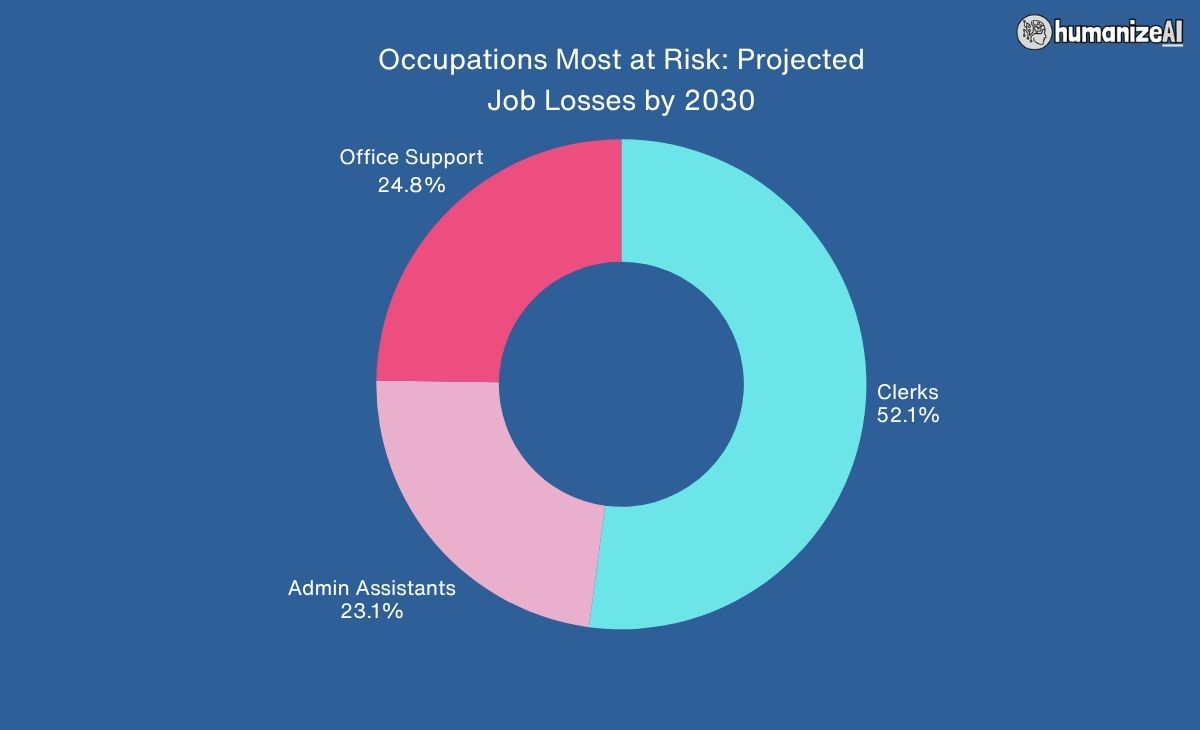
- Office support occupations are projected to lose 761,900 jobs between 2024 and 2034. (The Motley Fool)
- Demand for clerks could decline by 1.6 million jobs by 2030. (Source: McKinsey Global Institute)
- Demand for administrative assistants could decline by 710,000 jobs by 2030. (Source: McKinsey Global Institute)
- Office support, customer service, and food service occupations are expected to account for more than 84% of the 12 million occupational shifts projected by 2030. (Source: McKinsey Global Institute)
AI Is Reducing Entry-Level Opportunities
The biggest hit is, like always, the entry-level job postings. World Economic Forum reports that entry-level job postings have fallen 29% since January 2024. (Source: Randstad, cited by World Economic Forum)
If you look around, in the UK, 1.2 million graduates competed for fewer than 17,000 entry-level jobs in 2024. And a number like this makes you realize how intense the gap and this divide is. (Source: World Economic Forum). Here’s a quick look at the world youth unemployment rate as discussed in the same report.
| Country | Youth Unemployment Rate |
| USA | 10.8% |
| India | 17% |
| China | 16.5% |
| Morocco | Around 36% |
Source: World Economic Forum, 2025 Labour Market Analysis.
That’s not just it. At this point, 49% of Gen Z job seekers believe AI has reduced the value of a college degree in the job market. (Source: Hiring Lab) Along with that,
- 37% of Gen Z graduates are now pursuing or working in blue-collar occupations. (Source: Forbes)
Companies Are Reorganizing Around AI
It is only evident that now that AI is taking over the conversation, companies are reorganizing around its demand. There is a significant reduction in the workforce and a change in the workplace structure. At this point, 41% of organizations expect to reduce workforces in roles affected by AI-related skills conflicts. Here’s a quick look:
- 70% of organizations plan to hire workers with new AI-related skills.
- 85% of employers are investing mainly in upskilling programs.
- 77% of employers are providing AI training to workers.
- Only 64% of employers view employee well-being as a key strategy for attracting talent.
Source: Future of Jobs Report 2025, World Economic Forum
AI Agents Are Taking Over Routine Business Tasks
These numbers paint a clear picture of how the future will look for routine data entry jobs. But to add more context to the discussion, here is another set of studies published by the World Economic Forum.
- 82% of executives plan to adopt AI agents within the next one to three years. (Source: World Economic Forum)
- 99% of AI developers are already exploring or building AI agents. (Source: IBM survey, cited by World Economic Forum.
Most importantly, it is critical to note that AI agents are increasingly being deployed to handle repetitive business operations. Here are a few detailed observations as pointed out by another report published by the World Economic Forum on the report published by Nova Mundi:
- 63.04% of automation opportunities identified by companies involve repetitive administrative work.
- Only 20.65% of automation use cases were related to marketing and content creation.
- And 16.31% of automation use cases were related to sales, lead generation, and similar functions.
- Not only that, but 88.52% of companies said they would implement automation immediately if they had the time, capacity, or support to do so.
The Skills Gap Is Growing
At this point, 9 out of 10 executives report workforce overcapacity in traditional roles while facing shortages in AI skills. As in, AI automation has made the existing workforce redundant while demanding more people who have significant AI skills:
- 94% of leaders report shortages in AI critical skills.
- 1 in 3 leaders report AI skill gaps of 40% or more.
Source: World Economic Forum
Conclusion: The Shift Is Already Happening
One might think that it is just a mere replacement of workforce when it comes to AI’s impact on data entry jobs for 2026. However, it is more intense, concerning steeper than that. To begin with, from 2019 to 2022, the U.S. labor market recorded 8.6 million occupational shifts, which was 50% higher than the previous three-year period.
This is not just a trend you can point to on a graph. It is a real shift that is already affecting real people, across real industries, all over the world. And that is not it, McKinsey expects another 12 million occupational transitions by 2030.
Along with that, activities accounting for up to 30% of hours worked across the U.S. economy could be automated by 2030. The report further points out how customer service, office support, and administrative work remain among the occupations most exposed to automation-driven restructuring.
The question was never really "will AI replace data entry jobs?" That ship has sailed. The real question now is what comes next and whether workers, companies, and governments move fast enough to answer it.
(Source: McKinsey Global Institute)