

Sometimes, the real struggle of establishing research lies in its abstracts. The pressure to sum up the entire thing in a few lines can be challenging for many. So, eventually, we started relying on AI to make things easier for us.
But have you wondered which abstract in the market knows its job the best? Does it assure a fair representation of all the hard work that you have put in? Let us find out.
Read along as we discuss the top 5 AI abstract generators for 2026 and how, as researchers, scholars, and writers, you can make the best use of them. Consider this your go-to guide for everything you need to know about AI abstract generators in the market. 😎
But before that, a quick sneak peek into a few basics.
What Is An Abstract Generator?
An abstract generator uses artificial intelligence to generate accurate summaries for your given paper, thesis, or research. It scans your entire work to highlight the purpose, methodology, key findings, and so on.
Usually, an abstract appears at the beginning of your paper and lets your reader know what the paper is about. However, many people in general confuse it with a summary, but this is how it is different:
- An abstract is only used in academic writing.
- It is always written at the beginning of the paper.
- A perfect abstract always follows a fixed logic.
- The main purpose of an abstract revolves around a few key points.
So, for an abstract generator to be called a top tool, it needs to check all these boxes. But most importantly, understand the context of a given topic. It is not about some random lines that explain a topic, but about an overall stable setup that deep dives and also regulates.
What Makes A Good AI Abstract Generator?
We have reached a point where every available option seems like a great fit. Be it for the smart interface, easy-to-use features, etc. This is why the entire responsibility lies on the accuracy and contextual understanding of the tool to get things done. Or, in simpler terms, a “good” abstract generator should:
- Context understanding: Simply put, your preferred AI abstract generator should immediately understand what your topic is about. For example, a thesis on a new sleep study should not result in an abstract that merely explains what sleep is.
- Tone Control: We know that abstracts are mostly formal in nature. But a smart 2026 abstract generator adopts a blended writing style. So that you can enhance the readability while maintaining the academic intent.
- Maintain Research Logic: The perfect tool must maintain the natural flow of your research. Or, keeping in track with the research objective, methodology, key findings, and conclusion.
- Easy access: You have to always keep in mind that, at the end of the day, usually an abstract generator is for people, students, scholars who are already overwhelmed. Therefore, they need a tool that will make their work easier and give them constant support to rely on.
Now, for the most obvious question, which tool can do all this and more? Let us find out!
Top 5 Abstract Generators For 2026
We wanted to see in real time how these tools react to a given situation. So we relied on the topic “Ethical challenges of generative AI in academic writing” to help us see through the available options. This is what it looks like:
1. AI Abstract Generator by HumanizeAI.io
With the AI Abstract Generator by HumanizeAI.io, you have two things working in your favour. An easy setup that accommodates everyone, and a tool that understands what research and abstract are. It is a perfect blend of ease of access and contextual understanding packaged in one simple tool.
Key Features & Capabilities:
- You can generate unlimited abstracts for free without any sign-in, extra downloads, or added website extensions.
- It lets you set the tone of your abstracts while keeping in check the theme, concept, and research topic.
- Get the length right for every abstract you generate with one simple toggle.
- Since the tool is absolutely free to use, you can redo, rewrite, and make the most of your creative freedom and control than ever.
- But the best part of all this is that you get an easy copy and download button for every session.
Abstract Quality & Writing Accuracy:
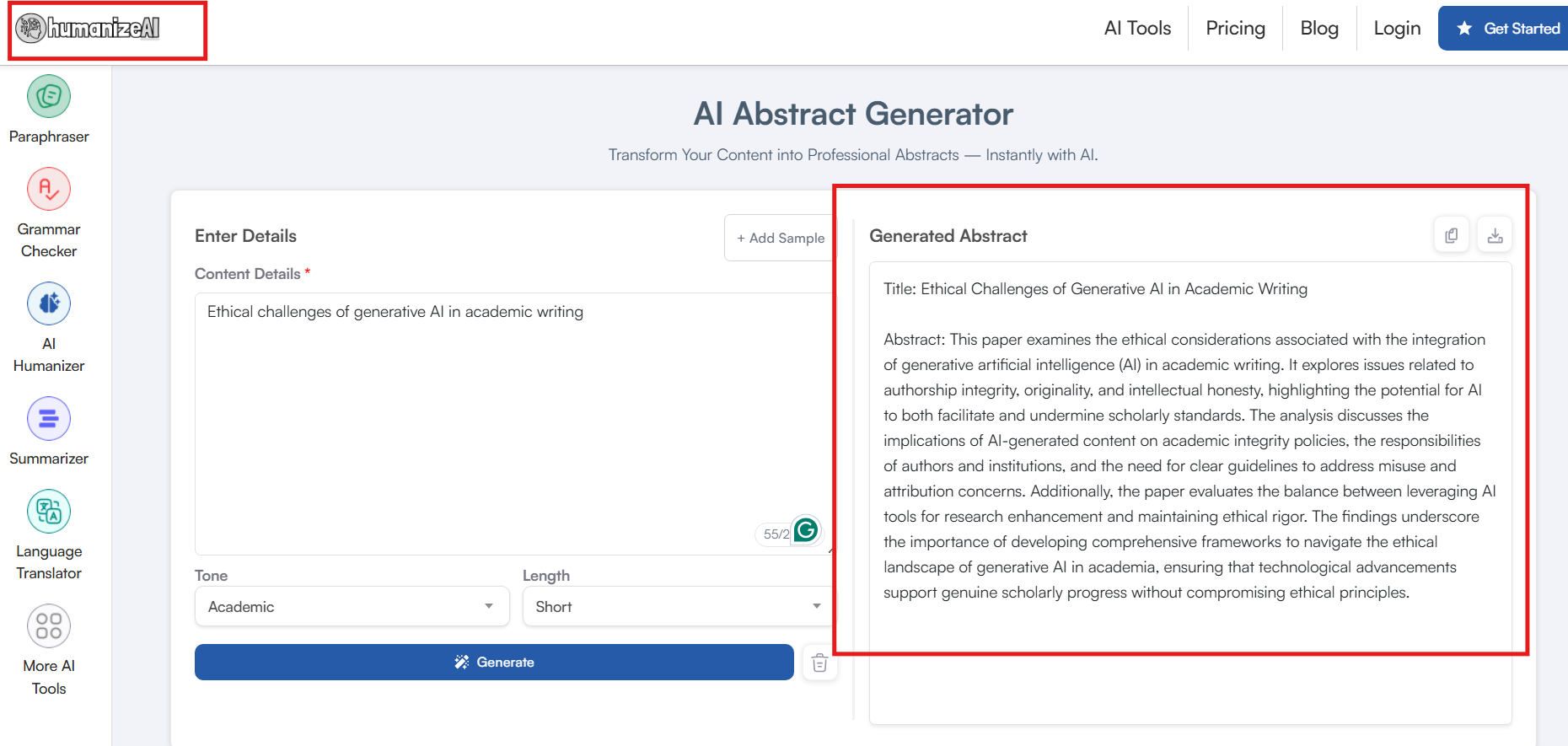
- It took less than a second for HumanizeAI.io’s AI abstract generator to grasp the concept and generate detailed results.
- You can see that it keeps up with standard research logic and addresses all key concerns, including the research focus, ethical concerns, and responsibilities of AI for the given institution.
- But what really stands out in this entire setup is its ability to be relevant and contextual. It doesn’t take the easy out and relies on the generic definition of artificial intelligence. Rather, it tackled ethical authorship, originality, policy considerations, and so on.
Pricing:
AI Abstract Generator by HumanizeAI.io offers unlimited usage for free.
2. Paperguide AI Abstract Generator
Paperguide offers complete academic assistance for its users in its integrated interface. Even with its AI Abstract Generator, it relies on a simple yet smart setup that makes the overall experience easier. Using the tool is relatively easy and allows you to have a quick session without signing in.
Key Features & Capabilities:
- You can either directly paste your text or upload PDF, DOCX, and TXT files for quick abstracts.
- It doesnt offer any added customisations but promises to maintain the academic and formal tone all throughout.
- Paperguide’s AI Abstract Generator doesn’t let you download your abstracts; however, you can make a quick copy and reload for a new session.
Abstract Quality & Writing Accuracy:
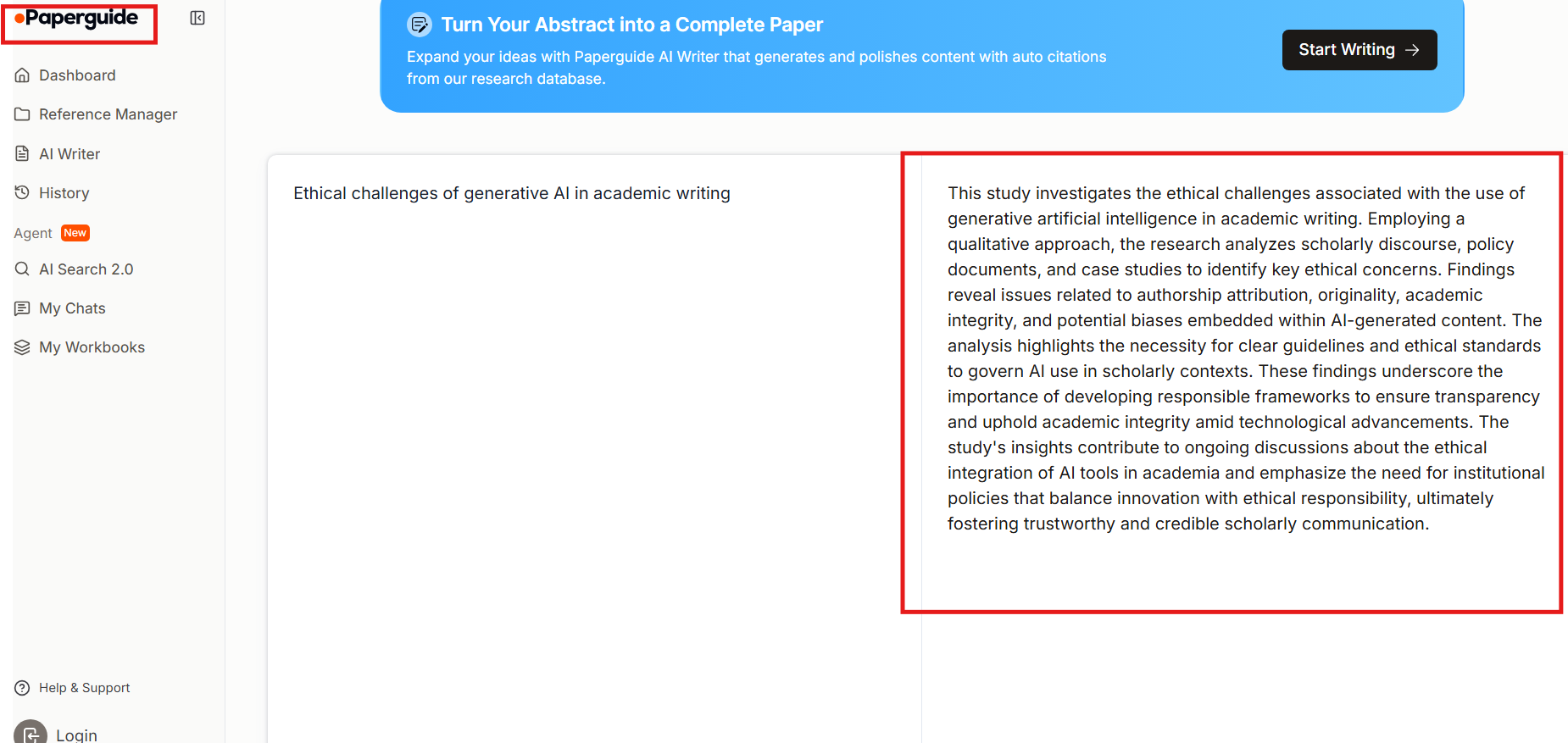
- With Paperguide, you will get a detailed, academically structured abstract that clearly outlines the methodology.
- However, the generated result here was more focused on intensive academic phrasing, which may require manual edits before the final submission.
- Undoubtedly, the wording was strong, but the abstract felt a bit tangled for users seeking clarity or quicker adaptations.
- There is a certain lack of control over the tone and length makes it a good yet unsure option.
Pricing:
Paperguide does have an unlimited free plan with limited features. However, its premium plans, both billed annually, are priced at :
- Plus: $12/month
- Pro: $24/month
3. Abstract Generator Tool by Originality.ai
You might have your doubts about a simple text box as a tool until you use the Abstract Generator Tool by Originality.ai. With a simple setup comprising of two step rules, it promises relevant abstracts for all your research types.
Key Features & Capabilities:
- All you have to do is simply paste your text ( no limit) and generate a quick abstract for your paper.
- You do not need any added layers, customisations, or so on.
- It operates with a simple copy and paste and generates results at an instant.
- There is a Finetune option that refines the parts you select and regenerates a new abstract for you in seconds.
Abstract Quality & Writing Accuracy:
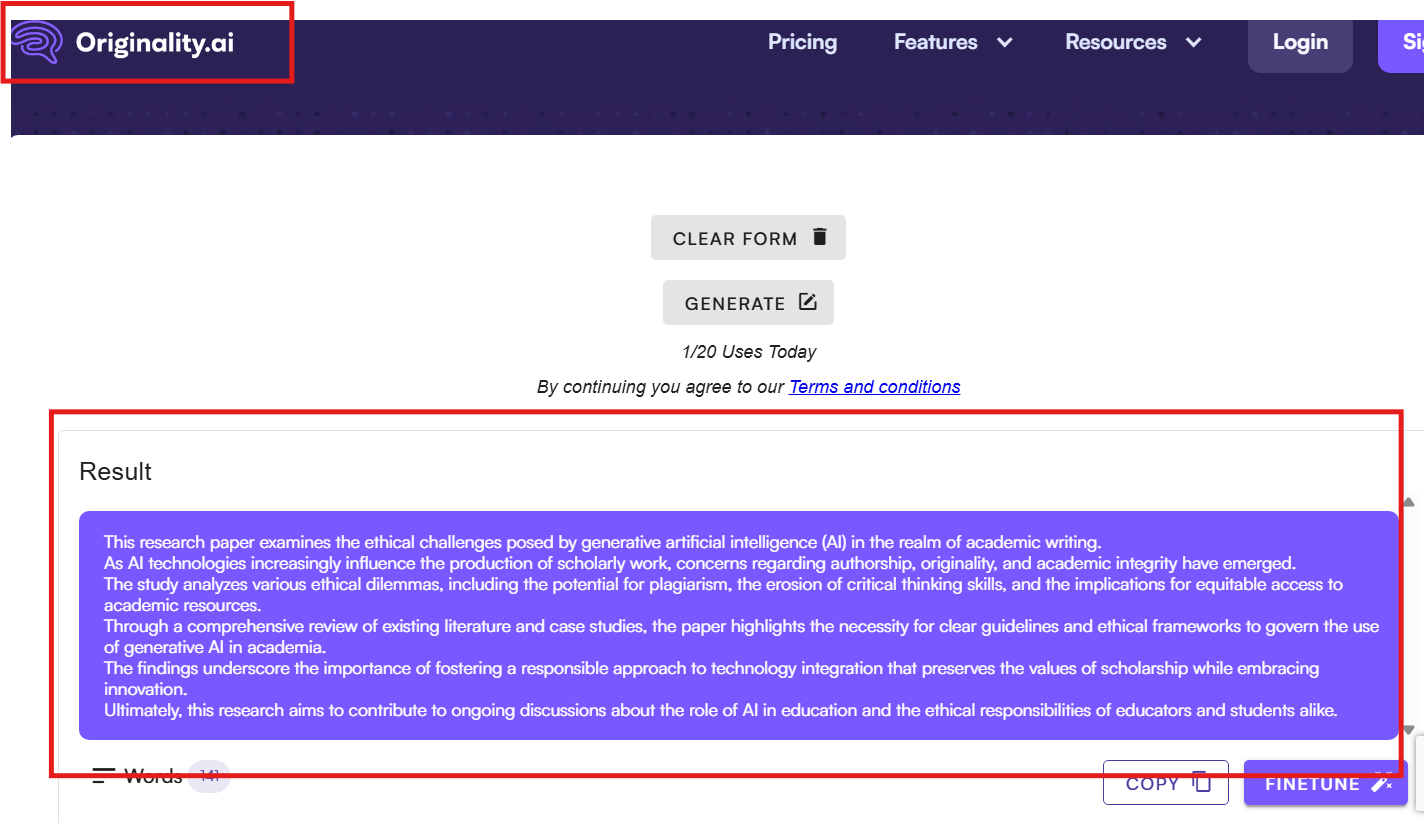
- It accurately reflects ethical themes such as authorship, originality, plagiarism concerns, and the role of AI in education.
- But the generated results were more of a descriptive narrative paragraph rather than a crisp academic abstract.
- Moreover, it misses out on asserting the details of research methodology, analytical framing, or result-oriented structure.
Pricing:
Originality.ai allows 20 free attempts daily for its free version. However, its paid plans are divided into three elaborate options:
- Pay as you go (One-time on-demand pricing): $30 One time payment
- Pro:$12.95/month
- Enterprise: $136.58/month
4. AI Abstract Generator by Grammarly
A trusted name that almost every writer relies on, Grammarly rarely disappoints. With a smart and clean interface, it relies on live prompts rather than customised features to generate the results. But the best part of all this is that it is still very easy to use and doesn’t require elaborate sign-ins or other steps.
Key Features & Capabilities:
- You have to keep feeding the tool live prompts to generate your results, which can feel a bit time-consuming for a few users.
- However, it does give you a certain creative control to shape your abstracts accordingly.
- But the entire process is carefully guided by instructional prompts, which makes it an easy-to-use tool even for the first time users.
Abstract Quality & Writing Accuracy:
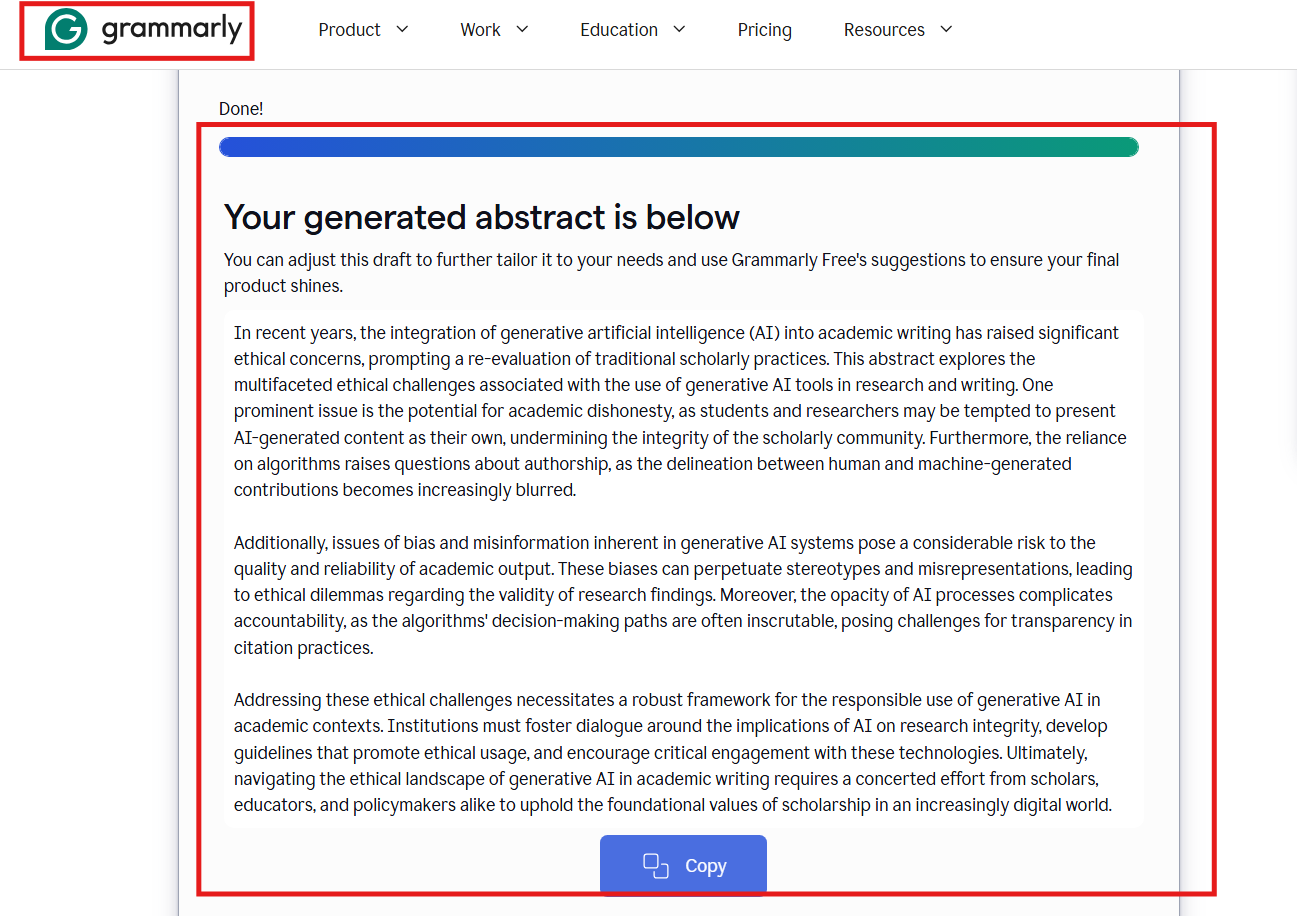
- Needless to say, the content was grammatically polished, well-articulated, and easy to follow.
- However, reading the generated result felt like more of a long from narrative or a discussion.
- It is not that it didn’t discuss the topic in depth, but it refrained from following the set pattern of a research abstract. For example, research objectives, methodology, findings, etc.
- It can be a great specimen for someone looking for a refined linguistic structure for a given topic. However, it is yet to catchup as an abstract generator.
Pricing:
Grammarly’s AI abstract generator is currently free.
5. Paperpal
Another fan favourite for all academics, Paperpal is a recurring name in every list. Unlike other top AI abstract generators, it opens up to an entire dashboard for you to start writing. However, it can be a bit confusing for first-time users, especially because there are no guided banners.
Key Features & Capabilities:
- Paperpal operates on an interactive dashboard with a live prompt-based AI assistant.
- It operates on dedicated AI prompts for each function, but on the same interface. As in, you have to type in all the details for the tool to proceed with the next step.
- For its abstract generator, it relies simply on the actions or prompts you type and generates results accordingly.
Abstract Quality & Writing Accuracy:
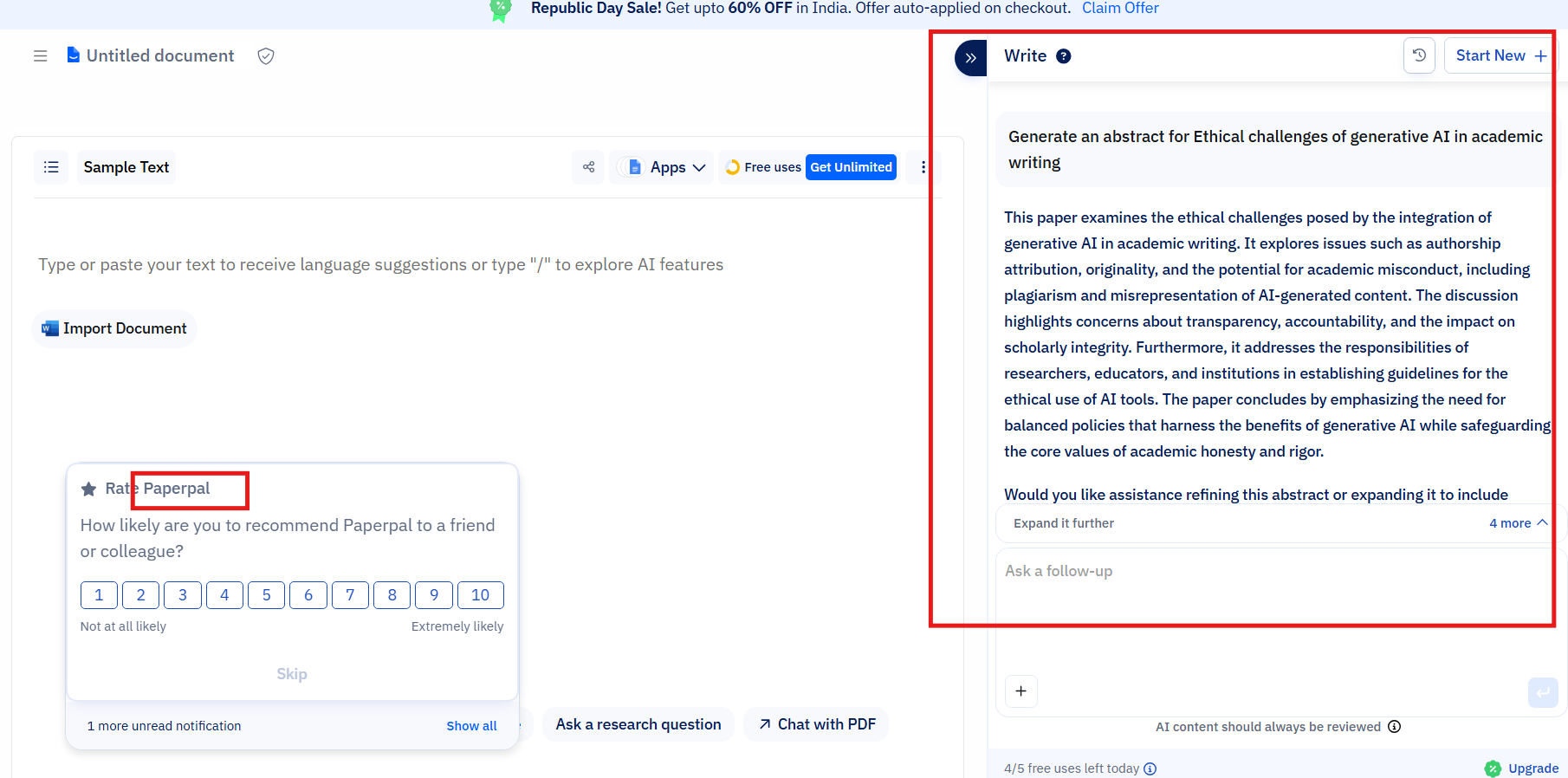
- Paperpal was well aware of the traditional research format and placed strong emphasis on methodological explanation.
- It efficiently highlights key concerns like authorship, originality, and institutional responsibility.
- However, the generated output was lengthier and made it read like a thesis itself instead of an abstract. Therefore, leaving a gap for an extra layer of manual refinement.
Key Takeaways From The Session
As we worked with each tool with the same prompt and in its basic mode, we realised one thing. Even though each tool aims for the same thing, they are all categorically different. Even in their basic modes, they show a variety in their character and generate unique results of their own.
Here is a quick glance at our observation for the top 5 AI Abstract Generators that we tried and tested in their basic mode without any manual edits.
| Tool’s Main Brand Name | Contextual Understanding | Abstract Structure | Ease of Use | Best Suited For |
| HumanizeAI.io | Excellent | Strong and balanced | Very easy | Accuracy and flexibility for any abstract |
| Paperguide | Strong | Methodology-heavy | Moderate | Traditional academic drafting |
| Originality.ai | Good | Limited | Very easy | Quick topic-based explanations |
| Grammarly | Moderate | Weak | Easy | Polished Writing, not abstracts |
| Paperpal | Strong | Very detailed | Complex | Thesis-level academic users |
Conclusion: Which Abstract Generator Works Best in 2026?
Each of the tools listed here brings something high-end and authentic to your research process. Moreover, it serves as a constant reminder of how AI has progressed so far. But from a user perspective, it is essential to know which tool tops the list and serves its intended purpose. That is why we needed to see how things turn out on a real-time basis.
Through consistent testing using the same research topic, it became clear that each abstract generator serves a different purpose. But, with HumanizeAI.io’s AI Abstract generator stood out for its ability to balance contextual understanding, research logic, and overall ease of access. So, if you are struggling with your submission, or the deadline is just around the corner, you know what to do! 😉