
With everyone going on about the AI hype, it suddenly hits you that a lot has changed since the last three to four years. ChatGPT, Claude, Elicit, Gemini, and Perlexity are no longer “good to know names” but are important frameworks in our writing process.
And it is no longer limited to one product line or brand. Data published by HubSpot says that “80% of marketers said generative AI has a positive ROI on their content writing tasks.” In other words, we are no longer about writing and getting approved by the editor workflow anymore.
It has now evolved to thinking, using AI to polish it further, and then getting it approved. Read along as we understand this in detail. But with relevant statistics and a detailed discussion to understand the extent of change after AI entered content writing.🤔
When Did AI Writing Become Normal At Work?
We first saw a glimpse of AI in our daily lives back when we were fighting the pandemic. But the real turning point in this journey was when ChatGPT was launched in late 2022, changing the future of content writing for billions of users forever.
And, it is not some dramatic effect for the sake of storytelling. A report published by Futurism (based on research by the SEO firm Graphite) analyzed a random sample of 65,000 English-language articles published between January 2020 and May 2025. Using an AI detector called Surfer, any article that was found to have 50 percent or more of the content written with a large language model was considered AI-generated.”
Therefore, suppose we have to create a timeline of AI slowly and gradually changing how we write, this is what it looks like:
📌 Pre-2022: AI tools existed, but as futuristic concepts or as Grammar checkers or sentence correctors, and so on.
📌 Late 2022: ChatGPT launches, and AI becomes accessible to everyday writers and users
📌 2023–2024: People started relying on AI for a fast, smooth, and effortless writing process.
📌 2025–2026: AI becomes embedded in writing processes and is now used for writing, editing, SEO and etc.
How Much Content Is Actually Written by AI Now?
This is where the real conflict begins. As AI became accessible to a wider audience, the situation grew increasingly volatile. The internet began filling up with robotic, generic, and repetitive content. Academic institutions raised concerns about its impact on learning and originality, while writers and marketers faced a new challenge as Google changed the search landscape with the introduction of AI Overviews.
Initially, it was all about following Google’s E-E-A-T principle, where Google had strict and elaborate guidelines for ranking. You know the one where your content should be trustworthy and come from a place of expertise?
But now, with the added pressure of AI Overviews, people are more cautious with AI-generated content. Simply put, everyone wants the speed and efficiency of AI minus the robotic and repetitive content.
This exact paradox is suggested by Hubspost’s research, where it says :
- 71% of marketers say AI helps them create significantly more content.
- 53% struggle to make their content stand out in an AI-saturated market.
- Another 52% believe AI has made content so easy to create that it's become less effective overall.
Together, these numbers reveal the core shift in content writing after AI: We no longer struggle with production but with execution and adaptation.
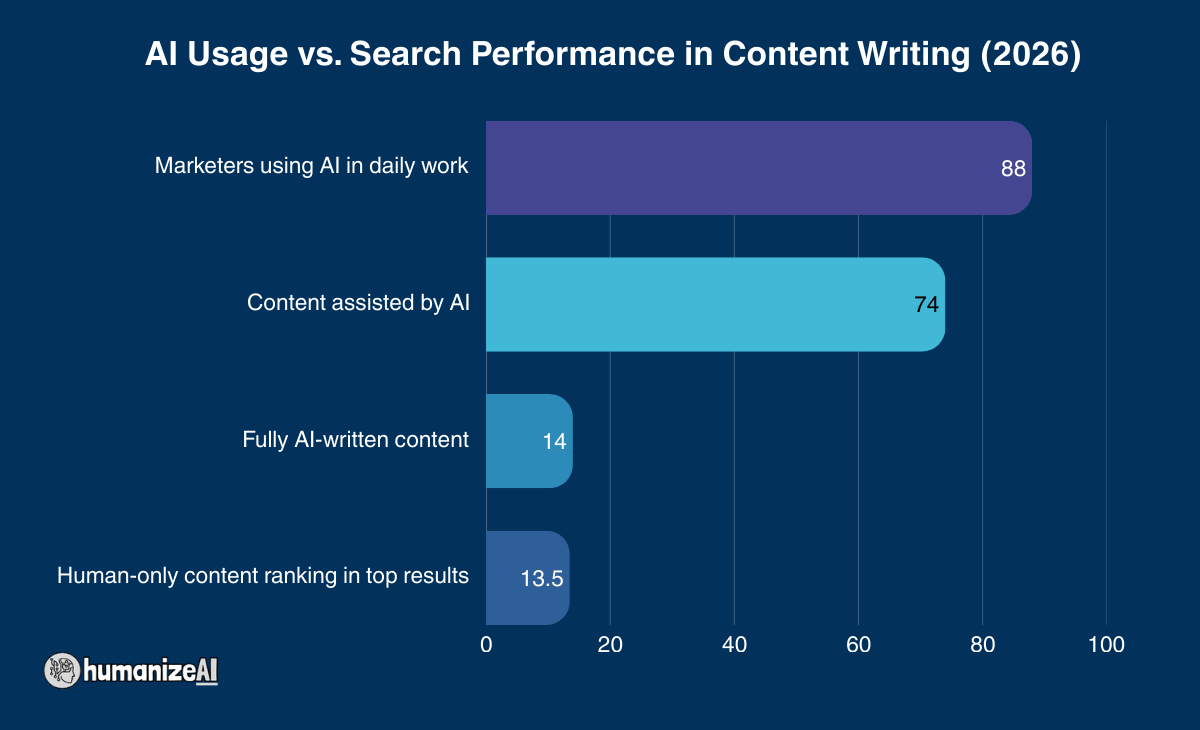
At this point, as AI grows more influential and an independent presence in our writing workflow, people are now also worried about the AI slope (low-quality content mass produced for scalability). This is exactly what a study published by Financial Content actually points out: “only 14% of top-ranking search results are AI-generated.”
Therefore, it is safe to say that AI has increased content output. However, it has also raised the bar for originality, relatable content, and most importantly, the need for authenticity and genuine connection.
What Changed After AI Entered Content Writing?
Non-content writers and others mostly think that the moment AI generates answers, the job is done! That too in seconds. But an AI-powered workflow, especially for writing, works in a very different way and in layers.
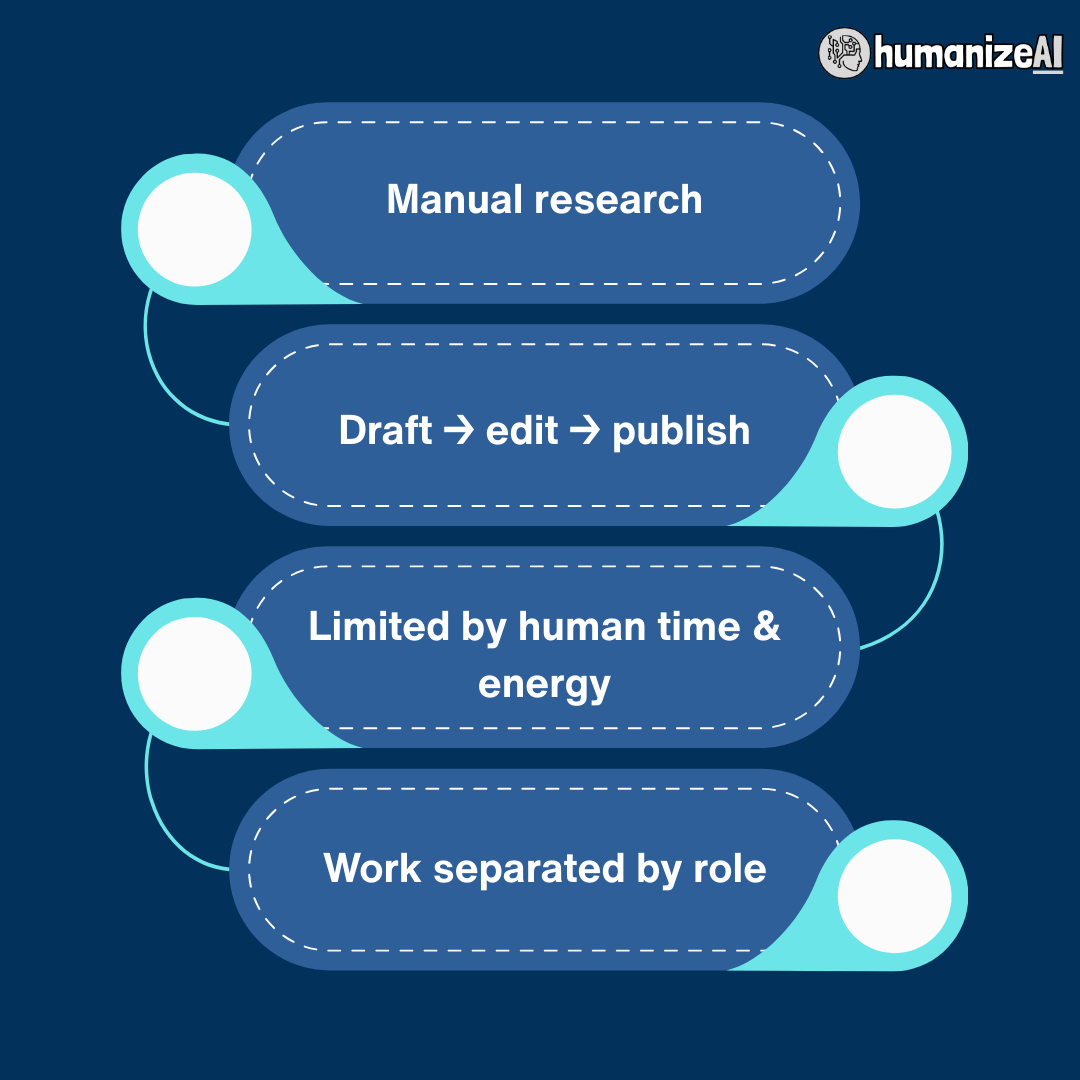
Before AI:
After AI:
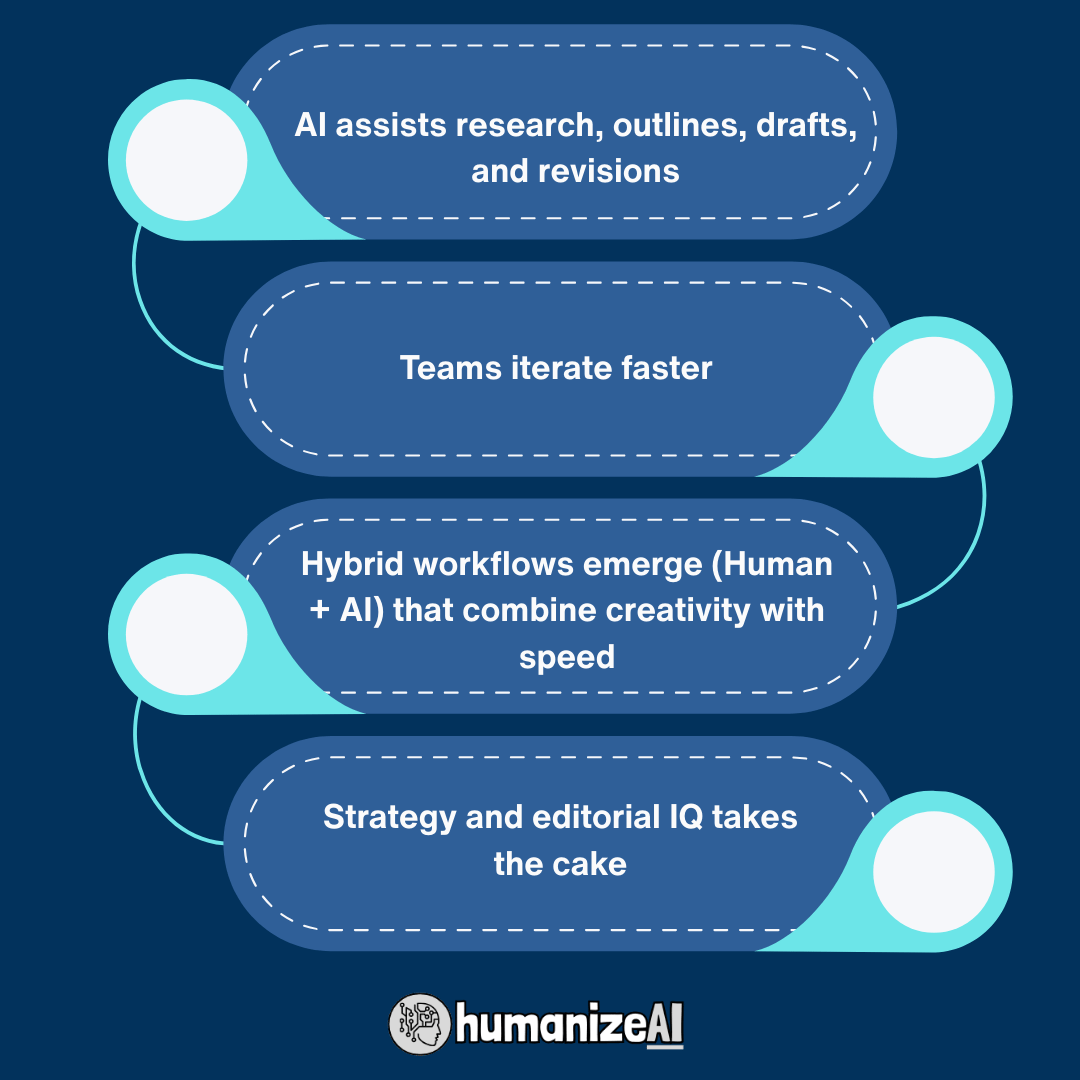
Now, this picture or our current workflow is mainly about understanding one simple thing: the role of the writer is shifting from typing words to being a part of the content outcomes.
This is exactly what a detailed research by Science Direct points out: “ 27% of firms using AI report replacing worker tasks, while only about 5% report direct job displacement or employment changes due to AI usage.
In other words, from a content perspective, as AI takes up the major part of typing, editing, and brainstorming, our roles in the workplace are also rapidly changing. It is not just how the work moves around, but how we used to perceive it as well.
🟦 Writers and Editors now often start with an AI draft and improve it.
🟪 Strategists generate multiple topics in minutes, not hours.
🟩 Analysts and SEO rely on AI for data summaries and evidence rather than simply relying on their guts or “guesswork.”
Therefore, currently, instead of “Write → Review → Publish,” we have progressed to
➡️ “Prompt → Collaborate → Optimize → Publish”
Needless to say, this is also why quality, originality, and intent matter more than ever. This is exactly what a report published by SurveyMonkey says: “now 88% of marketers use AI in their day-to-day roles”. Therefore, when AI makes writing easier, thinking becomes the main differentiator to survive in a competitive space like ours.
The Optimize phase includes search intent and tone adjustments, and many aspects of delivery such as the removal of quirks in formatting, localization for markets, and use of encoding conversion systems such as unicodetokruti.com to convert Hindi language websites for traditional typesetting software. However, the last steps of publishing also require some tools and some degree of human monitoring.
Where AI Is Used Most in Content Writing Today
Now this is where the real discussion begins. As we have seen earlier in our research, only 14% of top-ranking search results are AI-generated, despite 88% of marketers using AI in their day-to-day work. So, what exactly is this gap all about?
At this point, we have to understand one simple thing: contrary to popular belief, AI is no longer used for writing the entire thing, nor is it being considered as a replacement. But for most setups, it acts as an assistant that brings in speed and efficiency.
Or, in simple terms:
In most modern content workflows, AI is used for:
- Brainstorming and outlining ideas
- Generating drafts
- Refining the robotic edges of AI-generated content for tone and clarity
- Summarizing research and data.
However, we as humans still control:
- Intent and positioning of the content
- How it should read
- Originality and the perspective of the piece
- The final editorial or submission decision.
This is why you will see that the top research websites and the leading facts and figures point out that 53% of marketers still struggle to stand out. In other words, indeed, we are now largely dependent on AI for our writing. However, the ultimate decision and execution still lie with us.
Has AI Actually Improved Content Performance?
Now that we are deep diving into details, it is only fair to ask a few uncomfortable questions. If AI actually brings in speed and efficiency, does it also help with better content performance?
Well, this dilemma is clearly addressed by Ahrefs in their research with two critical points:
- Only 26% of new web content is entirely human-created, and only half of that (13.5%) ranks in top positions on Google.
However,
- Purely AI content rarely reaches position #1 in organic Google results.
Therefore, the answer to this question is not a simple yes or no but a more nuanced one. On one hand, AI has significantly improved the speed at which we work.
We don’t need to spend hours or have hundreds of tabs open to find that relevant data. Or, keep thinking about ideas, as now we brainstorm in seconds.
On the other hand, speed doesn’t guarantee content success. This is why (also as the data suggests) if it had, we would see AI-generated pages dominating search results.
Instead, what we see is selective success. In other words, content that combines AI’s speed, efficiency, and structure with human intent and originality. Therefore, to answer the question, yes, AI does improve content performance, but only when it is backed by human insight.
So, Lastly, What This Means for Writers and Content Teams in 2026
Now it is time to ask a more thoughtful question: so what does all this data and progress mean for content teams and writers? To begin with, we first have to accept and understand that AI is no longer a helping hand but an important pillar of content itself.
Along with that, when we think about the present content space and the ongoing debate that writing jobs are no longer relevant, we need to reflect on these urgent points:
- Writing roles are not disappearing but evolving. It now includes building a connection with AI and helping it shape our content rather than blindly following the AI way.
- At this point, human perspective, originality, and input are the ultimate way to use AI insightfully instead of sacrificing it all for the sake of mass production of content.
- We do rely on AI only because it makes work easier, but it also helps with insights that help us survive the competitive edge.
To sum it all up, AI has changed how content is created and has made our work easier, but humans still decide what makes all the difference.
AI Writing Statistics 2026: Key Data At A Glance
Now, let us rewind and see what we have discussed so far to make it all make sense. These numbers are the perfect reflection of how far we have come when it comes to the contribution of AI in content. Along with that, it also highlights the importance of human insights regardless of all the progress and development with AI.
| What the Data Says | Percentage / Insight | What It Means in Practice |
| AI delivers significant value in content writing tasks | 80% | AI has evolved to be an important setup for writing content. |
| AI is part of everyday workflows | 88% | AI is now infrastructure, not an optional or a good-to-have addition. |
| AI helps teams create more content | 71% | Our speed has significantly increased with AI. |
| Marketers struggle to create a stir with their content. | 53% | Overuse of AI has led to a saturation with the users. |
| Content feels less impactful overall | 52% | Since AI can only offer speed and facts, but not that emotional connection. |
| Few top results are fully AI-written | 14% | Google Search is still about original human-written content. |
| AI replaces tasks more than jobs | 27% tasks vs 5% jobs | Roles evolve instead of disappearing. |
| Only a limited number of content is fully human written. | 26% | Most content is now AI-assisted. |
| Human-only content ranks highly | 13.5% | Performance depends on intent. |
| AI-only content rarely dominates SERPs | Rare | AI alone doesn’t guarantee rankings. |