
Even just four years ago, talking to AI felt like a childhood fantasy. The idea existed, but we assumed that execution seemed a far-fetched possibility. Cut to 2026, where DataReportal says that more than 1 billion people now use AI. This massive shift in our habits is not only about how we browse.
It has affected how we see the internet as a whole, with Generative AI, such as ChatGPT, Claude, and Gemini, becoming an integral part of our daily lives. And now that big businesses have hopped onto the trend, it is only normal to wonder what all this means.
Read along, we discuss AI usage trends across industries, what it means for us, and how AI is reshaping search, the internet, and our consumer habits on a global level.
We will talk about recent trends, future predictions, and what it looks like in the coming future. Yes! We got you all covered. 😎
How Widespread Is Generative AI Adoption in 2026?
The very reason we are discussing this is that at the moment ChatGPT or Gemini is not some good- to- have app on our phone. It has not only reshaped our search habits but also how we make our decisions. Along with that, it has made the implementation of strategies much easier, and streamlining workflow is no longer a challenge.
So, obviously, almost every industry now wishes to be a part of this ease of access and ride along the new era of the internet. Before we dive into the details, let us understand what the widespread scenario looks like:
- Generative AI is now used by teams and creators on a day-to-day basis, from drafting emails to coding to curating a viral campaign.
- In the present business dynamic, AI shows up across functions (marketing, support, product, HR, security), not only in a single team.
- We now have companies building processes where AI is an integral part of the workflow ⇢ “AI drafts → human edits → publish.”
- The entire process of budgets, vendor contracts, hiring, and other mainstream operations is now dependent on AI.
- Along with this, verticals like finance, healthcare, and retail are now building around AI and reshaping their workflow accordingly.
From a data perspective, this change is even more stark. A report published by Fortune Business Insights says that “the generative AI market will grow very fast. Market size estimates show a leap from roughly $100B in 2025 to hundreds of billions by the early 2030s.”
And this is evident even on a functional and operational level. Where Deloitte reports that “Worker access to AI rose by 50% in 2025, and the number of companies with a large portion of their AI projects in production is expected to more than double within months.”
- Meaning that Generative AI is now moving from experiment to practical everyday execution in every business workflow.
If you consider all this together, including the present market scenario, growing daily use across teams, and how it is reshaping production, the use of Generative AI has now evolved. It is not experimental anymore but widespread, strategic, and deeply intertwined with our workflow.
Where Industries Are Actually Using Generative AI in 2026
As they say, the numbers don’t lie. At this point, Generative AI is across every industry, lending a helping hand with the workflow. In fact, a detailed report by the Wharton School of the University of Pennsylvania says that “about 82% of organizations use generative AI at least weekly, and nearly 46% use it daily.”
Therefore, at this point is only fair to ask how exactly the usage of AI is spreading across the vertices? Is every sector of the business now being led by generative AI, or does it find its home in just one?
A detailed research by Netguru for 2025 confirms that “78% of organizations now use AI in at least one business function, up sharply from 55% the previous year. So, we did a bit of further digging to understand how exactly it looks like on a practical level:
Customer Service & Support
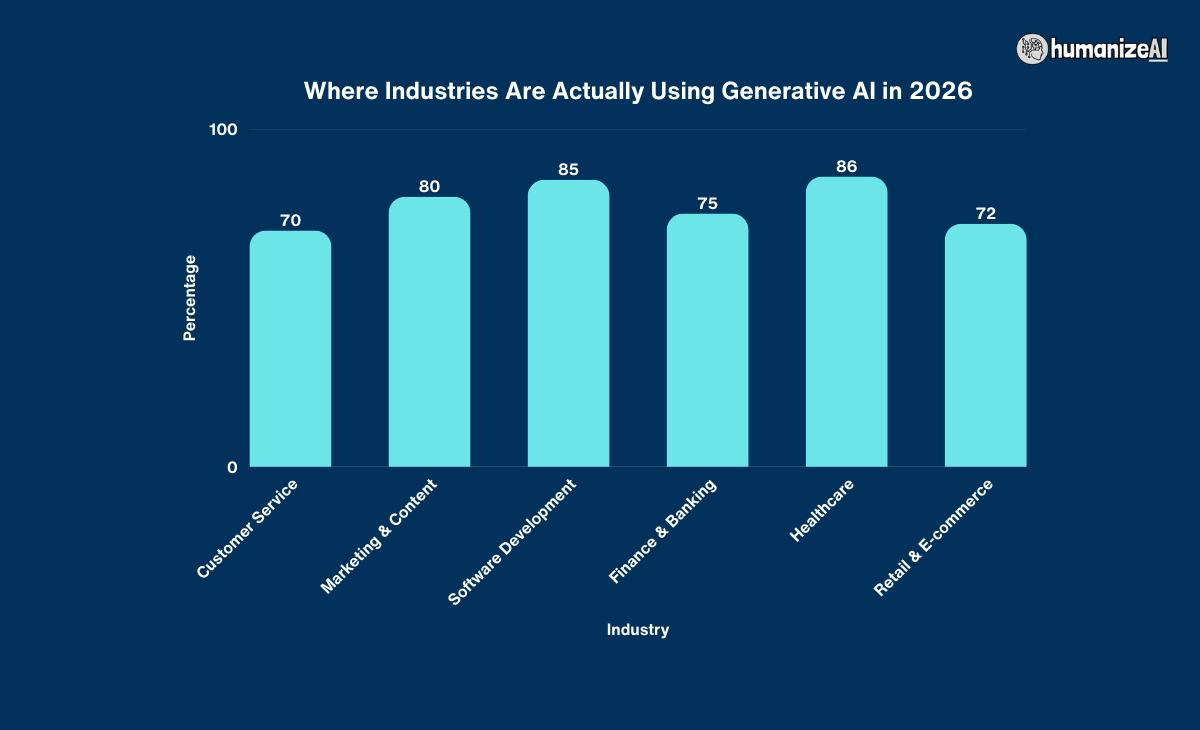
Well, needless to say, AI has been extremely remarkable and helpful in customer service and has changed its trajectory forever. A discussion by Salesforce accurately points out that “ AI improves customer service efficiency by automating time-consuming tasks such as ticketing, response generation, and case routing.” In other words, it means AI can now
- Automate routine inquiries
- Create tickets
- Deliver instant solutions
- This helps companies to provide better resolution and reduce workload to a great extent.
This is exactly what the two data points by Zendesk quite efficiently reflect:
- “70% of CX leaders believe chatbots are becoming skilled architects of highly personalized customer journeys.”
- “More than two-thirds of CX organizations think generative AI will help them provide warmth and familiarity in customer service, even if they have millions of customers.”
Marketing, Content & Personalization
You won’t be wrong if you say that marketing is where AI’s mainstream journey actually began. People started to know more about AI even before they implemented it in their workflow through ads, recommendations, and email campaigns.
What started with automation has now evolved to personalisation on a mass scale.
To make a clearer sense of its impact. Here are two keypoints of a HubSpot report on the influence of AI in market, content, and personalisation:
- 80% of marketers use AI for content creation, and 75% use it for media production.
- 61% of marketers believe that marketing is experiencing its biggest disruption in 20 years due to AI.
Software Development & IT
The obvious and most expected sector on the list, AI, has been leaving quite an impression on our engineers and developers. It goes beyond simple automation and extends to industries like technology, finance, and professional services.
What makes this a real turning point is the impact on speed. Tasks that once took weeks can now be done in days. Product delivery timelines are now seeing such speed that we would label as unnatural in the prior to the AI era.
- A report by JetBrains points out that almost “85% of developers regularly use AI tools for coding.”
- In other news, 80+ million developers now build on GitHub, with 36 million new developers joining in one year (more than 1 per second), as reported by GitHub in 2025.
- Lastly, a report by McKinsey points out that “Companies with 80-100% developer AI adoption see productivity gains of more than 110%”.
Finance, Banking & Enterprise Operations
This is exactly where AI finds its true purpose. When we talk about data, speed, and risk control, we mean how efficiently AI and the finance sector fit into it perfectly.
What makes generative AI especially valuable here is its ability to process massive volumes of structured and unstructured data in seconds. Tasks that once required long manual reviews are now being done in seconds.
A detailed report by the World Economic Forum- Artificial Intelligence in Financial Services 2025 points out this change quite elaborately:
- In 2023, financial services firms spent about $35 billion on AI adoption across banking, insurance, capital markets, and payment systems.
- That investment is projected to grow to $97 billion by 2027! One of the highest AI investment forecasts of any industry.
- The report also finds that 32–39% of work in capital markets, banking, and insurance has high potential for full automation with AI, while another 34–37% could still be driven by AI tools.
Healthcare & Life Sciences
Healthcare may not be the first industry to be associated with AI, but we are seeing a significant development there as well. Infact it is one of the fastest adopting sectors to make the most use of AI.
But what is different here is that healthcare providers are not relying on AI to help them diagnose a patient. It is more nuanced and layered than that. With generative AI, doctors can summarize patient histories, automate discharge notes, and ensure that the administrative workload is balanced.
If you look at the report published by SS&C Blue Prism, you will be able to understand and assess this better. It points out that:
- 94% of healthcare organizations view AI as core to their operations .
- 86% of healthcare organizations are using AI extensively right now.
But like any other industry, there are some serious apprehensions about privacy and data concerns. The report further elaborates that 57% worried about patient privacy and data security.
Retail, E-commerce & Consumer Brands
AI has helped e-commerce and consumer brands organize their entire operations to a all new level of efficiency. AI in retail, E-commerce & consumer brands has now helped business owners to:
- Personalized product recommendations
- Implement dynamic pricing strategies
- Help keep track of demand and inventory
- High-end automated product descriptions and marketing copy that aligns with the search intent.
A report by EY points this out with two relevant data points:
- GenAI is expected to boost productivity by 35%–37% by 2030, with a significant impact on insights-driven pricing and promotions and customer experience.
- Future GenAI success will depend on balancing automation with human experiences and overcoming skill gaps.
Simply put, generative AI has now become the invisible engine behind modern retail. It guides, instructs, and optimizes with efficiency and makes things easier to understand and operate.
What These Industry Trends Clearly Show
If you think about the numbers and the trends we have discussed so far, one thing is evident. Generative AI is changing things for the better and not in one vertical but in many. If we actually put all these industries together, there is one evident pattern that stands out:
Generative AI adoption in 2026 is:
- The influence of AI is not about following up on some trend blindly, but it is a result of real-time results that benefited every sector.
- AI is no longer just a reference point or a helping hand but a full-blown concept in our workflow.
- Yes, we still do make the final call, but AI makes the entire process faster.
In short, companies aren’t using AI just because it’s new; they are using it because it is bringing in results and fixing one backlog at a time.
Final Takeaway: Understanding the Real Impact of Generative AI Across Industries
From software development and finance to healthcare, retail, and marketing, AI is now everywhere. It has evolved from being a futuristic concept to an actual helping hand in the process.
At this point, it helps teams regardless of their sector. With AI, we can now move faster, reduce manual effort, and be more confident in our decisions. But most importantly, it supports our teams when there is a major lag or when we slow down.