
We keep seeing multiple arguments on the internet over how AI is taking over our workspace. But today, let us discuss something crucial. The impact of AI on our K-12 education system.
What does the adoption of AI in education look like? And does it actually interfere with or influence the learning outcome? Let us have a look and see what the numbers and research have to say! 🧐
AI Adoption In K-12 Schools Is Growing Rapidly
We are not in that phase anymore where we are discussing the possible implications of AI in schools. Things have progressed to the point where AI has entered our classrooms and is making significant changes. If you look at the numbers, the AI in the K-12 education market was valued at USD 0.53 billion in 2025.
- There is a growth projection of USD 18.47 billion at a 38.1% CAGR between 2026 and 2036.
- It is expected to increase by USD 17.73 billion during the same period.
- The solution segment ( the actual AI software, platforms, and applications) is expected to account for 71% of the market in 2026.
- Machine Learning is expected to account for 62% of the technology segment.
- Cloud deployment is projected to hold 60% of the market.
- The USA is projected to grow at a 40.5% CAGR, while the UK is projected to grow at 39.6% CAGR in the education market.
Sources
How Many K-12 Teachers Are Using AI?
This is the question that makes us wonder more, instead of the numbers. Are the teachers actually using AI? Are they easily onboarded with the idea of artificial intelligence when it comes to real-time classes? Well, here are the numbers:
- Currently, 60% of teachers reported using an AI tool during the 2024–25 school year.
- 32% of teachers use AI at least weekly.
- 28% use AI monthly or less often.
- However, 40% of teachers reported not using AI at all. Here’s a breakdown of the numbers that explain why our teachers are now leaning into AI:
| Teaching Task | Teachers Using AI (%) |
| Preparing lessons | 37% |
| Creating worksheets | 33% |
| Modifying learning materials | 28% |
| Administrative work | 28% |
| Creating assessments | 25% |
| Grading | 16% |
| One-on-one instruction | 14% |
| Analyzing student data | 12% |
- Another interesting thing is that teachers working in schools with an AI policy are more likely to use AI than those without one (There’s a 70% vs. 60%).
However, there is one thing that demands our immediate attention and conversation. Only 19% of teachers say their school has an official AI policy.
Sources
Student Adoption Of AI Continues To Rise Across K-12 Education
Today, our students are pretty aligned with the AI wave that we are riding on. Numbers say that 54% of K-12 students reported using AI for school in the RAND September 2025 survey.
- If you look at the details, student AI adoption increased by more than 15 percentage points in two years.
- Around 86% of students worldwide use multiple AI tools.
- Approximately 54% of students use AI on a daily or weekly basis.
- 66% of students use ChatGPT for educational purposes.
- 50% of students have used AI writing tools at least once.
- An amount of 51% of U.S. students use generative AI.
- 53% of students use AI for brainstorming.
- 53% use AI to help with schoolwork.
- 65% of students believe AI tools are essential for success.
Sources
Teachers Are Using AI To Save Time Every Week
One must think that AI is disrupting our learning process, but it is not really so. In fact numbers say that teachers who use AI every week save an average of 5.9 hours per week.
- Those weekly savings equal approximately six weeks over a 37.4-week school year.
- That means teachers who use AI monthly save 2.9 hours per week.
- Now, depending on the task, between 60% and 84% of teachers say AI saves them time.
- Only 7% or fewer teachers report that AI increases the time required to complete their work.
- Not only that but schools with AI policies report a 26% larger AI dividend.
- Teachers in schools with AI policies save 2.3 hours per week, compared to the 1.7 hours in schools without one.
AI Is Improving Teacher Productivity And Work Quality
This is for the AI sceptics who think that AI might interrupt with the organic flow of learning. It is true that we need a more planned way of doing things when it comes to AI in education. However, the present data points give us a green signal if not a complete reason to celebrate.
- Between 57% and 74% of teachers say AI improves the quality of their work.
- 74% of them report higher-quality administrative work.
- 64% say AI improves materials adapted for student needs.
- 61% report better insights from student learning data.
- 57% say AI improves grading and feedback.
- Only 16% or fewer teachers say AI reduces work quality.
- Teachers who use AI weekly are more likely than monthly users to report much higher quality work.
Sources
Does AI Improve Learning Outcomes In K-12 Classrooms?
Now comes the most important question, is all this actually helping the students? Or is AI another distraction or something we are putting on a high pedestal for no reason? Well, a meta-analysis of 49 studies found a learning achievement effect size of 0.857.
- The same meta-analysis found a learning motivation effect size of 0.803.
- The impact was varied by:
- education level
- subject area
- AI interface
- interaction method
- experimentation time
Here’s the thing: Stanford found only 20 high-quality studies that could clearly measure how AI affects students and teachers, showing that strong evidence is still limited.
By October 2025, Stanford had reviewed more than 800 AI in education papers, highlighting the rapid growth of research in this field.
Just a few months later, Stanford's AI in Education repository grew to more than 1,100 research papers, showing that interest in AI for education is increasing quickly.
Sources
Teachers And School Leaders Are Becoming More Supportive of AI
One might think that teachers are resistant to AI since it hampers the organic learning curve. But, now the numbers say that 40% of teachers support AI use in K-12 education compared to a 28% of them opposing it,
- 30% neither support nor oppose it.
- Among teachers who already use AI, 56% support AI in schools.
- Only 16% of teachers who do not use AI support AI in schools.
- 55% of administrators support AI in K-12 education.
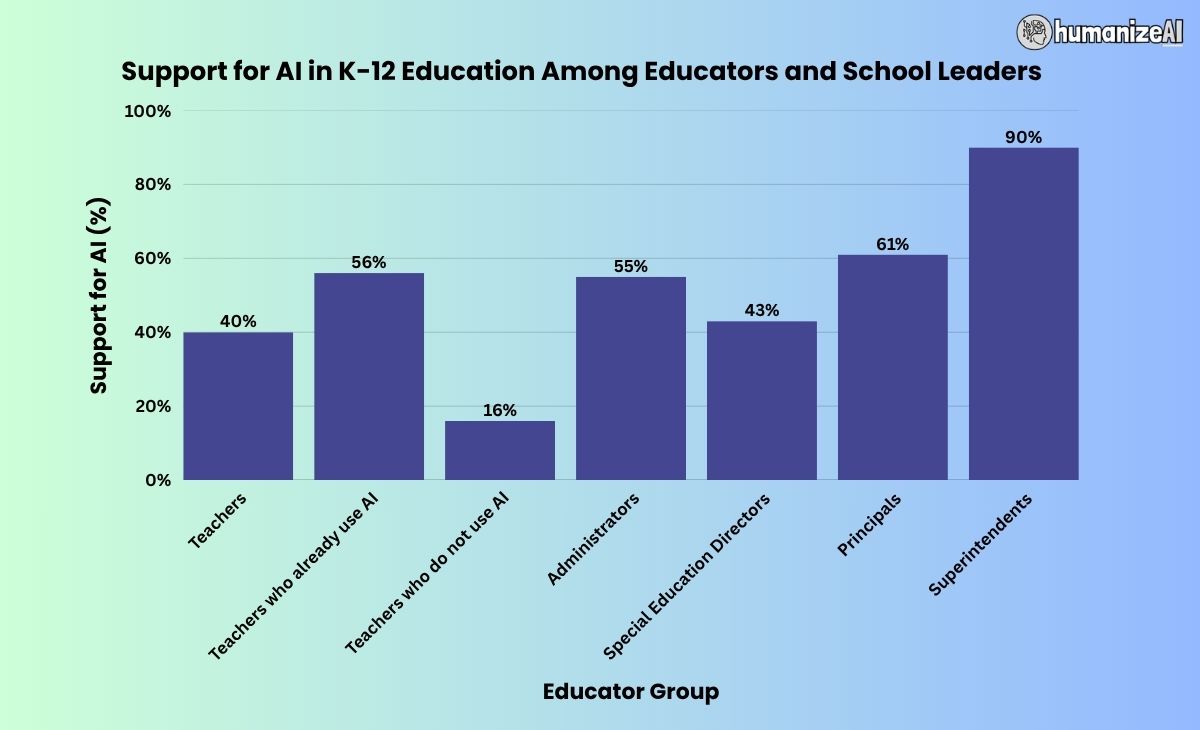
On the other hand, 30% of teachers remain neutral, and 13% oppose AI.
- 90% of superintendents support AI.
- 61% of principals support AI.
- 43% of special education directors support AI.
- 72% support AI tools for teachers.
- 72% support AI tools for school leaders.
- 52% support AI tools for students.
Sources
Schools Are Expanding AI Policies And Teacher Guidance
It is not that we are simply pushing AI into our classrooms. We are also taking measurable steps in the right direction, one day at a time. 34 U.S. states and Puerto Rico have official AI guidance or policies for K-12 schools.
- By early 2026, the numbers say that more than half of U.S. states had adopted AI guidance.
- Legislative trackers identified 52 active AI education bills across 25 states by late 2025.
- In fact, China has implemented a national AI curriculum covering primary aspects through secondary education.
- South Korea has introduced AI-powered homework tutors and requires social-emotional learning into its very national curriculum.
Sources
Many Schools Still Face Barriers To AI Adoption
But the numbers are not always in our favour, and to be honest, in this case, it makes sense. There’s a lot that we need to learn and understand before exposing our kids to AI. In fact, 61% of parents believe greater AI use could harm students' critical-thinking skills.
- 55% of high school students share the same concern.
- Not only that, but even 48% of middle school students also believe AI could harm critical thinking.
However, only 22% of school district leaders agree with that concern. Now, there is a systematic disconnect as well. More than 60% of federal Title II funds supported professional development, but most funding went to short-term workshops.
- Only 9 states used Title II funding for technology training.
- Fewer than 40% of school districts used Title II funding for technology-related professional development.
- Most importantly, we have to remember that 68% of urban teachers have not received AI training.
(Title II Funds: refers to money provided by the U.S. federal government under Title II of the Elementary and Secondary Education Act (ESEA), as amended by the Every Student Succeeds Act)
Sources
The AI-Powered Education Technology Market Continues To Expand
However, regardless of the contradiction and the crossroads people, the AI education market is blooming. In 2025, the global education technology market was valued at USD 187.0 billion.
- It is projected to reach USD 213.2 billion in 2026 and expected to grow to USD 437.5 billion by 2033.
- The market is projected to grow at a 10.8% CAGR from 2026 to 2033.
- The K-12 segment accounted for 38.9% of the market in 2025.
Sources
The Bottom Line
The numbers are here, and they tell a clear story. They tell us one simple thing: two years ago, when we were thinking about AI and discussing how the future might look with AI, we are now living in it. AI has now become a part of our classrooms, lesson plans, assignments, and almost every day of learning.
To be honest, the numbers are working in AI's favor, where teachers are saving time and many students are actively using AI tools. But then there are also concerns about critical thinking, organic learning, and most importantly, responsible AI usage, making sure it doesn't cause any real-life harm and so on.
Currently, we are standing at a crossroads where we know that AI can bring in and do greater good, but at the same time, we need proper policies in place that make sure schools can actually get the most out of an AI setup.
Now, we think it is the right time to say that we are actually looking at a shift from where AI belongs in education to how we can reorganize and restructure our framework so that it can be used responsibly.