
A translator is a saving grace during any crisis. Imagine a client mail that you cannot decipher or an international global meeting without someone communicating the details! It would be a catastrophe.
Humans have carried on this responsibility with due diligence ever since. But now things are changing. We have AI taking over the tedious task of translations. You name it, and AI can translate it in seconds.
So, how good is AI in holding the fort? What does automation with translation actually look like in 2026? How did it change the rates and industry trends? Let us find out by looking at some updated numbers and data points.🤔
How Big Is the AI Language Industry Right Now?
Before we make an assumption about how greatly AI has affected the translation jobs, we need to start from the basics. It is very easy to say that AI is impacting the pay rates or influencing how efficient a translator should be. But to what extent? A quick detail:
If you look at the numbers, the global language industry was valued at USD 72.6 billion in 2025. It is projected to reach USD 73.4 billion in 2026.
- Nimdzi predicts the market will touch USD 76.1 billion by 2030.
- That’s not it, but some forecasts put the market as high as USD 96.9 billion by 2030. Therefore, when it comes to the AI translation jobs, the expectations are sky-high.
However, there is another thing that you will have to keep in mind as you discuss AI and the language industry. The top 100 language companies account for only 19.8% of the entire language industry. Therefore, the present market is highly fragmented.
- The language translation device market was at USD 1.26 billion in 2025, and reports say that it should climb to USD 1.41 billion this year.
- By the time it is 2031, that same market is forecast to reach USD 2.42 billion.
- Which means it results in an 11.52% CAGR between 2026 and 2031.
Sources
- Nimdzi, State of the Language Industry in 2025
- Mordor Intelligence, Language Translation Device Market
Regional Demand for Language Services
Now, with the numbers so far, we can say that the global market did see a significant change when it comes to AI in translations. And, needless to say, it is growing at an unprecedented rate. But what do the numbers look like when we zoom in for a bit more detail?
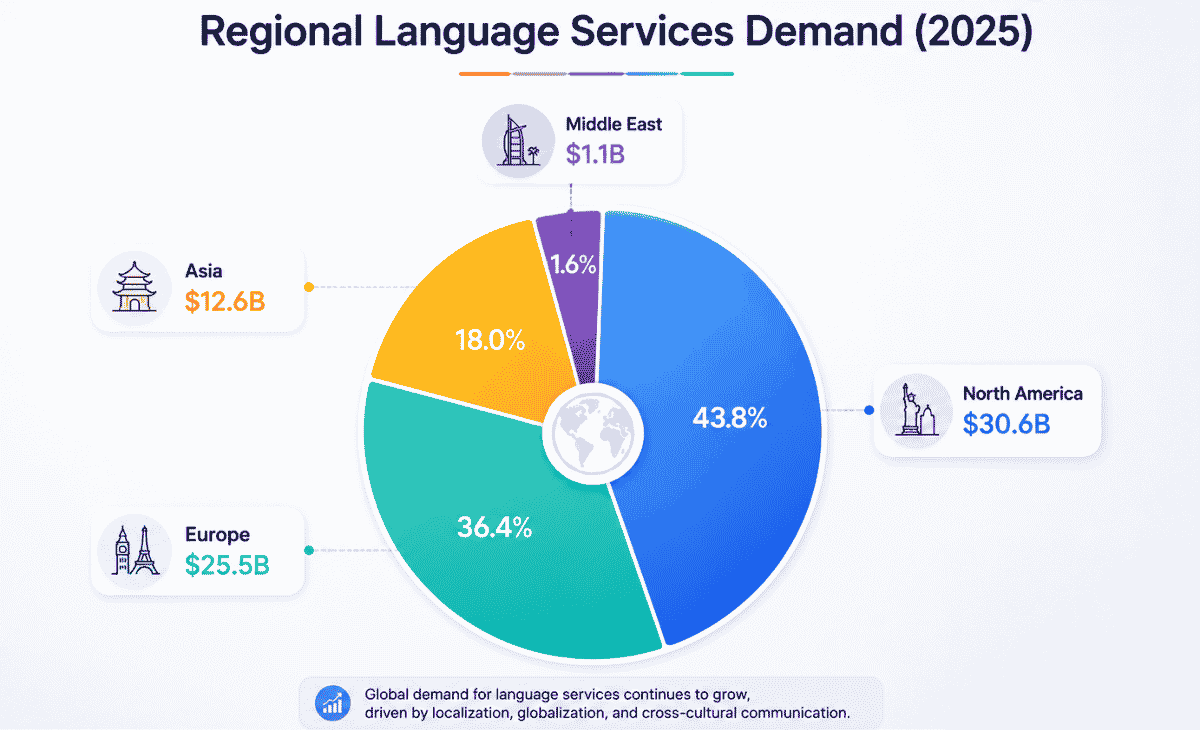
To begin with, North America and Europe remain the two largest buyers of language services globally.
- North America generated USD 30.6 billion in language services demand in 2025.
- Europe generated USD 25.5 billion in demand in 2025.
- Asia generated USD 12.6 billion in demand in 2025.
- The Middle East represented USD 1.1 billion of market demand in 2025.
- Africa represented USD 0.4 billion of market demand in 2025.
Sources
AI Is Reshaping the Language Industry
The Nimdzi report makes one thing clear. The impact of AI on translator jobs can now be felt and assessed on a regional level. Therefore, it won’t be wrong to say that AI is now reshaping the language industry.
AI-focused companies such as DeepL, Phrase, Smartling, and XTM International are now among the industry's major players. At this point, many language companies have reduced their traditional in-house linguistic and project management staff by 20%–25%.
Here’s the thing: AI has pushed many language companies to shift from translation work toward AI services, data services, workflow automation, and consulting. Therefore, the role of translators is evolving from language production to AI supervision and validation.
Not to forget that this is why there is a growing demand for prompt engineers, computational linguists, and AI-focused language specialists.
| AI's Impact on Language Providers (2025) | Data |
| Productivity gains from AI-driven workflows | Up to 3× |
| Providers reporting revenue growth | 53 of the top 100 |
| Companies with double-digit | 23 |
| Providers reporting negative growth | 22 |
| Providers suffering double-digit revenue declines | 6 |
| Asia's growth rate | 7.2% |
| North America's growth rate | 6.0% |
| Europe's growth rate | 0.7% |
| Oceania growth rate | 0.2% |
Sources
Fastest-Growing AI-Driven Segments in the Language Industry
Reports say that 60% of the top 100 language companies were actively seeking to acquire more companies in 2025. Simply because companies wanted to buy firms that already had:
- AI technology
- AI talent
- Data services
- Interpreting capabilities
- Specialized language technology products
One such example could be how AI dubbing, AI subtitling, and AI voice translation are expanding rapidly. Infact, Data-for-AI services are becoming one of the fastest-growing opportunities in the language sector.
- Privately owned AI services, data curation, prompt engineering, and custom LLM integration were among the largest sources of new revenue growth in 2025.
- Interpreting accounted for 33.6% of the revenue generated by the top 100 language providers.
- Only 11.0% of surveyed language companies described themselves as strongly technology-focused.
- At the same time, 33.4% of the top 100 companies launched multiple new products or services in 2025.
- 45.8% of the top 100 companies launched no new products or services in 2025.
Sources
AI's Impact on Translator and Interpreter Jobs
This is where things get serious and need your attention. The impact of AI on various aspects of the language world seems great and, honestly, inspiring. But what does the real-life impact look like?
- The U.S. had 75,300 interpreters and translators employed in 2024.
- This employment is projected to reach 76,600 by 2034.
- Currently, the employment growth for interpreters and translators is projected at only 1.7% between 2024 and 2034.
If you analyze this from a more results-oriented viewpoint, the truth is that AI translation tools are increasing translator productivity.
- Improved machine translation is reducing demand growth for translators and interpreters.
- The BLS specifically notes that advances in AI translation capabilities are expected to limit the demand for AI translators in general.
Sources
AI Translation Demand Is Being Driven by Global Travel and Multilingual Communication
We might think that an AI language translator is something that will add great value to a global leader’s summit or a corporate client meeting. But we have now evolved far beyond so. The AI translation demand is now crossing borders and making a place in our daily lives. A quick look:
To begin with, the language translation device market was valued at USD 1.26 billion in 2025. For the same tool, the industry revenue is projected to reach USD 1.41 billion in 2026, and the market size is forecast to grow to USD 2.42 billion by 2031.
- The market is expected to expand at a 11.52% CAGR between 2026 and 2031.
If you look at the numbers, Europe pulled in 594.5 million international tourist arrivals in 2022, the highest number of any region in the world.
And with the EU running across 27 member countries and 24 official languages, it's no surprise that translation and localization tools are basically a necessity there.
- Finland's machine translation system was used over 600,000 times, generating more than 12 million translated words.
- Tilde's AI translators handled over 1.4 million translations during EU Council presidencies, and needless to say, that is never a small number.
If we look at the numbers between May 2022 and April 2023, the US alone hosted more than 33,000 conferences, business meetings, and trade exhibitions. The UK wasn't far behind in its own way, pulling in 6,400 events across every sector during that same window.
Highlighting how crucial it is for one to rely on translator tools in order to make sure their event sails through. And why not? The report further cites a LinkedIn study that says 45% of future B2B events are expected to go fully virtual, which means more multilingual communication, especially across digital platforms, has become a lot more important.
- Out of 200 UK B2B event organizers surveyed, 72% said they will be loyal to virtual events long term, mainly because it is easier with language access for attendees.
- From a travel perspective, Slovenia saw tourist arrivals jump 10.6% year over year, hitting 510,096 visitors in May 2023 alone. Meanwhile, the United States pulled in a massive 4,996,037 tourist arrivals in June 2023.
- South Korea's medical tourism scene was all about Americans in 2022, who made up around 18% of all inbound medical tourists there.
- Canada topped the charts entirely on this front, scoring 76.47 on the Medical Tourism Association's index and ranking first out of 46 destinations worldwide. Therefore, now you know how these numbers say a lot about why translation tools and AI assistance are becoming non-negotiable in healthcare travel.
Sources
What These Translation Trends Mean for 2026 and Beyond
AI has not really replaced the translators, yet the US employment growth for interpreters and translators is just 1.7%. So, what exactly are we dealing with here?
The market itself is still growing, sure, from $72.6 billion in 2025 toward a possible $96.9 billion by 2030, with Asia taking the charge. Yet, out of the top 100 language companies, 22 actually saw revenue drop last year, with 6 of them dropping double digits. So, this is yet to become a clear AI success story.
What's really happening is a shift in who gets paid for what. Translators aren't disappearing; they're turning into AI supervisors, quality checkers, and prompt specialists to make sure the job is done right.
Meanwhile, demand for actual human language access keeps climbing everywhere, from EU Council meetings to medical tourism in Canada. People still need real communication; AI just changed the structure and rebuilt the repetitive parts.