

Public relations is the disaster management of marketing. Without our PR professionals, the big brands will crumble in no time. But the rumors in the market now say that AI can do that as well!
Is it true? Can a robot actually replace someone as trained as a PR professional? Let us find out by looking into the global trends.
Read along as we discuss AI’s impact on Public Relations jobs in 2026, the AI adoption rate, and the overall industry statistics. 🤔
How Many PR Professionals Use AI in 2026?
A PR person using AI doesn’t seem right with the book. But the numbers say otherwise. Since last year, the adoption of AI in PR has remained almost unchanged. Hinting that it is slowly making its own way without any disruption.
- 76% of PR professionals now use generative AI in their work, hinting that it is now a general process of how things work.
- More than 75% of PR professionals now use at least one paid AI tool, up from 57% a year earlier.
- However, there is also a disruption. Among PR professionals who avoid AI, 56% believe the technology is overhyped.
- Another 41% of non-users say AI tools are too risky for their work.
- Interestingly enough, only 12% of AI users currently use AI agents, even though they are well aware of the ease of access to the technology.
- Out of all these people, only 7% of PR professionals say they don't use generative AI and have no plans to adopt it.
Sources
- Global NewsWire Citing Muck Rack: State of AI in PR 2026
- PRSA: In Brief: Majority of PR Pros Using AI, Survey Finds
How Are PR Professionals Using AI at Work?
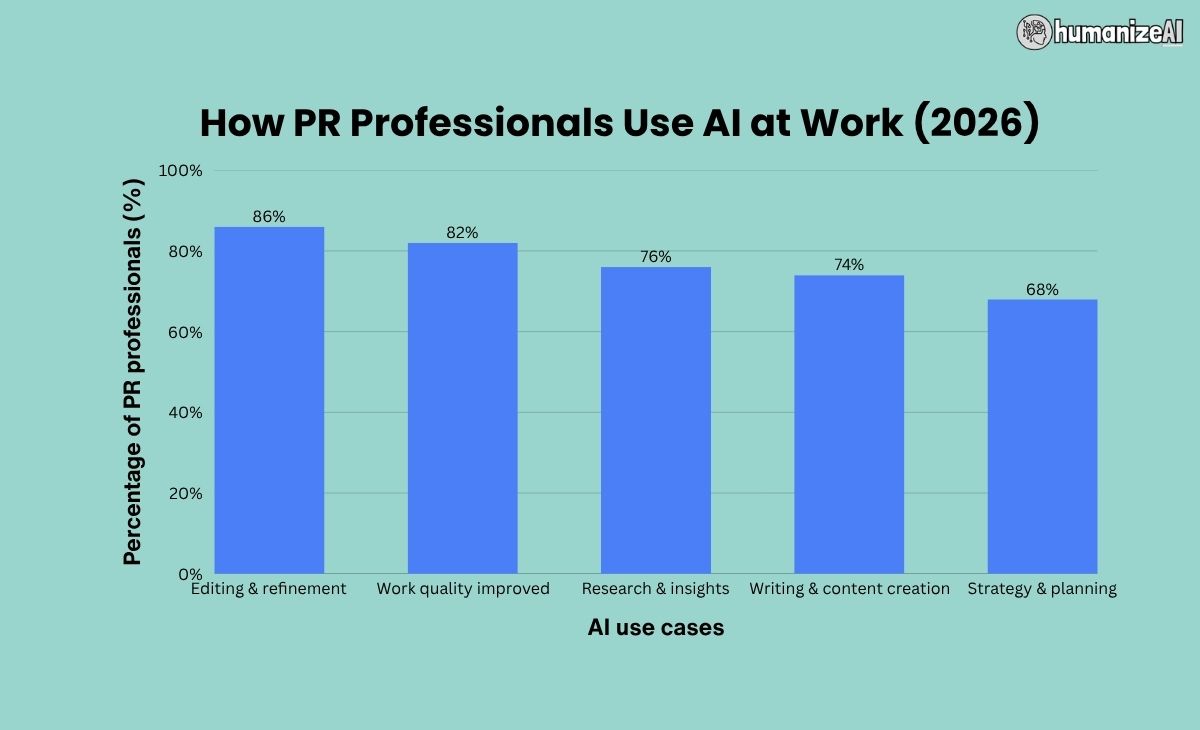
Before we get into the details, let us understand this from the very core of things. Why does a PR professional even need AI? And even if they do, where does it fit into the scheme of things? Well, to begin with, the numbers say that 86% of PR professionals use AI to edit and refine their work. Hence, making it the most common use case. This is what follows after that:
- 76% use AI for research and gathering insights.
- 74% of PR professionals do the basics, like writing content, including press releases, pitches, and other important communications.
- Whereas 68% rely on AI for strategy and planning activities.
Now, it is not that AI is being imposed on them as a trend. 82% of the professionals genuinely believe that AI improves their overall work quality. But here comes the disconnect once again:
- Even with widespread use of AI in this line, 98% of PR professionals say they always or often edit AI-generated content before publishing it.
- However, they think that only 45% of AI-generated content still requires editing. Clearly hinting at a certain level of confidence for AI-generated content.
- But, here’s the thing 77% avoid entering financial information into AI tools.
- 69% avoid uploading personally identifiable or proprietary company information.
Sources
- Global NewsWire Citing Muck Rack: State of AI in PR 2026
- PRSA: In Brief: Majority of PR Pros Using AI, Survey Finds
- Muck Rack, AI in PR: What You Need to Know
Is AI Making PR Professionals More Productive?
Is the trend working? In other words, are we actually seeing significant changes with AI in PR, or is it just another good-to-have helping hand? Well, even with the ongoing debates about AI’s credibility and usefulness, the numbers say something important: 82% of PR professionals say AI improves the quality of their work. Here’s a quick look at its overall functions:
- AI now helps PR teams automate all kinds of repetitive work. Be it media monitoring, research, reporting, drafting press releases, or journalist discovery.
- According to the Cornell University study, 15% of the entire tasks can be completed much faster with the use of tools like ChatGPT
- When other AI tools built on top of large language models are included, that number instantly jumps to 47%-56% of all work tasks.
- According to PwC, companies with the highest AI utility have 40% higher productivity growth. Compared to the ones with the lowest AI exposure.
However, there is one silver lining. PwC found something assuring. The biggest productivity gains from AI lead to an increase in both wages and hiring rather than simply reducing headcount.
Sources
- Cornell University: GPTs are GPTs: An Early Look at the Labor Market Impact Potential of Large Language Models
- PwC: 2026 Global AI Jobs Barometer
- Muck Rack: State of AI in PR 2026
Are PR Teams Investing More in AI Training and Policies?
If we look at the numbers today, 51% of PR professionals now work at organizations with a formal AI use case policy. Back in 2024, it was only around 21%. Needless to say, the PR workflow is changing and going through a massive shift, and how:
- 43% say they have received AI training at work, up from 21% in 2024.
- But here’s the thing: 90% of PR professionals using AI agents say they would feel more comfortable if every AI-generated piece of content had a space for human approval.
It is not that the entire team is happily onboarded with this structure. 85% believe PR professionals need to develop prompt writing skills.
- 71% are still debating the ethical dilemma and how it is one of the most important skills PR professionals should develop, alongside AI.
- At the same time, Muck Rack notes that the industry is shifting from simply adopting AI tools to a more sustainable structure. It is focusing on building governance, training programs, and workplace policies around using AI responsibly.
Sources
Is AI Changing Public Relations Jobs?
Well, like any other sector, PR is also seeing a significant change when it comes to AI. To begin with, public relations specialists rank 23rd among occupations most affected by AI, according to Microsoft's occupational analysis cited by PR Daily.
Along with that, Cornell University reports that around 80% of the U.S. workforce could see at least 10% of their work tasks affected by the LLMs.
- For about 19% of workers, the impact goes deeper. We are talking 50% or more of their job tasks seeing significant change.
- Media and communication workers land at No. 1 across all occupational groups for AI impact. Their AI applicability score sits at 0.39, the highest of any category studied.
(This affects a group that represents over 602,000 professionals.)
To sum it all up, the study draws a clear line here. These findings suggest that AI is more likely to reshape how PR professionals work than replace the profession altogether.
Sources
- Cornell University: GPTs are GPTs: An Early Look at the Labor Market Impact Potential of Large Language Models
- PR Daily / Ragan -The AI Revolution in Public Relations: What Microsoft's Latest Study Means for PR Professionals
Which PR Tasks Are Most Likely to Be Affected by AI?
Even if the numbers say that AI is reshaping PR and not replacing it altogether, what does it actually look like? Which areas of the work are going to be replaced on a real-time basis? Reports say that writing and content creation are among the areas most exposed to AI, with 74% of PR professionals already using AI for this work.
- The numbers say that 86% of PR professionals now use AI to edit and refine content instead of doing the entire process manually.
- 76% use AI to speed up research and gather insights before starting campaigns.
- PR Daily reports that AI performs especially well in information gathering, research, and writing, making them the most replaceable tasks.
- Microsoft's occupational analysis, as cited by PR Daily, says that public relations specialists are 23rd among roles most affected by AI.
- Muck Rack draws a useful distinction. Automation is picking up the heavy work, like monitoring coverage, drafting releases, finding journalists, and pulling campaign reports. But the more in-depth work, like building trust, is in human hands for now.
Sources
- Global NewsWire Citing Muck Rack: State of AI in PR 2026
- Muck Rack, AI in PR: What You Need to Know
- PR Daily / Ragan -The AI Revolution in Public Relations: What Microsoft's Latest Study Means for PR Professionals
Will AI Replace Public Relations Jobs?
Well, let us be honest here, emotional intelligence remains one of the highest-priority leadership skills in PR. Simply because trust, relationships, and crisis management are not something that AI can register. But here is a detailed look:
- Jobs that become more specialized with AI are growing twice as fast as jobs that become easier through automation.
- Since 2021, these more specialized roles have also recorded 42% faster wage growth.
- Skills required for the most AI-exposed jobs are changing more than twice as fast as those in the least AI-exposed jobs.
- AI-exposed junior roles are now 7 times more likely to require traditionally senior skills like leadership and strategic thinking.
- PwC also reports that entry-level AI-exposed roles requiring higher-level skills have grown 35% since 2019.
However, there is another side to the story. McKinsey expects demand for social and emotional skills in the United States to increase by 26% by 2030.
- Demand for higher cognitive skills like creativity, critical thinking, and decision making is projected to grow by 19%.
- Time spent using advanced technological skills is expected to increase by 50% in the United States.
- Basic digital skills are projected to grow by 69%, making them one of the fastest-growing workplace skill categories.
- McKinsey also expects demand for leadership, adaptability, and communication will continue to increase as AI automates routine work.
Now, the 2026 PR skills report identifies AI integration, data analysis, emotional intelligence, storytelling, crisis management, SEO, strategic thinking, and ethical communication as the core skills PR professionals need today.
- The same report notes that 52% of agencies and 51% of in-house PR teams say connecting PR work to business growth is now one of their biggest challenges.
- More than 40% of PR professionals still focus on measuring activity instead of business outcomes.
- 39% of PR professionals identify stronger journalist and creator relationships as one of the biggest opportunities for 2026.
- 59% of PR professionals say storytelling and content creation remain among the most valuable PR skills despite AI adoption.
Sources
- PwC: 2026 Global AI Jobs Barometer
- McKinsey Global Institute Skill Shift: Automation and the Future of the Workforce
- Global NewsWire Citing Muck Rack: State of AI in PR 2026
- 10 Essential PR Skills Every Professional Needs in 2026
So, What Is The Verdict?
At this point, it is pretty evident that AI has entered the PR conversation. But the data tells more than one story. It suggests that the profession is somehow not shrinking, unlike other workflows. Instead, it is sorting itself out. It is understanding where to rely on AI and when to take things into its own hands.
The numbers also suggest that people who are using AI are getting faster, earning more, and moving towards a more productive workflow. But there is one part of PR that no AI tool can touch. PR, at the end of the day, is about crisis management. It is about knowing which journalist to call and how to save the day.
So, if you look at the numbers, they tell one simple thing. The people making a mark in PR today are not the ones wondering whether to choose between AI and their instincts. They are the ones trying to find the perfect balance between both and create the best workflow out of it.