
Sometimes online information can become outdated, misinterpreted, or applied incorrectly by readers. Or some users may find AI-generated pictures original and expect the same results after a few days of using your product. Or, worse, they think a general discussion is a legitimate source of financial or medical advice. But you don’t have time to think about all this every time you publish.
Therefore, to ensure you do not lose your brand value and image, you need to inform this to your users in advance. This is why it is always safe to add a disclaimer on your website that says the facts may vary, or that you are not authorized to deliver medical advice, etc.
Read along as we help you figure this all out and understand why you need to rely on a disclaimer as you build a credible online presence. We will start with the basics and also see how AI can help with all this. So, let us begin! 😎
What Is a Disclaimer?
You will often find a disclaimer on websites, blogs, apps, online businesses, and even for clothing brands these days. To put things in perspective, a disclaimer is a clarification on how to use a product or service and who will be held responsible in case of any misstep or damage.
In simple terms, it is you telling your users the way your product or service can be used, and they must follow the instructions to avoid any damage or misstep. It is a detailed warning in a few quick lines that safeguards you from any future blame or accusations. So, therefore, when your users come and tell you, “Hey, you didn’t tell me all this before, so I am suing you,” You can always say, “Oh, no, of course I did.”
A quick, easy example of a disclaimer can be as simple as “The information on this website is for general informational purposes only and should not be considered professional advice.” Now, the purpose of a disclaimer varies depending on the industry you operate in and the service you provide.
- A finance blog may include a disclaimer stating that the information shared is not professional investment advice.
- While a health website might have a disclaimer that this is only for educational purposes and shouldn’t replace a real-life consultation.
- Similarly, SaaS products, affiliate websites, and AI-powered tools often add disclaimers on the extent of the use of their product, AI-generated images or content, etc.
Do You Legally Need a Disclaimer?
Well, it is not a legal requirement that you have to put up a disclaimer in order to operate your website or launch your new product. However, in certain cases, like affiliate disclosure, sponsored content, financial disclosures, etc., disclaimers are required.
Think about it this way, suppose you sell a vitamin supplement that helps people sleep.
Now, if you do not put a disclaimer about the allergies or whether it’s safe for pregnant women or heart patients, you might invite some serious legal troubles. In other words, disclaimers save you from any legal hassle when your product has the capacity to cause real-world damage or harm.
But also remember, a disclaimer does not replace your product safety duties. It just helps explain the risks and the boundaries of use for the people reading it.
Therefore, to answer the question, no, you are not legally bound to add a disclaimer to your website. However, adding so helps you with:
- Establishing clear communication with your users.
- Making your users understand the true scope and nature of your product.
- It saves you from any legal liability that comes after the post-sales formalities.
However, if you run a website that recommends products and services and you get paid for endorsing a product, you have to add a disclaimer. Or if there is a sponsored product on the list, or if there are any other financial obligations, you are bound to reveal the same. Let us understand it in a bit of detail:
When is a Disclaimer Legally Required?
The simplest way to get the idea is this: if a product or service you sell can lead to real-world harm, you are usually legally required to show a disclaimer. Even though general disclaimers are optional, here are a few situations where you must have a disclaimer:
Affiliate Marketing Disclaimers
When you earn commission or a payment from the products you endorse, you have to reveal it. These are called affiliate marketing disclaimers and help with transparency with your users. It simply explains that “this post contains affiliate links, which means we may earn a commission if you purchase through our links.”
Financial and Investment Advice Disclaimers
These are for all investments, trading, cryptocurrency, and other websites that help with financial advice. It sets clear boundaries with the users that you are not responsible for a refund if something goes wrong. This disclaimer clearly states how the content is only for informational purposes and so on.
Medical and Health Content Disclaimers
This is for every website, blog, video, or product description where you are selling a product or advice that can directly affect or alter your user’s health. For example, you cannot promise a heart patient that your blog or medicine will cure their tiredness or fatigue. This is why this disclaimer always comes with a highlight or warning that nothing replaces actual medical consultations.
AI-Generated Content Disclaimers
As we currently live in a world being dominated by AI tools and software as a business, you have to be upfront with your users. Not many of them can distinguish between original and AI-generated content. This is why an AI-generated content disclaimer underlines how:
- The content is AI-assisted
- Outputs may vary as per the prompts
- The website is not responsible for the quality of the outputs, etc.
Where Should You Put a Disclaimer?
Now, this completely depends on the kind of product or service you are selling and also on the design of your website. See, here is the thing: more than it being a safety cushion for you, it is also a polite nudge for your users. It helps them to understand what they are actually signing up for. Therefore, if you wish to build a long-lasting bond, you always have to keep their ease of access in mind. However, some common places to add a disclaimer include:
- Website Footer: This is the most preferred location by most website owners. Since the footer appears on every page of a website, it allows users to easily access the disclaimer whenever they need it.
- Terms and Conditions Page: Many businesses add it to their terms and conditions page. This works well since the users have a detailed list of the things they must keep in mind. Moreover, it helps understand the legal liabilities, terms of use, and responsibilities at one go.
- Blog Articles or Informational Pages: A blog about financial advice, or even a quick health hack, really needs some kind of disclaimer. So you can explain that what is shared is only for learning purposes and it is not professional, legal, or medical advice.
- Product or Service Pages: For SaaS tools, digital services, or AI-powered platforms, adding a disclaimer directly on the product page helps them understand the repercussions easily. It also encourages for a more mindful use of your products or services.
- Chatbots or AI Interfaces: Some websites give a quick warning to the users before they start interacting with their chatbots. This helps them set their expectations right about how the outputs may vary, or results are not refined or checked by a human, etc.
Can AI Help With Writing Disclaimers?
From adding disclaimers for AI-generated content to relying on AI to write disclaimers for us, we have come a long way. To begin with, yes, AI can most definitely write disclaimers for you, but only if you rely on the right tool.
For example, if you rely on the free AI Disclaimer Generator by HumanizeAI.io, you will have a tool that not only is fast and accurate but also offers personalized disclaimers. It makes sure it generates dedicated disclaimers that are best suited to your product or services and goes beyond generic templates. It is one of those simple, smart yet free tools that can:
- Generate accurate and personalized descriptions in seconds.
- Offers multi-lingual assistance, tone modulation, and many more such customized features.
- It works without any detailed prompts or elaborate descriptions, and with any added effort or hassle.
- The best part? It offers unlimited usage for free with no premium plans, no added downloads, or any browser extension. It is fast, reliable, and customizable, and operates on a very simple interface.
How to Use the Free AI Disclaimer Generator by HumanizeAI.io?
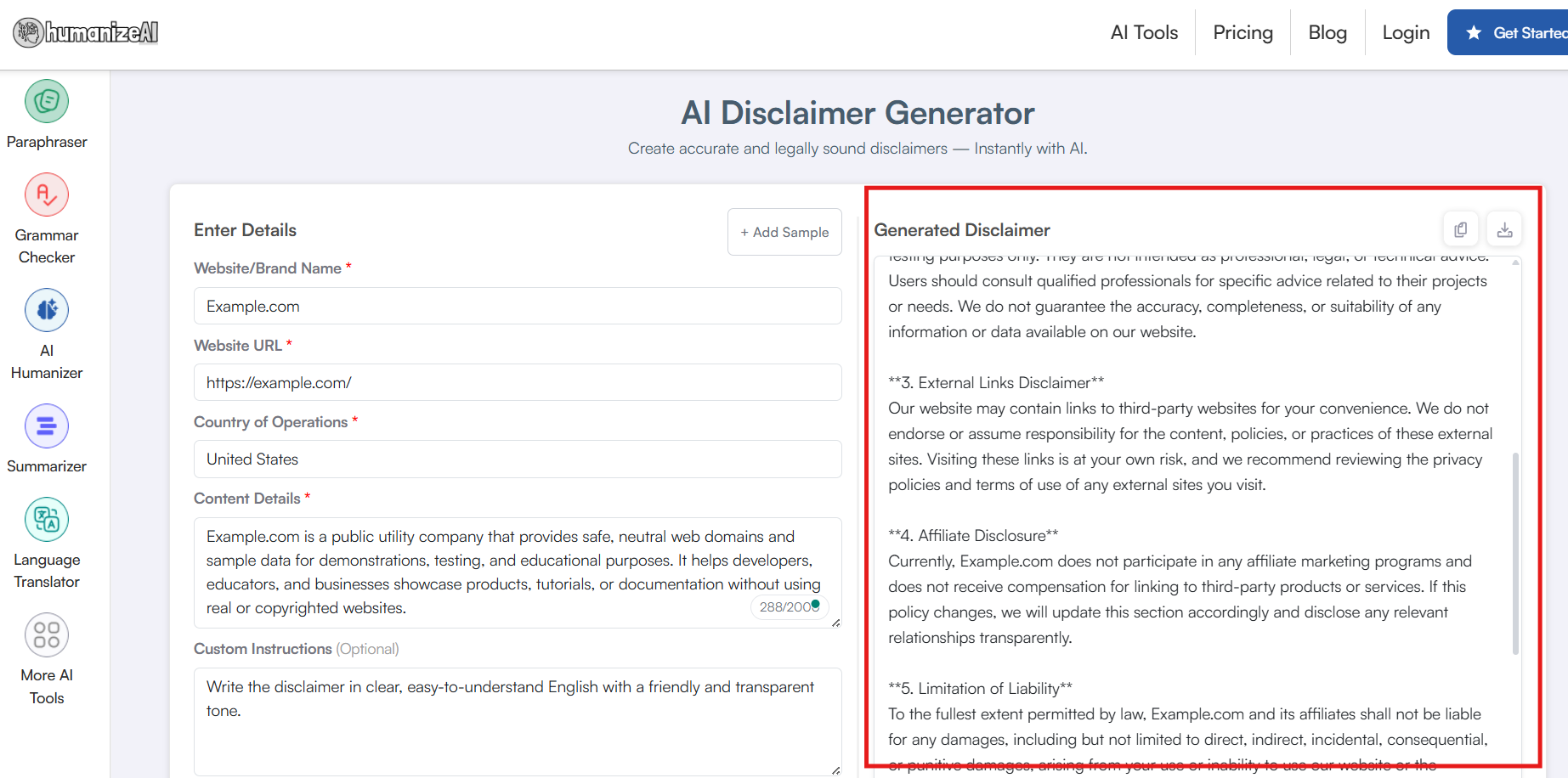
All you need is a few seconds and three or four quick clicks to work with our tool. Our intuitive AI understands the sensitivity and the urgency for a disclaimer and helps you to navigate accordingly. The entire process can be categorized into three simple steps:
Step 1: Basic Details
With our disclaimer generator, you don’t need any manual edits or multiple revisions. You get everything done in the first attempt itself because it lets you add your brand name, website details, and country of operations all in one go. So, not only is the disclaimer personalized, but it is also accurate and ready to go live after each session.
Step 2: Content Details
This is what makes our tool unique and easy to use. Since we have replaced prompts with easy-to-write content details. All you have to do is explain or write about your product, service, or website, and you are good to go! No decorative language, no rules to follow, just simple details in a few lines.
Step 3: Custom Instructions
With custom details, you get to refine the descriptions on a finer level and add various other important aspects for it to read better. You can set the tone or language or explain the kind of description you want, and our AI will do it for you. Yes, it is that simple.
Final Thoughts: Why Adding a Disclaimer Is a Smart Move
To start, a disclaimer is probably one of the easiest ways to make clear your responsibility, lower legal risk, and lay out what users can expect. So, you might think that it is a simple addition or a mere formality, but it goes way beyond that.
A disclaimer is one of the simplest ways to clarify responsibility, reduce legal risk, and set expectations for users. Moreover, the best part in all this is that you don’t have to spend hours writing the ideal description anymore.
With HumanizeAI.io’s free AI Disclaimer Generator, it is all free and instant, and you get customized disclaimers tailored to your website, product, or service. So, if you are launching a new venture or updating a new one with our setup, you have one less thing to worry about.