
How do you tell someone that your essay has the best argument or that you have talked about points they have never read before? It’s obviously with your title. But then what happens if your title betrays you and all your hard work? Everything goes for a toss.
No matter the effort you put into your essay, it is the title that makes the first impression. You know something like a brand ambassador or a movie trailer, or you decide to wear a nice dress to a date, regardless of how great you are in real life.
The point is, we humans tend to form an opinion quickly and sometimes are overly rigid about it. That is why the essay title needs to be without the more precise word “the best.” So, what exactly do we mean by a perfect title, and can AI help with all this?
Read along as we discuss essay titles, AI essay title generators, and what they bring to the table. If there’s an ideal tool, and if so, what can you expect from it? Don’t worry, we have you all covered. 😎
Most Essay Titles Are Technically Correct, But Still Do Not Do Much
At this point, you must be wondering it's just a title, how hard can it be anyway? Moreover, all you need to check for the grammar, and the problem solves itself. Well, to be honest, you are right, but if you were the only person writing the essay.
In the sense, if you are a student, researcher, marketers there are hundreds of others like you who are doing the same thing. Therefore, for you to stand out in your submission, make an impression with your research, or ensure that your users are reading your blog, you need to do more.
Think about it this way: say you write an essay on global warming. Now, since it is a popular and important topic, you will find hundreds of essays and papers on it. Therefore, a simple attempt like “Global Warming is a Major Crisis” won’t work anymore. Even though it is technically correct, it gives out an impression that:
- Your essay will be saying the same things your readers already know.
- Sometimes it also gives the impression that you didn’t do much in-depth research. ( Everyone knows it is a crisis since the last decade; why is it even a point of discussion now?)
- It genuinely bores or frustrates your evaluators when they have to skim through facts they have read a thousand times before.
- When it comes to marketing it is way more layered; a user sees an essay with a cliched title, they will scroll past it in less than a second.
But things get more intense, or to be honest, unfair when you present new research, findings, or insights under the same old title. It somehow dims the excitement of your readers and evaluators, and your essay has to work extra hard to help them shake that feeling off.
Moreover, they usually tend to think you can do all that, put in so much effort, but couldn’t spare 5 extra minutes for a title?
What Your Title Is Supposed to Do (But Rarely Does)
From one writer to another, we all know writing a title well takes way more than five minutes. Sometimes, the pressure is so mind-numbing for that one perfect line that many writers tend to give in to it. They pick up a title that somehow reflects the concept and hit that submit button.
But writing a perfect essay title is not about matching keywords but matching the intent. Let us understand this with a more layered example. Think that you have been asked to write an essay on Artificial Intelligence. Now, this is a huge ground to cover because now writing on AI can mean a lot of things. Therefore, an ideal essay title should:
Highlight the core argument
Whether you are writing on the effects of AI in academia or how workplaces are now evolving with AI, your title needs to reflect the same. In other words, if you wish to write on AI in the workplace, it should go beyond this simple phrase. The title itself should highlight if you think AI in the workplace is either good or bad.
Therefore, instead of a simple “AI in Workplace”, it needs a more polished version like “AI in Workplace: a Blessing”, or “ Is AI Taking Over the Workplace or Making It Better?” or “Why AI Won’t Fix Your Workplace Problems” is always the more preferred way to go.
Set expectations for the reader
It simply means your reader should know from the first line itself what you have to say to them. For example, if we are talking about AI in the workplace, a title like ‘Why AI Won’t Fix Your Workplace Problem” lets them know your essay will be critical of AI. Or, when you write “Is AI Taking Over the Workplace or Making It Better?” they know the essay will have a neutral standpoint.
This makes them genuinely more interested in your work and helps them read between the lines better. Think about it this way: someone hoping for a critical analysis of AI will surely not be happy with a neutral discussion.
Balance clarity with engagement
And no, this is not only a marketing checkpoint. By engagement, we do not mean your impactful academic research on greenhouse gases or say mental health will make people stop scrolling.
But it simply means an inviting title helps with genuine interest in the readers. Engagement doesn’t always mean taking the essence out of something to make it look more digestible. You can make people read your essay, no matter how obscure it is, only when there is a little clarity. It is not only about making things easier but also about providing a slice of added details to connect the loose ends.
The 3 Patterns That Instantly Weaken an Essay Title
Up until now, we were discussing about what the essay title should look like. But now let us understand what the few key things you can actually avoid. Most of us think writing a grammatically perfect sentence or using polished and unique words is the secret.
But, for the sake of your ideal essay title, there is one little thing that you have to remember: you can weave the best of the stories even with the most simple-sounding lines. The answer lies in three simple touchpoints:
1. Avoid overly broad titles
If your work starts with a clutter of words, it automatically gives out a discouraging impression. Your readers assume that you are unable to gather your thoughts, leading to a very suspicious attitude towards the worthiness of your essays.
For example, the title “Why AI Won’t Fix Your Workplace Problem” is a great option to work with. However, the moment you start expanding and decide on alternatives like :
- “Why You Cannot Completely Rely on AI in Your Workplace and Still Maintain Productivity and Efficiency.”
- “How AI May Not Always Be the Best Solution for Solving Different Types of Workplace Problems”
- “Understanding the Limitations of AI in the Workplace and How It Affects Overall Work Performance”
This is where the problem begins. Even though it appears to be technically correct and infact elaborates on the topic, there is a major issue. It stretches to so many subpoints and directions that you somehow lose the plot.
2. Overloaded titles
Now, if you look at the third example, you won’t be able to guess what the essay is about. Is it talking about a problem of how AI is disrupting the workplace? Or is it offering a solution by understanding the limitations? This is why overloaded titles are a strict no since they confuse the readers and push them away from the main idea.
3. Over-formal titles
The bare minimum for writing a great essay title? Do not rely on phrases that do nothing. A formal title is a very safe approach, and in fact, it will never be flagged by any evaluator. But that is the point, people will barely notice its existence and simply move past it. Moreover, for a few readers, it might appear as boring, a lack of effort, or too stringent, especially during a detailed academic discussion.
So, Where Do AI Essay Title Generators Actually Fit In?
Up until now, we were talking about why and how most titles fail. But now let us answer the most obvious question. Where does an AI essay title generator fits in an equation like this?
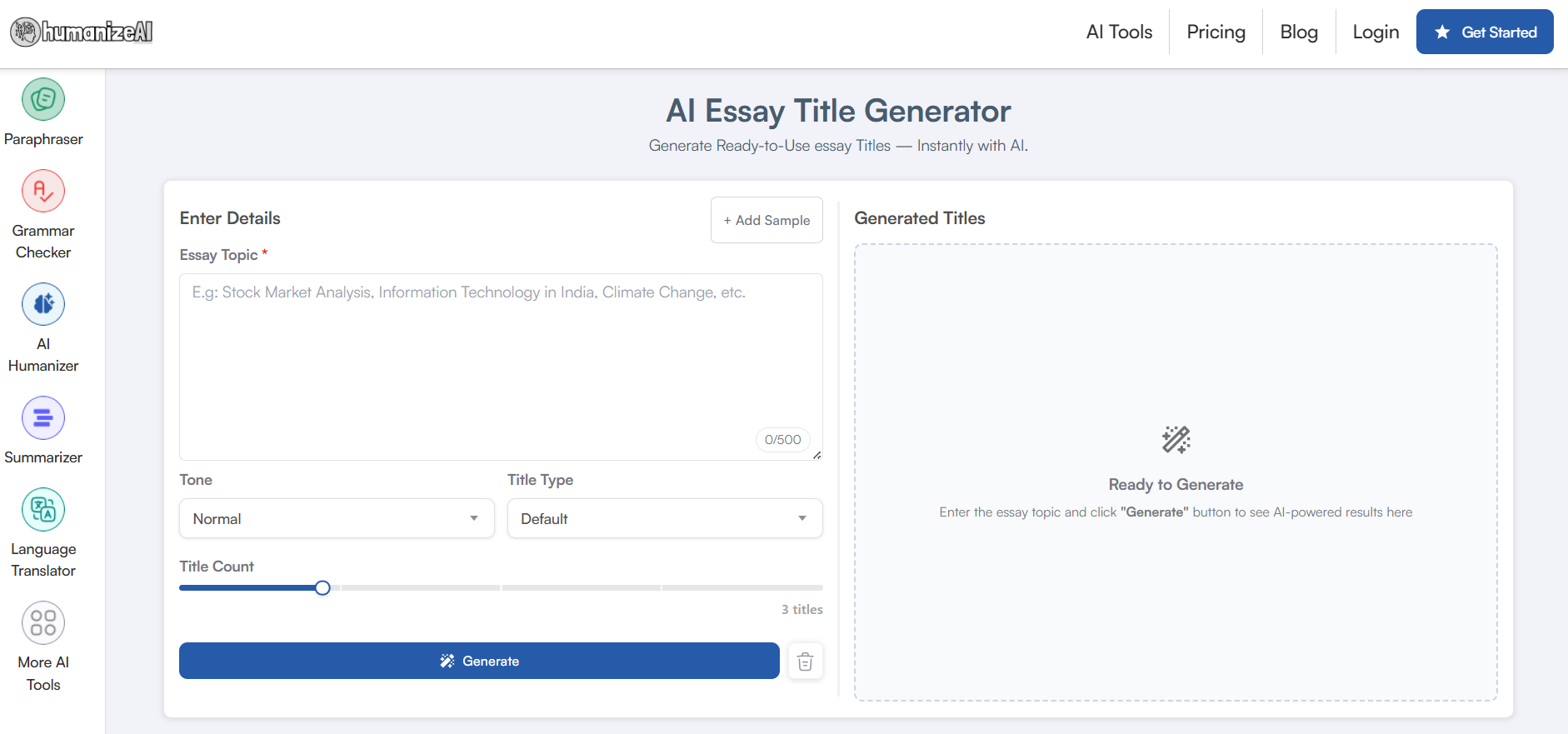
Well, to be honest, the answer is very simple: a tool like HumanizeAI.io’s Free AI Essay Title Generator fits exactly where you want it to. In other words, it is one of the few tools in the market that is not only free or offers unlimited usage, but can also:
- Help you with contextual, to-the-point titles that help your readers form an instant connection with your work.
- There is no need for a prompt or for you to paste your entire work to generate results. You can simply paste your essay topic, and it can help you with titles even before you start working. This way, you not only get unique, highly refined titles but a brainstorming companion as well.
- With dedicated options regarding the type of title you want, it solves the major pattern issues that we had discussed till now.
- You can decide the tone, title type, and variety you want, ensuring you do not fall into the gaps we had talked about earlier.
- The best part? You get to do all this for more than 25 languages with unlimited attempts.
Therefore, when it comes to relying on AI for generating the perfect title, it is about choosing a tool that makes things easier for you. Along with that, it is smart and well-equipped enough to understand the various layers of an essay regardless of the topic.
Conclusion: A Good Title Doesn’t Say Everything, But It Says Enough
When we say a good title doesn't say everything, but it says enough, we don't mean it in a poetic way or that there is another hidden layer to this line. What we mean is that a good title should be on the spot enough to talk about what the essay is, and yet at the same time not overwhelm users with every other piece of information.
To put it in simple terms, most titles fail not because your execution is weak or because you're trying too much, but because they either overexplain or completely miss the point they try to highlight.
Therefore, as you accept that a title is not only a label but also a gateway or a signal of what your work looks like, it is also about telling your users what they can expect from you.
Now, AI can most definitely help you in this entire process, but only if you rely on a tool that can understand how to guide, refine, and shape your ideas instead of imposing its own generic thought process.
So, to sum it all up, instead of asking, " Does this title read well or is the title good enough, all you have to do is ask a better question: is this title really clearly reflecting what my work is trying to say? Once you get that right, everything else becomes easier.