
When we talk about AI in research, the room suddenly goes silent. The traditional, well-decorated scholars were always sceptical about whether AI can ever take up something this critical and big.
But now things have changed, and for the good. Research doesn’t need you to be anxious, running on 2 hours of sleep and months of hard work for one simple argument. AI can help you build, cite, and establish your research now in seconds.
This is why we are seeing a growing involvement of AI in every critical aspect of academia. Read along as we understand the extent of AI in academic research with statistics and figure out what changed.
We will look into it from a global perspective, with valid and well-researched numbers, so that we can understand the entire dynamic. 😎
Key Takeaways From This Article
- 84% of researchers now use AI tools, up from 57% in 2024, showing rapid adoption in academic research.
- 85% of researchers say AI improves their efficiency, especially for time-consuming research tasks.
- 61% of researchers use AI to discover and summarize academic papers.
- 51% rely on AI for literature reviews and simplifying existing studies.
- 38% of researchers use AI for research data analysis and drafting academic reports.
- 69.2% of researchers believe AI will transform their research field within the next decade.
Key AI in Academic Research Statistics (2026)
Before we begin, you need to understand that AI’s role in research is not limited to just writing an essay in seconds. It goes way beyond and supports a temperament that favors scientific research and authentic, credible facts. Along with that, it helps with other key functions, such as factual research, literature reviews, data analysis, and paper writing.
Here’s a recent report by Wiley News based on the research by ExplainAtions that highlights the extent of AI usage in academic research in detail:
These numbers are based on a comprehensive study that was done with 2400 researchers worldwide.
- Researchers are mainly optimistic about AI, with 85% reporting that it has improved their efficiency.
- The use of AI in academic research surged from 57% in 2024 to 84% in 2025.
- With a specific use for research and publication tasks that also saw an increase from 45% to 62%.
- But this adoption also comes with a growing concern for privacy, accuracy, and hallucinations:
- Scholars' worries about AI-generated hallucinations grew from 51% to 64%.
- The privacy concerns have also seen a rise in the numbers from 47% to 58%.
- Another major observation highlights one of the common challenges of AI in academic research. Not many people know about the diverse AI tools that can help with research.
- 80% of the researchers relied on mainstream tools like ChatGPT compared to 25% of them relying on dedicated AI research assistants.
- 70% of researchers use free tools, even though 48% of them also have access to paid tools.
These numbers clearly indicate that AI is now slowly becoming an integral part of research. However, it goes side by side with growing concerns over privacy, hallucinations. Lastly, most users prefer to rely on generic or popular AI tools instead of dedicated AI research assistance for quick, easy-to-access solutions.
How Are The Researchers Using AI?: A Quick Look
Not every researcher has the same relationship with AI. Some make it a non-negotiable to rely on AI to get ahead of the roadblock. Whereas others use it for a literature review or maybe to add significant facts and figures. Let us break it down and see what it looks like:
*The numbers shown here are based on Elsevier’s global survey of 3,000 researchers.
- Only 45% of the researchers agree that they have sufficient time for research.
- 58% of them now use AI in their work as compared to 37% in 2024.
Now this distinction is not only in the perception of AI but also in how it is being used in various parts of the world as well:
When it comes to believing that AI gives them a choice and empowers them, the number varies significantly.
| Country | Thinks AI gives them a choice in research | Thinks AI empowers them in research |
| China | 68% | 64% |
| US | 29% | 25% |
| UK | 26% | 24% |
Now, there are conflicting views even when it comes to how the researcher views AI’s potential in academic research:
| Country | Save research time | Improve the quality of work | To accelerate discovery |
| China | 79% | 60% | 49% |
| US | 54% | 22% | 30% |
| UK | 57% | 17% | 26% |
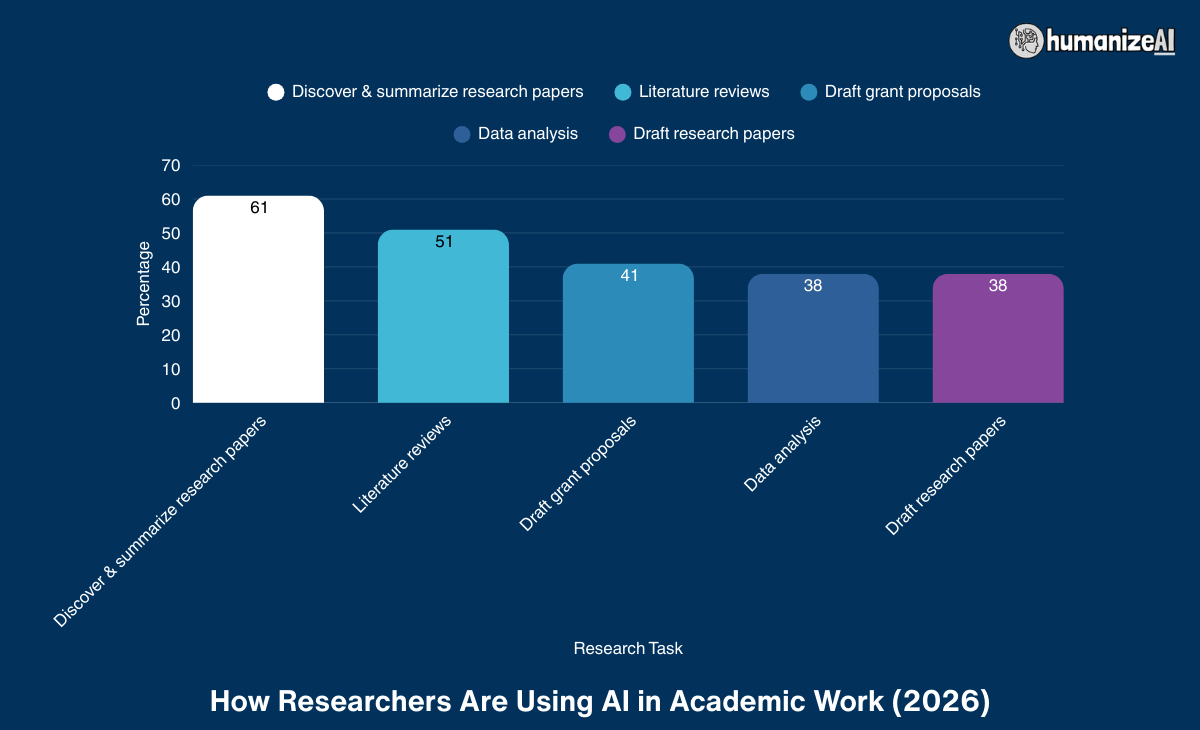
The report further highlights another significant detail. Where exactly are the researchers using AI when it comes to their work? Even though 58% of them say AI tools save them time, the numbers paint a different picture:
- 61% use AI to discover and summarize new research papers.
- 51% rely on AI to support literature reviews and also make existing studies simpler.
- 41% researchers use AI tools to help draft grant proposals.
- 38% rely on AI when analyzing research data.
- 38% also use AI to draft research papers or academic reports.
But in all these numbers, there is once again a reflection of how most researchers are worried about their privacy and security. However, one distinctive data report sums up this entire study. Only 55% of the researchers believe that, as the report quotes, “AI’s training data includes the most up-to-date scholarly literature.”
Another important observation that is also relevant to how we perceive AI in general is also discussed in this report. It says that only 23% of the users believe that AI is ethically developed, compared to a striking 38% who think otherwise.
How AI Is Changing the Research Process
The numbers that we have seen so far are not about what people started to feel suddenly on a random day. But it is a gradual reaction to the change in the process and their entire workflow. With AI taking over more space in academic research and shaping how we perceive and do things, the data surely do paint a compelling picture.
One of the biggest changes brought by AI is how quickly it can put together something that initially took weeks. Moreover, it is always ready with all the information in seconds. This massive upgrade has now completely changed the entire workflow of academic research.
A paper on ScienceDirect called Who uses AI in research, and for what? highlights this with some striking numbers:
- 25.9% of users or researchers now rely on AI frequently for their research at least once.
- 19% of them said that their research involves studying or developing AI.
- The report further highlights how researchers tend to use AI tools on tasks they spend more time on.
It further points out how varied the use of AI in academic research is and how it is in turn changing the entire workflow:
- 36.9% report using AI for creative tasks unrelated to research.
- Most researchers (50.6%) use AI for 2 to 5 research-related tasks.
- AI is rapidly becoming both a tool for research and a subject of research, with more scholars integrating it into their daily academic work.
- Even though there are debates about AI’s long-term effect on innovation, skills, and research equity, most experts agree that it is going to reshape how research will be conducted in the future.
The Future of AI in Academic Research
As we keep talking about how AI is reshaping research, as we discuss the numbers, realize one simple thing. We are moving to a new era of technology that will go hand in hand with our thought process. And, it is not some random prediction but a well-calculated observation backed by facts.
As we have seen earlier in the paper published by Science Direct, “69.2% of researchers believe 'AI will transform or even revolutionize their field of research within the next decade.”
Furthermore, another paper published by Cornell University called Artificial Intelligence, Scientific Discovery, and Product Innovation also gives us a glimpse of how future of academic research looks like:
- The AI system helped automate about 57% of idea-generation tasks, allowing researchers to focus more on evaluation.
- This also led to a 39% increase in patent filings and a 17% rise in new product innovations.
However, this also resulted in less satisfaction amongst the scientists, mainly because AI reduced creativity and underused their skills.
But, on the other hand, we have a study published by Nature based on the input of around 4,000 researchers, which once again tells a different story. It says 54% believe AI will bring more benefits than risks.
Conclusion: What These AI Research Statistics Tell Us About the Future of Academia
It is safe to say that the near future will be about how to make research easier, stress-free, and, most importantly, accurate and instant. At the same time, we will have a significant number of people who will still doubt the abilities that AI brings to the table. This is not something new or a prejudice against AI, but this is basic human behaviour. We are always a bit sceptical about new and innovative discoveries.
The statistics show a clear trend that researchers are increasingly adopting AI to improve efficiency, but that adoption also brings concerns about hallucination data, privacy, and ethical development. If we keep aside these uncertainties, one thing is clear. AI is not replacing researchers, but it is refining the very workflow that researchers are accustomed to.
That is why at this point the conversation is about analyzing the significant numbers that we see, understanding their impact, and paving the way for a framework that accommodates both the sceptics and the believers.