
Do you know that 2026 is being called the year of the AI agents? We have now evolved from telling AI what to do to letting it take action. At this point, using AI is about how efficiently it can take action for us.
Now it is the core working model for many digital marketing agencies, big corporates, and even customer-centric roles. So, what exactly is happening? How wide is the adoption rate, and is this what the future is all about?
Read along as we discuss AI agents' latest statistics for 2026, the present market dynamic and what the future holds. We will look at some numbers and have a detailed discussion so that you know if it's all worth it! Hang tight.😎
AI Agent Statistics Key Takeaways
- 70% of companies in North America are already using agentic AI, with larger businesses leading the way.
- 52% of executives using generative AI apply it across multiple functions, especially customer service (49%), marketing (46%), and tech support (45%).
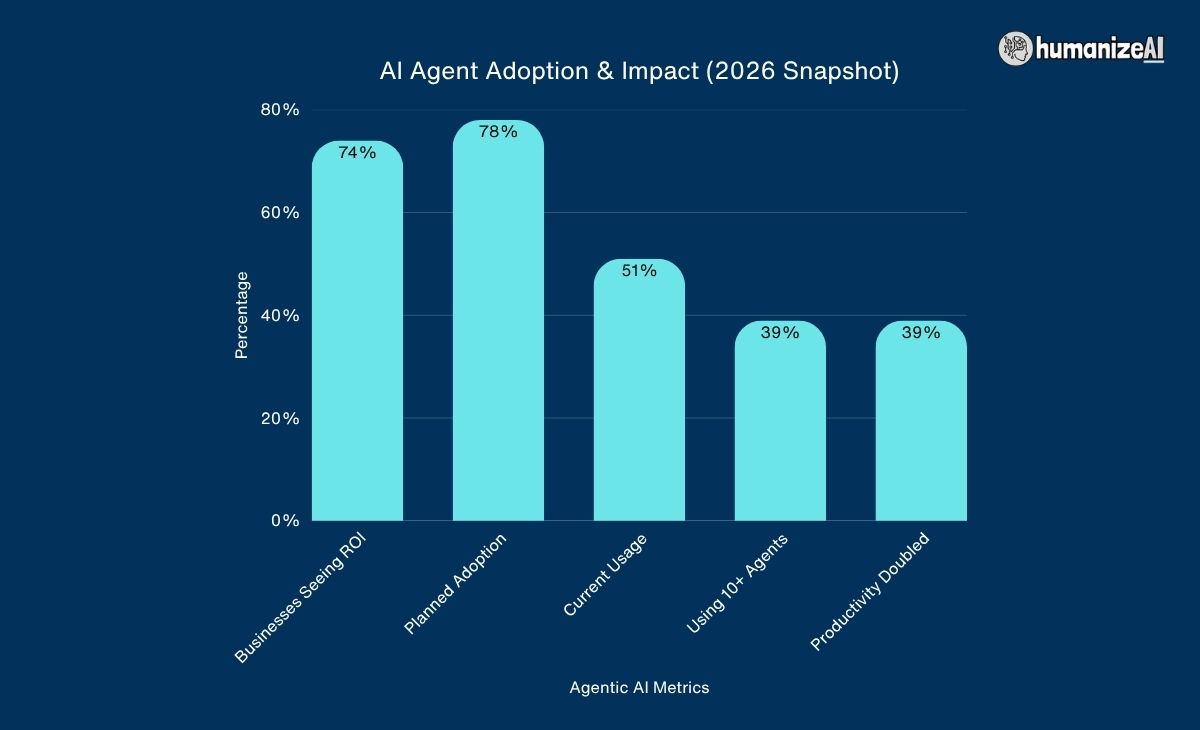
- 51% of professionals already use AI agents, and 78% are planning to adopt them soon.
- 90% of businesses believe AI agents can improve workflows, while 37% are already using them.
- 74% of executives say they see ROI within the first year of using AI agents.
- 39% of companies are already using more than 10 AI agents, and 39% have seen productivity double.
- 40% of enterprise applications will include AI agents by 2026.
- By 2028, AI agents will make 15% of daily work decisions, up from 0% in 2024.
- 33% of enterprise software will include AI agents by 2028, compared to less than 1% in 2024.
- Over 40% of agentic AI projects may fail by 2027, mainly due to execution challenges.
- Healthcare AI adoption is growing at a CAGR of 36.83%, making it one of the fastest-growing sectors.
- 89% of manufacturers plan to adopt AI, and 72% are already seeing cost and efficiency benefits.
- AI is expected to handle 20% of digital storefront interactions by 2028.
What Is an AI Agent?
Google Cloud explains an AI agent as an automated system that completes any given AI-driven task for you. In simple words, it goes beyond being a chatbot and implements necessary actions that involve reasoning, planning, memory, etc.
Let us understand it with an example. Imagine that you are using or have set up an AI agent for content writing purposes. This will mean that not only does the AI agent write the content for you, but also:
- Ensures the facts are well researched and updated.
- Fixes editing mistakes.
- Publishes them whenever required.
- Distributes it to relevant channels and so on.
A report published by Nvidia says that at this point, “North America leads in agentic AI adoption, with 70% actively using the technology.” It further points out that “Larger companies (with more than 1,000 employees) demonstrate broader adoption.”
Therefore, at this point, it is safe to say that AI Agents are slowly building a new perspective of how we perceive work. It can process multimodal information like text, voice, and video and adjust to your workflow accordingly. But more than anything else, it is an AI tool that not only follows orders but also sets the rules by itself as well.
AI Agent Statistics 2026: Key Data & Adoption Snapshot
Luckily, we don’t have to do much digging when it comes to AI Agents statistics for this year. Google has published a dedicated report that shows how exactly AI agents are becoming a regular part of our workforce. Here’s a quick look:
- Out of 52% executives who use Generative AI use it for a wide range of cases, which include:
- 49% use agents for customer service
- 46% use agents for marketing or security operations
- 45% use agents for tech support
- 45% use agents for innovation, research, and productivity
And it is not only about the numbers, but Google’s VP, General Manager, Cloud AI, Saurabh Tiwary says that “By 2026, agents will manage complex, multi-step workflows across systems.”
- The report further highlights how Suzano, the world’s largest pulp manufacturer, partnered with Google Cloud and Sauter to develop an AI agent using Gemini Pro, reducing query handling time by 95% for 50,000 employees.
Another report by Gartner predicts that :
- “40% of Enterprise Apps Will Feature Task-Specific AI Agents by 2026,” or in other words, almost half of the software that the companies use at work (like CRM, HR tools, finance systems) will have built-in AI agents that can do tasks for you, not just assist.
- By 2029, at least 50% of knowledge workers will develop new skills to work with, govern, or create AI agents.
That’s not it, another detailed study by Langchain done with over 1,300 professionals reported some interesting insights:
- Out of those 1300, 51% of respondents are relying on AI agents.
- 78% have active plans to implement agents.
- From a data perspective, the report highlights that mid-sized companies (100 - 2000 employees) were the most active in putting agents into production (at 63%).
- Surprisingly enough, 90% of respondents out of those 1300 were working in non-tech companies that have or are planning to implement agents.
How AI Agents Are Being Used in Real Businesses
To begin with, a report published by UiPath, known as the UiPath 2025 Agentic AI Research Report, says that 90% believe agentic automation could enhance current business processes. It further highlights how businesses are slowly leaning towards an agentic AI-based workflow:
- 93% of US IT executives are “extremely or very interested” about agentic AI, and 45% of them are ready to invest in it.
Now the report further highlights the perception of people on agentic AI with dedicated numbers that look like:
- 37% of US executives are already using agentic AI.
- 58% Believe that its top perceived use can be improving business workflows.
- Whereas 52% believe it is about automating complex workflows.
Here’s a detailed insight into why businesses are relying more on an agentic-based workflow:
- Better visibility into workflows (58%)
- Stronger integration across tools and systems (53%)
- Automation of complex operations (52%)
- Faster response times for customers (51%)
- Improved internal responsiveness (48%)
- Reduced dependency on IT teams (47%)
- Lower need for manual human intervention (41%)
- Reduced operational burden overall (39%)
But the road to agentic AI is not always glorious. Apart from automation and quick access, we have pretty serious concerns that need to be addressed. This is what the report further highlights:
- 56% of the users fear IT security issues.
- 37% are worried about the cost of automation
- Whereas, 35% have concerns about the integration with existing systems.
Moreover, 47% of users believe it can lead to poor quality data, whereas 31% fear its lack of decision-making skills. Then there are the other 28% who are worried about ethical, legal, and other privacy concerns.
Where AI Agents Are Actually Being Deployed: A Sector-by-Sector Breakdown
Up until now, we were looking at various perspectives and how people feel about agentic AI. Now, let us dive in a little deeper and see how AI agents are making their presence felt in various workflows and sectors that we have.
Healthcare
AI agents have been a blessing in disguise for the healthcare sector. With an overflow of patient queries and calls that never seem to end, AI agents offer relief. It provides a better communication channel that assures the patients and also makes things easier for the agent.
- A study by McKinsey reports that healthcare is one of the top two industries for AI agent adoption. (McKinsey State of AI 2025).
- Healthcare AI adoption is growing at a CAGR of 36.83% [one of the fastest of any sector (Source)].
Finance & Banking
Having an automated banking system with agentic AI solves a major chunk of the worries. It helps with fraud detection, automated customer support, report generation, transaction validation, and so much more.
- 56% of finance functions plan to increase AI investments by at least 10% in the next two years (Gartner).
- With banking leading the way, the financial services industry will account for more than 20% of all AI spending. (BusinessWire).
Manufacturing & Supply Chain
Agentic AI is transforming manufacturing and supply chain operations by introducing real-time decision-making, predictive intelligence, and end-to-end automation like demand forecasting, supply chain visibility, vendor management, and so on.
- 89% of executives aim to implement AI in their production, and 69% of manufacturers have already started their journey. (Source).
- 72% of surveyed manufacturers report reduced costs and better operational efficiency after introducing AI (McKinsey).
Retail & E-Commerce
With retail and e-commerce, you are in a highly competitive territory with intense pressure. In here, agentic AI helps with speed and personalization and offers a better shopping experience. Be it for automated customer support, personalized recommendations, real-time product analysis, or tailored interactions.
- By 2028, AI-powered agents will handle 20% of interactions at digital storefronts (Gartner).
- AI shopping is on the rise: 44% of Gen Z already use it, and another 10% plan to. Among Millennials, 46% have adopted AI for shopping, with 12% more expected to join in. (Firework)
What Is Driving the Rapid Growth of AI Agents?
We are seeing such rapid growth in the use of AI agents simply because we are always on the lookout for making our workflow more efficient. Moreover, we are tired of the same old repetitive workflow and tedious manual labour that keeps the ball rolling.
However, even though agentic AI brings relief and organization, it comes with its own challenges. A rise in AI agents means high-end automation, which eventually means a loss of job roles for our existing hands.
Yes, it does make running a business cheaper and more affordable, and that’s why we see a rapid growth in agentic AI workflows. But at the same time, it is seeing significant returns. The recent report by Google Cloud's research shows that:
- 74% of executives report achieving ROI within the first year.
- 39% of executives say their organizations are already using more than 10 AI agents across the company.
- Among those seeing productivity improvements, 39% say their productivity has at least doubled.
But here is another flip side of this digital world fairytale. Research by Gartner says that “Over 40% of Agentic AI Projects will never see the light of day by the end of 2027.” It further says that:
- Gartner predicts that by 2028, at least 15% of daily work decisions will be made by AI agents, up from 0% in 2024.
- It also expects 33% of enterprise software to include AI agents by 2028, compared to less than 1% in 2024.
Overall, all these scattered data points point to one simple thing: we are on board with the AI agent train and seeing great results from it. However, we are not really sure where all this is actually heading at this point. Since multiple experts have layered opinions about agentic AI and its future.
So, Is Agentic AI the Future or Just a Passing Phase?
In our discussion, we have seen a diverse range of opinions when it comes to agentic AI. But this is also the present reality of how everyone is building their workflow around it. Here’s a quick look:
On one hand, we are seeing:
- Rapid adoption by the industries.
- Steady ROI within the first year
- Significant productivity gains
- Increasing integration across industries.
On the other hand, reports like Gartner’s warning that over 40% of agentic AI projects may be canceled by 2027 suggest that not everything will succeed. But here’s the important distinction: the failure of implementation does not mean failure of the technology.
This is exactly what Deloitte’s AI research points out:
- They lack a clear strategy
- They underestimate integration complexity
- They fail to align AI with business goals
This explains why we are seeing two parallel realities:
- High success rates where AI is implemented correctly
- High failure rates where execution is poor
Conclusion: The Future Is Not Certain; However, It Is Clearly Agentic
There is still a lot of curiosity and speculation around agentic AI, and to be honest, it is only normal since the agentic AI system is yet to reach a certain level of perfection.
At this point, it is evolving; in most cases, it is experimental and is inconsistent sometimes with results. However, it is also:
- Delivering a measurable return on investment
- Redefining how our workflows are implemented
- Changing how decisions are made
- And reshaping how the future of work looks.
Yes, some projects will fail.
Yes, there are valid concerns around security, cost, and reliability. But despite all of that, one thing remains clear: we will keep finding new ways to get ahead of the challenges. Since at this point, agentic AI is the future of how we project, implement, and work things.