
Are all developers actually relying on AI? We know that AI has made coding easier per se and more approachable, but is it working? Do developers trust it? Does it actually increase productivity?
Let us find out as we read along the numbers for AI coding statistics for 2026. We will look into the updated numbers for adoption, productivity, and market trends and analyze what exactly is happening. 🙂↔️
AI Coding Statistics 2026 (Key Highlights)
How exactly does it look from an analytical standpoint for a coder looking at the AI market? Well, the AI code tools market is valued at USD 9.35 billion in 2026 and is projected to reach USD 29.96 billion by 2031. ( growing at a 26.23% CAGR)
- Now we have another industry report that estimates the AI code tools market at USD 9.46 billion in 2026, with forecasts reaching USD 22.2 billion by 2030.
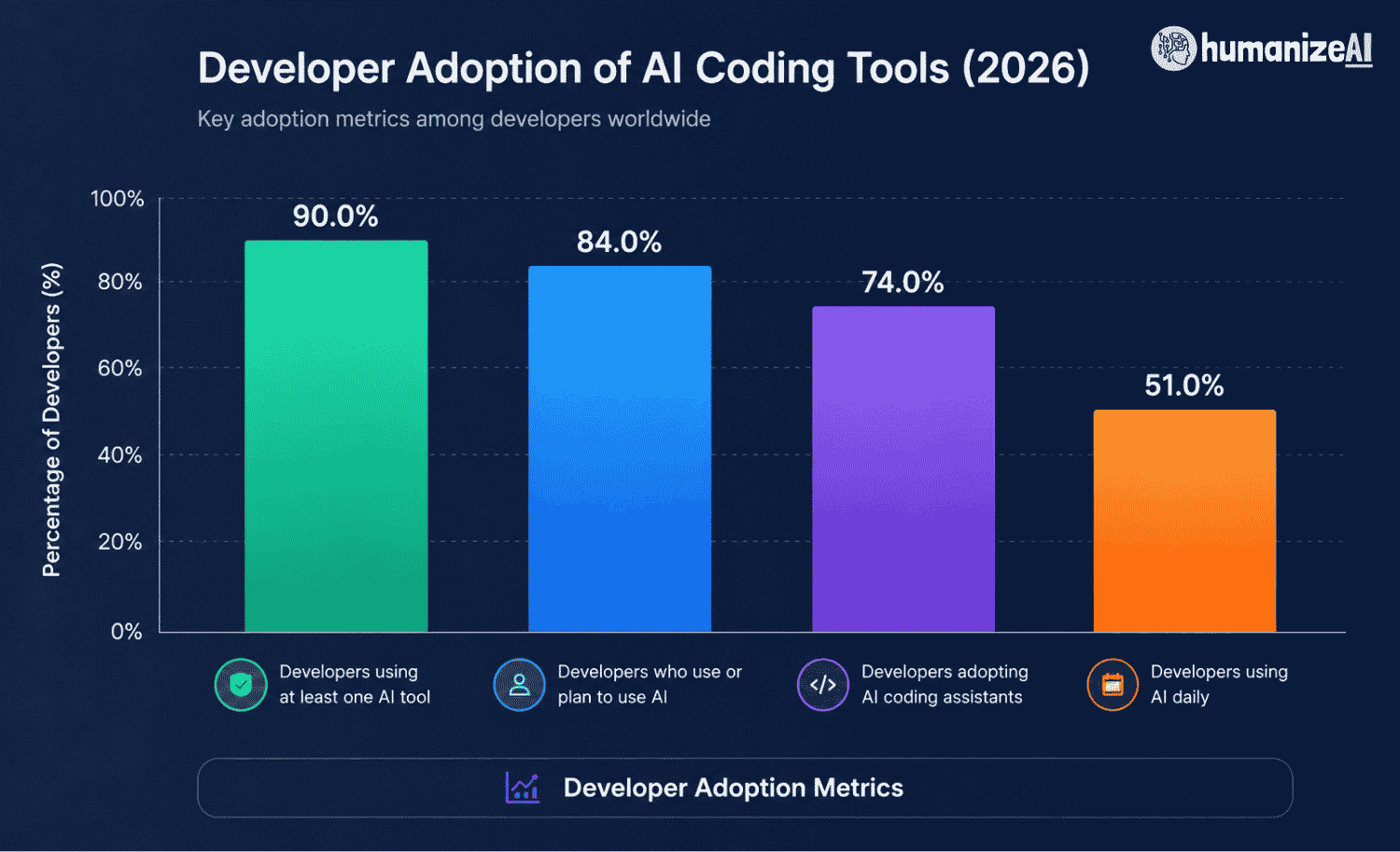
- Here’s the thing: around 90% of developers regularly use at least one AI tool, be it for work or for coding and development tasks.
- 74% of developers worldwide have adopted specialized AI coding assistants, editors, or agents.
- 84% of developers already use or plan to use AI tools in their development workflow.
- And all this change is actually working, because 90% of engineering leaders have reported improvement in productivity. (They have seen that with enterprise AI coding agents, there is an average productivity gain of 19.3%.)
Sources
- Mordor Intelligence
- Research and Markets: AI Code Tools Market Report 2026
- Gartner: Leading in Enterprise AI Coding Agents Requires More Than Product Momentum
- JetBrains Research
- Stack Overflow Developer Survey 2025
How Big Is the AI Coding Market?
Mordor Intelligence says the AI code tools market was worth USD 7.37 billion in 2025. It grew to USD 9.35 billion in 2026. Now it is projected that by 2031, this market could reach USD 29.96 billion.
- The expected growth rate between 2026 and 2031 is 26.23% CAGR.
- Research and Markets gives slightly different numbers. They say the market was USD 7.65 billion in 2025 and USD 9.46 billion in 2026.
- Their report says the market could reach USD 22.2 billion by 2030, growing at 23.8% CAGR.
- Gartner looks only at enterprise AI coding agents. They say this part of the market is worth between USD 9.8 billion and USD 11.0 billion as of April 2026.
Now, if you are someone new to numbers and analysis, think about it this way. USD 9.35 billion is roughly what it would cost to buy the entire NFL franchise lineup of three or four top-valued teams. That too for people who simply write code! Yes, the influence is that big!
Sources
- Mordor Intelligence
- Research and Markets: AI Code Tools Market Report 2026
- Gartner: Leading in Enterprise AI Coding Agents Requires More Than Product Momentum
AI Developer Adoption Statistics
Our coders and developers are looking at this with a fresher perspective. One can even say that they consider it a relief. As 90% of developers regularly use at least one AI tool at work.
- 74% have adopted specialized AI coding assistants, editors, or agents.
- 84% of developers already use or plan to use AI during software development.
- 51% of professional developers use AI tools every day.
It is just that out of all the people studied in the survey, only 16.2% say they do not plan to use AI tools.
AI Coding Tool Adoption Statistics
Adoption in terms of numbers also tells a clear story. To begin with, GitHub Copilot is recognized by 76% of developers worldwide. Not only that, but about 29% of them use it daily for work. A quick look at the numbers:
| AI Coding Tool | Developer Adoption / Awareness |
| Cursor | 69% of developers know Cursor |
| Cursor | 18% of developers use Cursor at work. |
| Claude Code | 18% of developers use Claude Code at work. |
| Claude Code | Awareness increased from 31% in mid-2025 to 57% by January 2026. |
| ChatGPT | 28% of developers use ChatGPT for coding tasks. |
| OpenAI Codex | 3% of developers use OpenAI Codex at work. |
| Google Antigravity | Reached a 6% workplace adoption rate within months of launch. |
| JetBrains AI Assistant | 9% of developers use JetBrains AI Assistant. |
| Junie | 5% of developers use Junie. |
How Developers Actually Use AI for Coding
| Development Task | Developers Using AI |
| Search for answers | 54.1% |
| Generate content or synthetic data | 35.8% |
| Learn new technologies | 33.1% |
| Document code | 30.8% |
| Understand existing codebases | 24.8% |
| Debug code | 20.8% |
| Test code | 20.7% |
| Write code | 17.9% |
| Deployment and monitoring | 6.2% |
Sources
Which AI Coding Tools Are Developers Choosing?
Here’s another thing, Digital Applied found Claude Code leads primary tool adoption at 28%. The study further revealed that more than half of developers use a three-tool AI coding stack instead of relying on a single assistant.
- Cursor follows with a 24% primary share.
- GitHub Copilot accounts for a 17% primary share despite leading any-use adoption at 58%.
- OpenAI Codex holds an 11% primary share.
- Claude Code records the highest Net Promoter Score (NPS) at +58.
- Cursor follows with an NPS of +51.
- GitHub Copilot records an NPS of +14.
Sources
AI Coding Productivity Statistics
As we were discussing earlier, the coders are relying on AI simply to save time. But how exactly does productivity look in terms of numbers? It is just that only 3 to 4% of developers have a negative impression of AI coding tools. The rest of the numbers tell a different story:
- 90% of engineering leaders report productivity improvements from AI coding agents.
- The Average productivity gains reach 19.3%.
- 52% of developers say AI tools or AI agents improved their productivity during the past year.
- Developers report a median productivity improvement of 34% after the first 60 days.
- Lastly, the research points out that Median productivity reaches 37% after 180 days.
Sources
- Gartner: Leading in Enterprise AI Coding Agents Requires More Than Product Momentum
- Stack Overflow Developer Survey 2025
- Digital Applied: AI Coding Tool Adoption 2026: Developer Survey Results
AI Coding Workflow Statistics
But all these numbers and easy access do not mean that things get done in seconds. Research says that developers spend 11.4 hours each week reviewing AI-generated code. Infact, they now spend more time reviewing AI-generated code than writing code with AI.
- They spend 9.8 hours writing new code with AI assistance.
- 6.1 hours are spent debugging with AI.
- 4.7 hours go toward refactoring.
- 3.3 hours are spent writing documentation and tests.
Sources
AI Coding Challenges and Trust Statistics
Now it is time to ask the most important question. Do the developers trust AI to write their code? Well, 66% of developers say AI produces solutions that are almost correct but still require fixes.
- 45.2% say debugging AI-generated code takes longer.
- 46% of developers are skeptical about AI accuracy, compared to 33% who trust it.
- Only 3.1% highly trust AI-generated code.
- 87% express concerns about AI agent accuracy.
- 81% worry about security and data privacy.
- 42% of developers say changing token costs are one of the biggest challenges when using AI coding tools.
- 31% of developers say prompt injection is one of their biggest concerns.
Sources
- Stack Overflow Developer Survey 2025
- Digital Applied: AI Coding Tool Adoption 2026: Developer Survey Results
AI Coding Agent Statistics
When it comes to AI agents the numbers are not that extraordinary if you put things in perspective. For example, 14.1% of developers use AI agents daily at work. However, approximately 70% agree AI agents reduce time spent on development tasks.
- 17.4% plan to adopt AI agents.
- 37.9% do not plan to use AI agents.
- 83.5% of developers who use AI agents rely on them for software engineering tasks.
- 69% say AI agents improve productivity.
- Only 17% believe AI agents improve team collaboration.
Sources
AI Coding Market Trends
The numbers say that Cloud-based AI code tools generated 72.47% of market revenue in 2025.
- The on-premises AI code tools market is projected to grow at a 26.55% CAGR
- Code completion held a 38.19% market share in 2025.
- Security and compliance assistants are projected to grow at a 26.83% CAGR.
- IT and telecom represented 31.94% of end-user demand in 2025.
- Healthcare and life sciences are forecast to expand at a 26.94% CAGR.
- Large enterprises generated 59.47% of market revenue.
- North America held a 41.89% market share in 2025.
- Asia Pacific is expected to be the fastest-growing regional market.
Sources
Will AI Replace Software Developers?
So, is this the end of software developers? Well the numbers say that 43% of jobs could be significantly reshaped by AI automation. Yet, BCG says software engineering is an "Amplified Role," meaning AI is expected to help developers do their jobs rather than replace them.
- BCG estimates that 50% to 55% of US jobs will be reshaped by AI over the next two to three years.
- Only 10% to 15% of jobs are projected to be eliminated over the longer term.
- Gartner found that 90% of engineering leaders have seen productivity improvements from AI coding agents.
Sources
- AI Will Reshape More Jobs Than It Replaces
- Gartner: Leading in Enterprise AI Coding Agents Requires More Than Product Momentum
What These AI Coding Statistics Tell Us
If you look at the numbers, you will realize that software development did not just adopt AI. It has built a new layer of work around it. Ninety percent of developers now have some kind of AI tool to work with. Yet at the same time, they are spending eleven point four hours a week checking if things are in place or not. At this point, it is a simple exchange of productivity for trust.
Now if you look at the finances of it, the market currently stands at nine point three five billion dollars, with the potential to triple by two thousand thirty one. Developers are choosing their favorite tools fast, with tools like Claude Code helping decide who will win this race.
So will AI replace developers? At this point, to answer that question, it is not about whether AI will replace software developers or whether the numbers point that way. It is about finding common ground in how all of this fits together. The safe assumption is that engineers who learn to direct AI well will obviously be pulling ahead.
Sources
- JetBrains Research
- Stack Overflow Developer Survey 2025
- Gartner: Leading in Enterprise AI Coding Agents Requires More Than Product Momentum
- Digital Applied: AI Coding Tool Adoption 2026: Developer Survey Results
- Research and Markets: AI Code Tools Market Report 2026
- Mordor Intelligence
- AI Will Reshape More Jobs Than It Replaces