
Initially, an internet browser was just used for accessibility. It was nothing more than a pathway. But now things have changed, and how! Currently, an AI-powered browser can help you think, summarize, decide, and do so much more in seconds.
But, how popular are these browsers, and how many are currently relying on them for daily use? Is the adoption worth discussing? Let us find out. 🫢
Read along as we look into AI browser statistics for 2026 with adoption, traffic, and user growth trends.
Internet Browser Adoption and Usage Statistics
Before we understand how big the AI browser market is, let us quickly take a look at the normal browser usage. In the time of AI and generative tools, how many people are actually searching through browsers? Currently, more than 5.4 billion people actively use the internet worldwide. A quick look:
- According to the Business Research Insights Internet Browsers Market Report, more than 5.4 billion people actively use the internet worldwide.
- The report also states that approximately 92% of users access the web through browsers every day.
- In addition, browsers account for 78% of all digital interactions across devices.
- Mobile browsers hold 64% of total browser usage.
- Desktop browsers account for 36% of browser usage.
- Chromium-based browsers represent 72% of all browser installations.
- About 58% of users prioritize browsing speed when choosing a browser.
- Around 49% of users focus on privacy features.
- Currently, browser extensions are used by 46% of users.
Browser Market Share Statistics
The numbers are pretty telling. Currently, the top four browsers control 79% of the global browser market. Google Chrome holds 65% market share and serves more than 3.5 billion users globally.
| Browser | Market Share / Users |
| Google Chrome | Google Chrome is the biggest browser. It holds between 68% and 79% of the global browser market. |
| Safari | Safari comes next. It has 19% market share and around 1.1 billion users worldwide. |
| Chromium-Based Browsers | These browsers are very common, too. They make up 72% of all browser installations. |
| Edge, Firefox, and Opera | Edge, Firefox, and Opera are smaller. Each one has less than 12% market share. |
What Is the AI Browser Market Worth in 2026?
Is everyone actually relying on a browser that helps them decide, think, and organize? How lucrative is the idea that you get tailored shopping recommendations, mail suggestions, etc.? Well, to begin with, a lot more than you think! The global AI browser market was valued at $4.5 billion in 2024.
- The same market is expected to grow to upto to $76.8 billion by 2034.
- It is expected to grow at a 32.8% CAGR between 2025 and 2034.
- North America was the biggest player with 36.6% of the global AI browser market in 2024, with approximately $1.6 billion in revenue during the year.
- If you look at the U.S, the AI browser market was valued at approximately $1.4 billion in 2024.
- It is forecast to grow at a 33.4% CAGR through 2034.
AI Browser Market Share Statistics
Are the AI browsers now a real thing? Do they have the potential to control the market and help decide its course? Apparently, yes! Because AI-powered web browsers made up for 45.7% of the market in 2024.
- When you look at Cloud-based AI browsers, it captured 65.2% market share.
- Natural Language Processing (NLP) counted for 32.7% of AI browser technologies.
- The enterprise use for AI browsers accounted for 76.8% of the AI browser market.
AI and Browser Technology Statistics
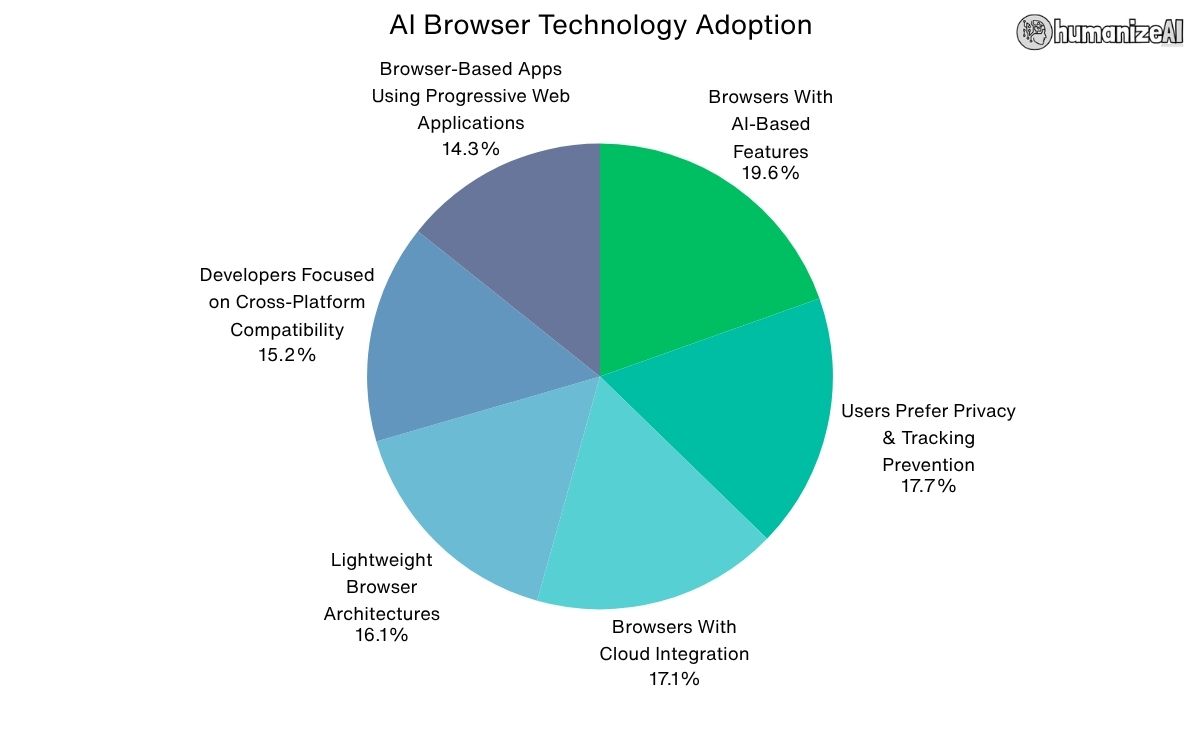
The days of normal browsing are almost over. Today, Approximately 63% of browsers now have AI-based features. A quick look at the usage pattern for browsers:
- Around 57% of users prefer browsers with built-in privacy and tracking prevention tools.
- Today, Cloud integration is present in 55% of browsers.
- Lightweight browser architectures are used in 52% of new developments.
- Progressive web applications account for 46% of browser-based applications.
- Security updates have increased by 58% across browser platforms.
- Around 49% of developers focus on improving cross-platform compatibility.
Mobile Browser Statistics
Before we dive into the detailed numbers, we must talk about our beloved cellphones. Without our mobiles, we are one lost species, and that’s why mobile devices continue to dominate how people access the web worldwide.
- Currently, mobile browsers account for 64% of browser usage worldwide.
- If you look at the numbers, around 67% of global users access the internet primarily through mobile browsers.
- Mobile browsing represents 72% of browser activity in the Asia-Pacific.
- Whereas in the United States, 67% of users rely on mobile browsers.
Browser Investment and Growth Statistics
If you are from a non-technical way of thinking, you can wonder what the fuss is about the browsers. Aren’t they only supposed to help us access the internet? Well, exactly, and that is why it is critical to assess its growth and overall presence.
- Around 49% of technology companies invest in browser innovation.
- Approximately 64% of investments target mobile browser development.
- Cloud-based browser technologies account for 55% of investment allocation.
- Around 43% of firms invest in AI-based browsing tools.
- Approximately 38% of investments focus on privacy-enhancing technologies.
- Emerging markets contribute 47% of new user growth.
- Private sector funding represents 61% of total investments.
- Around 44% of investments emphasize cross-device synchronization.
AI-Native Browser Adoption Statistics
AI-native browsers are one of the fastest-growing in the traditional tech category right now. As we have discussed earlier, unlike traditional browsers, these tools combine browsing, AI search, summarization, and other task automation in a single go. The numbers below show how quickly platforms like Atlas, Comet, and Brave are attracting users. A quick look at Atlas’s present usage:
ChatGPT Atlas Usage Statistics
- ChatGPT Atlas reached approximately 11 million monthly active users in Q1 2026.
- Its monthly active users reached 4 million by Q3 2025.
- Atlas was sitting at around 1.6 million monthly active users back in Q1 2025
- Fast forward to Q1 2026, and Monthly Atlas posted a wild 175% quarter-over-quarter growth number
- That growth meant Atlas had grown its user base nearly 6.9x in just one year (roughly 11 million).
- These days, Atlas handles something like 320 million queries every month.
- And here's the thing: about 58% of those queries are coming straight from address-bar AI searches.
- Approximately 24% come from inline page-summary requests.
- Lastly, 18% come from agentic tasks.
- If you look at the numbers, Atlas executes approximately 9 million agentic tasks per month.
- Memory-enabled context persists across approximately 73% of Atlas sessions.
- The United States accounts for 41% of Atlas users, backed by the United States with 41%.
AI Browser Traffic Is Surging Across the Web
HUMAN Security observed a 6,900% increase in requests from AI agents and agentic browsers since July 2025. And this is not some small milestone. If you further look into the numbers, Address-bar AI searches generate approximately 186 million monthly queries in Atlas.
- Inline page summaries generate approximately 77 million monthly summaries.
- Memory-augmented sessions account for approximately 63 million monthly sessions.
- Address-bar AI searches recorded 490% year-over-year growth.
- Inline page summaries recorded 620% year-over-year growth.
- Agentic tasks recorded 940% year-over-year growth.
AI Browsers Are Changing Online Shopping
This is where you will understand what the hype is all about. AI browsers are increasingly being used to complete tasks that are seemingly tedious. For example, Online shopping. No one knows browses through thirty different tabs to buy one product.
A quick reminder: Agent traffic targeting e-commerce websites increased 144.7% during the Black Friday to Cyber Monday period. So, you can only understand how it is reshaping the entire shopping experience. A quick look:
- Atlas executes approximately 9 million agentic tasks per month.
- It reports a 76% task completion rate.
- Comet reports a 71% task completion rate.
- The median Atlas task takes 4.2 minutes to complete.
- The median Comet task requires around 6.1 minutes to complete.
Emerging AI Browser Statistics
Mind you, this is not just one simple browser that is changing the ecosystem. Several new AI-native browsers are competing for users alongside Atlas and Comet.
| AI Browser | Feature |
| Arc Browser | Holds approximately 0.2% of the global browser market share |
| Brave Browser | Surpassed 30 million daily active users |
| Brave Search | Processes approximately 1.6 billion queries per month and 20 billion queries annually. |
| Vivaldi | Serves approximately 2.4 million active users and gets 2.7 million monthly visits. |
| Opera Aria | Supports summarization in 40+ languages |
| Microsoft Edge Read Aloud | Supports 40+ languages |
SQ Magazine Browser Statistics 2026
Quick TidBits:
- Around 73% of Atlas sessions use memory-augmented context.
- The fun part? Atlas reports a 41% improvement in framing stability for brands with consistent positioning.
- Studies show that brand recall is 28% higher in memory-augmented sessions compared to fresh sessions.
- Presenc AI analyzed approximately 1,400 monitored Atlas sessions in Q1 2026.
AI Browser Adoption Trends: ATLAS
If you look at the numbers, Atlas is described as the second-largest AI browser by user count after Perplexity Comet. It grew 175% quarter-over-quarter in Q1 2026.
- Comet grew 41% quarter-over-quarter during the same period.
- Atlas expanded through ChatGPT Plus, Pro, and Enterprise distribution channels.
- Atlas reached approximately 11 million monthly active users in Q1 2026.
- It executes approximately 9 million agentic tasks per month and has a 76% task completion rate.
- Whereas Comet achieves a 71% task completion rate, with tasks taking a median of 6.1 minutes, whereas Atlas completes tasks in 4.2 minutes and the standalone Operator in 3.4 minutes.
Who Is Actually Using AI Browsers: Perplexity
AI browsers are no longer limited to developers and early adopters. The latest user data shows that students, researchers, and working professionals make up a large share of the audience.
In fact, Perplexity now serves millions of users worldwide, with strong adoption among people from the education sector and the young age group. The numbers also suggest that many people are using AI browsers regularly, rather than treating them as a tool they try once and forget. A quick look:
Perplexity User Base and Growth
- Perplexity AI now serves approximately 30 million monthly active users worldwide.
- Users collectively generate more than 780 million queries per month on the platform.
- Annual user growth reached approximately 66% year over year.
Perplexity User Demographics
- The biggest age group is 25 to 34 years old. They make up 29.14% of all users.
- Next is the 18 to 24 age group. They are 21.68% of users.
- Many users are well educated, too. About 45% have a bachelor's degree or higher.
- And 18% of users have a master's degree or some advanced qualification.
Perplexity Usage Habits
The interesting thing is that nearly 19% of users rely on Perplexity every day.
- Another 27% use it several times per week.
- Overall, 61% of returning users access Perplexity at least three times weekly.
- People perform an average of 9 searches per day, compared with roughly six on traditional search engines.
What Are People Using Perplexity For?
No points for guessing, Academic and research-related queries account for 29% of platform activity.
- Follow-up questions appear in 22% to 25% of sessions, suggesting users are having longer conversations instead of running one-off searches.
AI Browser Adoption Is Being Driven by Knowledge Workers
One of the strongest adopters is coming from users who regularly research, analyze information, or need resolution with complex problems. If you look at information and technology, it reports 41% daily usage of Perplexity.
- Finance accounts for 28%.
- Marketing professionals represent 33% of users accessing the platform at least three times per week.
- Around 22% of healthcare organizations have integrated Perplexity internally.
- Educational institutions account for 18% of adoption.
- E-commerce contributes 14% of usage.
- Legal organizations represent 9% of adoption.
- Manufacturing accounts for 12% of usage.
AI Browser Adoption Is Expanding Beyond Early Adopters
Here is the thing: more than 55% of Americans say they regularly use AI. Approximately 27% of Americans interact with AI several times per day. Now,
- More than 6.04 billion people use the internet globally in 2026, creating a massive audience for next-generation browsing tools.
- Mobile browsers now generate 62%–64% of global website traffic, highlighting the growing demand for faster and smarter browsing experiences.
- Around 53% of users abandon websites that take longer than three seconds to load, increasing the appeal of AI-powered features such as instant summaries and faster information retrieval.
Sources
- Demandsage
- SQ Magazine Browser Statistics 2026
- Perplexity AI User Statistics 2026 (ClickVision)
- Digital Applied, AI Browser Landscape 2026
- Presenc AI, ChatGPT Atlas Usage Statistics 2026
- HUMAN Security: ChatGPT Atlas vs Perplexity Comet
- Business Research Insights Internet Browsers Market Report
- Market.us AI Browser Market Report
- Digital Applied, Zero-Click Search
- Market.us report citing Statcounter
The Next Chapter of the Internet
Even two or three years ago, browsers were simply a bridge to the internet. But now, things have changed. Browsers have become an integral part of our online habits because they can research, summarize, and organize information. For many of us, relying on a browser without these capabilities now feels incomplete.
If we talk about this article, one thing is clear: the browser market is growing, and it is growing rapidly. The future is all about AI-powered features that are becoming standardized across all kinds of browsers. For new players like Atlas, Comet, Brave, and Perplexity, things are only just getting started.
But we also have to remember that browsing habits continue to shift toward mobile devices, cloud-based experiences, and AI-assisted workflows. At this point, the biggest takeaway from this article is that AI browsers are no longer a niche experiment or limited to a specific brand.
Students, researchers, marketers, and enterprise teams are all embracing them. More importantly, people are increasingly accepting AI browsers as a part of their daily routine.