
I think all of us have memorized this line by now: “AI has changed how we search.” But what exactly has it changed, and how is it impacting the numbers? To put it simply, almost everyone is on the internet, so how does the traffic look now?
Let us find out as we discuss AI search statistics for 2026 users and market share and how it impacts the traffic and industry trends. 😶🌫️
AI Search Market Share Statistics
Before we jump into the numbers, let us quickly rewind what AI search is all about. It is when people stop relying on Google and the same old blue links and ask the AI tools for answers.
And in this blog, we look at the numbers behind this shift: how much traffic it generates, which AI platforms are growing, whether people still click websites, how AI affects businesses and SEO, and etc. Let us begin by looking at the present situation:
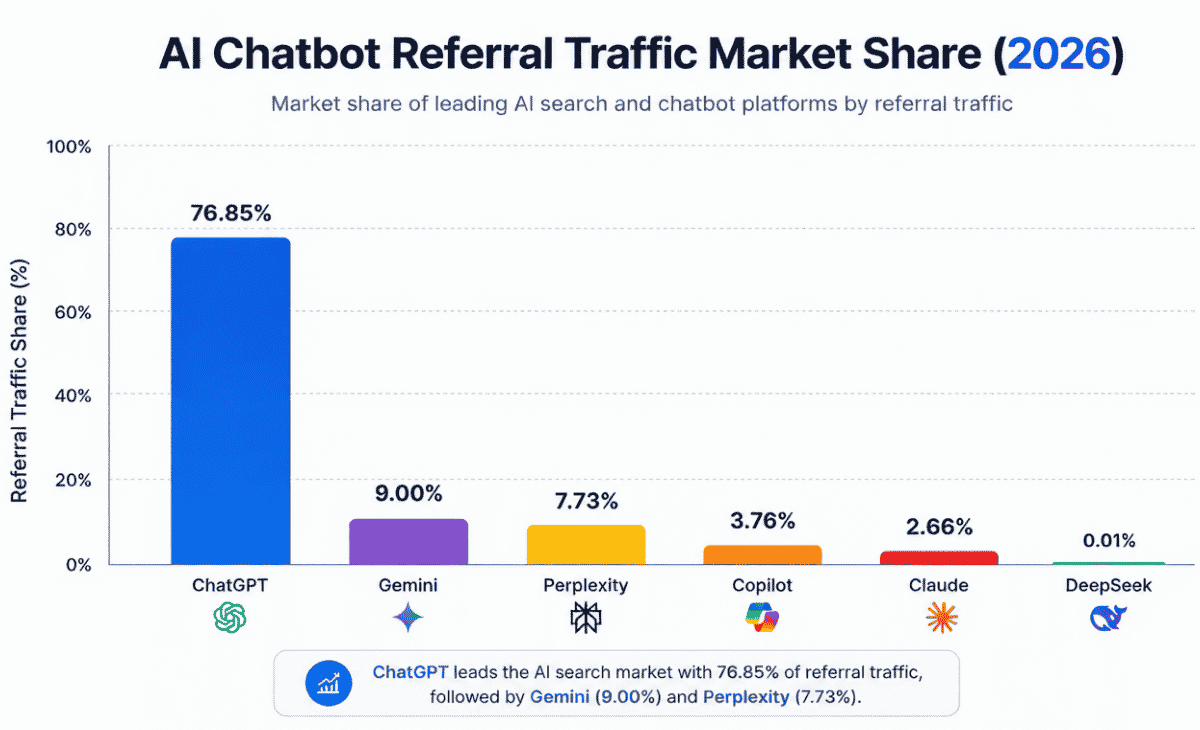
- ChatGPT holds 76.85% of AI chatbot referral traffic. ( ChatGPT reached 900 million weekly active users in early 2026, roughly doubling from 400 million a year earlier)
- Gemini accounts for 9.00% of referral traffic.
- Perplexity holds 7.73%.
- Microsoft Copilot represents 3.76%.
- Claude accounts for 2.66%.
- DeepSeek represents 0.01%.
- However, ChatGPT referral share sat at 84.21% in April 2025. By April 2026, that number fell to 76.85%.
- Gemini tells a different story. It went from 2.31% to 9.00% in the same twelve months.
- Perplexity peaked at 12.07% in April 2025, slid to 7.73% by April 2026, and has since held steady.
- Claude started at just 0.30% referral share. It closed at 2.66%, nearly a 9x jump in under twelve months.
Sources:
- Axis Intelligence: AI Search Statistics 2026: Market Share, Traffic, Citations & What It Costs You to Be Invisible (citing StatCounter Global Stats)
- Reporter Outreach: AI Search Statistics: Market Share & Data for 2026 (citing StatCounter)
AI Search Statistics 2026 (Key Highlights)
To begin with, at this point, AI search is becoming a substitute for traditional search rather than an additional discovery channel. If you look at the numbers, research says that AI search visitors are projected to surpass traditional organic search visitors by 2028. The Global adoption of generative AI tools reached 16.3% of the world's population by the end of 2025.
Moreover, Gartner predicts traditional search engine volume will decline by 25% by 2026 because of AI chatbots and virtual agents. A quick look:
- ChatGPT processes 2.5 billion queries every day.
- The AI platforms collectively process more than 3.5 billion queries every week.
- They saw a jump in visits as it grew 28.6% between January 2025 and January 2026.
- Total AI chatbot traffic increased 81% year over year, reaching 55.2 billion visits.
Sources:
- Omnibound: AI Search Statistics (2025–2026): 55+ Data Points on GEO, Buyer Behavior, and Citation Rates
- Reporter Outreach: AI Search Statistics: Market Share & Data for 2026
- Semrush
AI Search User Statistics
The point is, it is not only me or you asking ChatGPT or Gemini to help find a nice restaurant or hassle-free project management software. People all over the world have started to rely on AI for quick search options. To begin with, around 51% of B2B software buyers now begin research with AI chatbots more often than Google.
- Gemini recorded 157% growth between April and September 2025, reaching 1.1 billion monthly visits.
- ChatGPT accounted for roughly 79% of generative AI web traffic.
- 61% of B2B buyers use both AI search and Google during product research.
Actually, before we proceed further, this is where the entire secret lies: 85% of buyers think more positively about a software vendor when AI includes that brand in its answers.
- Not to mention, 41% of B2B buyers already use Deep Research tools for structured software evaluations.
- Nearly 94% of B2B buyers have used generative AI during their latest purchases.
Sources:
- Omnibound: AI Search Statistics (2025–2026): 55+ Data Points on GEO, Buyer Behavior, and Citation Rates
- Position Digital
AI Search Traffic Statistics
It is now clear that people are using AI to search. Hence, it is only normal to wonder how exactly the traffic is being distributed. Let us have a quick look:
To begin with, AI traffic to U.S. retail websites increased 393% during the first quarter of 2026. Infact, Adobe analyzed more than 1 trillion visits to U.S. retail websites. The overall AI traffic increased 269% over the previous 12 months as of March 2026.
| Industry | AI Referral Traffic Growth (YoY, Nov–Dec 2025) |
| Retail | +693% |
| Travel | +539% |
| Financial Services | +266% |
| Tech & Software | +120% |
| Media & Entertainment | +92% |
Sources:
AI Search Referral Traffic Statistics
Now let us talk about what is really important. Is AI actually helping the business? Do AI referral traffic leads to conversion, or it simply satisfy the eagerness to know about an AI-recommended product? Well, the numbers say that AI traffic converted 42% better than traditional traffic in March 2026.
- One year earlier, AI traffic converted 38% worse than regular visitors.
- AI referrals converted 31% better than other traffic sources during the 2025 holiday season.
- AI conversions were 54% higher than non AI traffic on Thanksgiving.
- AI conversions were 38% higher than non AI traffic on Black Friday.
- AI referral traffic generated 37% higher revenue per visit than non AI traffic by March 2026.
- AI driven revenue per visit increased 254% during the 2025 holiday season.
- Revenue per visit from AI traffic increased 84% between January and July 2025.
- AI referral traffic converts at 7.1%, second only to paid search at 7.8%.
- Claude generated the highest AI platform conversion rate at 16.8%.
Lastly, the numbers say that AI referral traffic converts approximately 2.5× better than Google organic traffic.
Sources:
- Adobe for Business
- TechCrunch
- Axis Intelligence: AI Search Statistics 2026: Market Share, Traffic, Citations & What It Costs You to Be Invisible (citing Similarweb, Digital Bloom)
AI Search Engagement Statistics
So, to lay it all bare, are AI visitors better than the others? Well, the numbers say that AI visitors recorded 12% higher engagement than non-AI visitors. And that’s not it; here are a few other quick details:
- AI visitors spent 48% longer on retail websites.
- Visits prompted by AI led to 13% more pages per visit.
- AI visitors were 33% less likely to leave immediately after arriving on a website.
- Bounce rate improved by 14% since the beginning of 2025.
- AI shoppers spent 45% more time on websites during the 2025 holiday season.
- Visitors from AI search spend 68% more time on websites than visitors from traditional organic search.
- The average AI search visitor is worth 4.4× more than the average organic visitor based on conversion value.
Sources:
- Adobe for Business
- TechCrunch
- Omnibound: AI Search Statistics (2025–2026): 55+ Data Points on GEO, Buyer Behavior, and Citation Rates (citing SE Ranking)
- Semrush
Google AI Overview Statistics
When we are discussing AI in search we cannot simply not talk about Google Overviews. It has systematically changed how we perceive the internet as a whole. So, how impactful are Google’s AI Overviews? Well, for starters, the numbers say that half the Overviews were shorter than 67 words, half were longer, and yet it changed Google search forever. A quick look:
- AI Overviews appear in 25.11% of Google searches according to 2026 benchmarks.
- BrightEdge found AI Overviews appearing in 48% of tracked Google queries.
- 88% of AI Overviews cite 3 or more sources.
- Only 1% of it cites a single source.
- AI Overviews reduced clicks to websites below them by 34.5%.
- A randomized 2026 experiment measured a 38% decline in clicks.
- AI Overviews reduced clicks to the top-ranking page by 58%.
- AI Overview citations change 70% of the time for identical queries.
- 45.5% of citations are replaced whenever Google regenerates an AI Overview.
- AI Overviews and AI Mode share only 13.7% of citations.
Sources:
- Reporter Outreach: AI Search Statistics: Market Share & Data for 2026 (citing Pew Research, Ahrefs)
- Omnibound: AI Search Statistics (2025–2026): 55+ Data Points on GEO, Buyer Behavior, and Citation Rates (citing Conductor, Ahrefs)
- Position Digital (citing Ahrefs)
- Pew Research Center
Zero Click Search Statistics
Well, the numbers are here, 60% of all Google searches now end without a click. Most importantly, AI Overviews have contributed to traffic declines of 20%–40% for many websites. This is why being quoted by AI Overviews has now become a non-negotiable for almost every writer and business out there. A quick look:
- 58.5% of U.S. Google searches end without clicking any external website.
- 59.7% of European Google searches end without an external click.
- AI Overviews produce an average zero-click rate of 83%.
- Google AI Mode records a 93% zero-click rate.
- Google Search with AI Overviews records a 43% zero-click rate.
- 75% of mobile searches end without an external click.
- A 61% decline in organic CTR has been reported when AI Overviews appear.
- Brands cited inside AI Overviews see 35% higher organic CTR.
Sources:
- Reporter Outreach: AI Search Statistics: Market Share & Data for 2026 (citing SparkToro, Semrush, Ahrefs, Bain & Company)
- Omnibound: AI Search Statistics (2025–2026): 55+ Data Points on GEO, Buyer Behavior, and Citation Rates (citing Conductor, Ahrefs)
- Position Digital (citing Semrush, SparkToro)
- Pew Research Center
AI Search Consumer Behavior Statistics
AI has successfully changed how we used to interact with search. It has done what it was supposed to do. Now, it is our turn to analyze and understand how exactly it impacted the users. We have initially seen that it does contribute to conversions, but how exactly does it look in terms of numbers?
- 35% of U.S. consumers now begin product discovery using AI tools.
- Only 13.6% begin product discovery with traditional search engines.
- Nearly 40% of Americans use at least one AI chatbot every month.
- 20% of Americans are heavy LLM users.
- Around 3 in 4 Americans report using AI search every week.
- 40.46% trust traditional search engines and AI equally.
- 25.03% trust search engines more than AI.
- 24.69% trust AI more than search engines.
- 57% still prefer traditional search for important topics.
- However, 95% of Americans continue using traditional search engines alongside AI.
Sources:
- Position Digital (citing SparkToro, Mango Thrive, Search Engine Journal, NN Group )
- Axis Intelligence: AI Search Statistics 2026: Market Share, Traffic, Citations & What It Costs You to Be Invisible (citing Similarweb)
What These AI Search Statistics Tell Us
As we have seen with these numbers, AI search and looking for recommendations within a generative AI tool is no longer happening on the sidelines. Nor is it just a selective pattern. It has completely changed how people search for products, discover information, look for websites, and so on.
As ChatGPT continues to dominate AI search traffic with almost 76.85% referral share, platforms like Gemini, Perplexity, and Claude are still trying to catch up. The competition becomes intense to deliver precise recommendations.
At the same time, the impact goes beyond the numbers. The research says that AI referral traffic is converting better, visitors are spending more time on websites, and businesses are now actually beginning to rethink how they approach the entire concept of search visibility.
Now, as we have seen Gartner predicts a 25% decline in traditional search volume by 2026. While on the other hand AI search traffic is projected to surpass traditional organic search by 2028. Hence, a shift is already in progress, and no one can deny that.
However, it is not that search is disappearing. It is simply evolving. It is true that AI is now becoming a part of how people find answers online. But at the end of the day, those answers come from the content that businesses, marketers, and content creators create, and how they curate it while keeping AI search overviews and AI search tools in mind.
Sources:
- Position Digital (citing Graphite)
- Omnibound: AI Search Statistics (2025–2026): 55+ Data Points on GEO, Buyer Behavior, and Citation Rates (citing eMarketer, Incremys)
- Gartner
- Semrush