
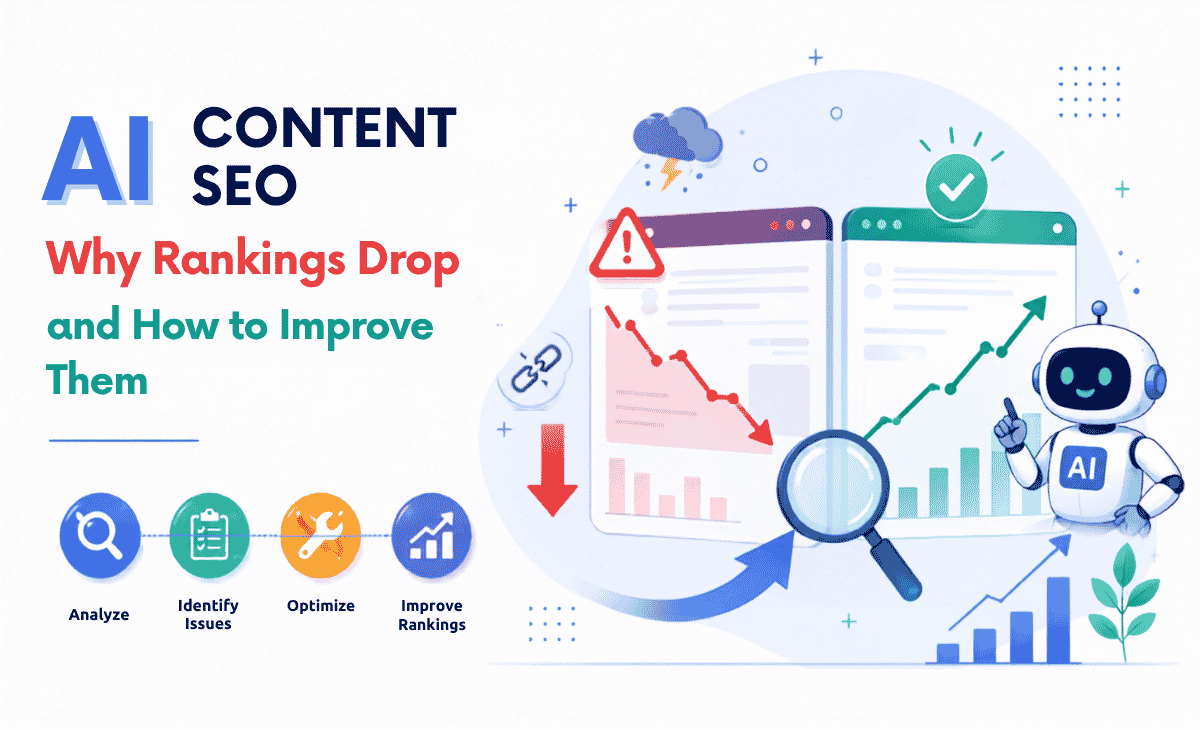
While we had our fun with relying on AI-generated content and thinking we had resolved our content gap forever, came the blow. The rankings started to drop and how. Even highly curated pieces struggled to see the light of day.
So, what exactly happened in 2026, and how does one recover from the same? Let us find out as we discuss why the rankings for AI content dropped and how you can fix them. Spoiler alert, though: it needs a bit of patience. 🫡
Why The Rankings Dropped in 2026?
Well, it has been a busy year for Google in 2026. One can say that our growing reliance on AI search tools made Google a bit stricter. It wanted us to get the cream of content and be that trusted source again. Long story short, Google ensured that nothing goes past it. Especially AI-generated content that offered no original insight.
That’s why this year has seen six core updates up until now, and this is how the experts have marked it:
| # | Update | Dates | Source |
| 1 | Discover Core Update | Feb 5–27 | Search Engine Land |
| 2 | Spam Update | Mar 24–25 | Google Keyword |
| 3 | March 2026 Core Update | Mar 27–Apr 8 | Search Engine Land |
| 4 | Spam policy revision (names AI manipulation) | May 15 | Google Search Central |
| 5 | May 2026 Core Update | May 21–Jun 2 | |
| 6 | Second Spam Update | Jun 24–26 | Search Engine Land |
These links will give you the technicalities behind the updates. But if we need to keep up with them, we need more. Or, in other words, we need to discuss the why for the drop in rankings. A quick look:
Discover Core Update
This update sees beyond the clickbait and talks about articles that genuinely have some value to add. It focuses more on expertise here and says a news website posting about gardening can rank. Provided they offer detailed information instead of a clickbait title like “grow your plants overnight.”
However, this was more about being noticed on the Discover feed rather than the web search itself.
Spam Updates
Many websites fell prey to this update since it established form rules on what will be considered authentic from here on. With the Spam update, Google put an end to:
- Getting rid of low-quality content.
- You loan out your high-domain-authority website to a third party to help with their reach. (Site Reputation abuse)
- When you buy an expired domain to harbour the fruits of its past labour, only to post low-quality content.
Now, to throw light on the Spam policy revision (names AI manipulation) part. Simply put, it says not to mass-produce content with AI. If you are only chasing search rankings without adding any significant value to the readers, Google will notice and stop you.
But a quick heads-up, though: this doesn’t mean Google bans AI-generated content itself. It bans content that is written with AI only to manipulate the rankings. In other words, you use ChatGPT to write and give the users exactly what they are asking for; Google won’t bat an eyelid.
Other Core Updates
Search Engine Land reports that “About 24.1% of pages ranking in the top 10 fell out of the top 100 entirely, versus 14.7% after the December update.” It further says that 79.5% of top-3 rankings changed position. In other words, the updates so far have shaken all of us.
But here is the thing: these numbers do not tell us exactly who lost and who won. Moreover, how can we fix something when we are only tiptoeing around the problem? It is time to dig a bit deeper. So, we relied on the experts, and International SEO Consultant, Author & Speaker | Aleyda Solis points out that:
After the March 2026 Core Update, Google started favoring websites that are the original source of information, instead of websites that contribute less or simply collect, compare, or summarize information from other sites. It further reports that sites like ZipRecruiter and Glassdoor lost visibility.
Instead, Google ranked USA Jobs (official government jobs) and Amazon.jobs (official employer website), etc.
- The May Core Update, or the latest one, added one more significant disruption. It somehow made domain authority a less critical factor when it comes to ranking and how:
▶️Google wanted to improve Search so people find more useful and relevant pages, regardless of whether they are from big or small websites.
Therefore, what we have known so far about Google search and SEO itself once again changed, and we saw the effect directly in our dashboards. AI was no help either since AI-generated content needed to be checked, verified, and humanized with precision. So, how does one solve a problem like this?
The Road to Recovery: What You Can Actually Do Now
Let us assume that you are someone who got hit and now you desperately need a way out. Well, to begin with, there’s no need to panic, and it is not some made-up assurance. If you play the cards right, things will eventually fall in place and, most importantly, give you better results.
Currently, what works in our favor is how Google has made a careful list of all the things you are expected to do from now on. And that will be our entry point as we try to navigate through this ranking crisis.
The good news is that the rollout is done. Both the March and May core updates have officially completed. But, on the other hand, John Mueller, Google's own Search Advocate, has said that realistically, recovery is a three-month process.
So, this time, sprinkling some keywords in each blog won’t really save the day. It is about fixing things from the core:
Start with what's actually missing
You begin by understanding or picking the top ten pages that lost traffic. I know that numbers are sometimes discouraging, but it is the only way to set things in order. You begin by comparing the pages that are currently ranking and analyzing what you missed out on. In most of the cases, it's usually how one misses out on acknowledging the entire query or backdated facts and figures.
Put a real name on your content
Author bios are no longer negotiable. Google wants to know upfront and directly who is the one writing the content. Especially if you are writing about money, giving medical advice, or anything legal, Google will want to check the credentials.
So if your articles are still signed off as "Admin," or “Team,” this is the sign to fix it right now.
Go Deep, Not wide
This is where things get a bit technical, but in a content strategy way. Here’s the thing: you cannot do everything and expect Google to reward you as an expert. You have to stick to one subject.
For example, if you talk about money and finance in the morning and quick breakfast ideas in the evening, Google will be confused. It will be hesitant to call you an expert or give you any authority over your content.
Don't ignore the actual boring technical stuff
Content quality took the spotlight this year, but that doesn't mean the technical side got a pass. Site speed and interactivity still count, and so do other technical SEO aspects. So before you rewrite everything, make sure your pages aren't slow for reasons that have nothing to do with your writing.
What Google actually confirmed about AI content
No matter which report you read, you will find one simple thing: Google representatives have reportedly said AI-generated content 'isn't inherently problematic.’
As in, you can use AI to write your content and save time. But what matters is how you plan to use it as you write it. Are you adding relevant information or repeating the same thing that your competitors have already talked about? This is where the scrutiny comes in.
In simpler words: AI tools were never the villain. Using AI to help you write was never the problem. Using it to flood the internet with 500 versions of the same page or adding no original insight is and always will be the problem.
The Bottom Line: What 2026 Really Taught Us
If you are someone who is really invested in building your content strategy around AI tools, it's not that Google will punish you for that. Google has never said it will punish you for using AI. It's not about how much AI you use; it's about whether what you publish is worth reading.
Every update that we talked about here, whether it was Discover, spam, or the core updates, points to one simple thing: Pages that simply exist to attract users instead of giving relevant answers will no longer see the light of day.
If you think about it as a writer or a digital marketer, this is the most reassuring part of everything that has happened this year. Think about it this way: if anybody can get a premium subscription and start running a content business, leaving you wondering where you went wrong.
Let us be honest: the pattern is right here. The data backs it up, and the fix, while it may not happen instantly like magic, is completely doable.
So, if you had to sum up what 2026 really taught us, it's simply this: Understand search intent and bring your own expertise when you write. Say something that hasn't already been said.
Most importantly, you have to remember that recovery is not an overnight process. If somebody tells you it works like magic, they are selling you false hope. You have to be consistent. You have to believe in your writing and in your brand's vision and give it time to deliver the results you are waiting for.
Because at this point, the internet is getting smaller and more suffocating for content that adds nothing.