
From “don’t use AI, it is cheating to adopting AI into our curriculum, we have come a long way. We are no longer apprehensive about it, but rather hopeful that it will revolutionize learning in school for us.
The interesting thing here is that it's the students who brought in AI and its ease of access, and the teachers followed through. National Library of Medicine, in its article Exploring Teacher Awareness of Artificial Intelligence in Education: A Case Study from Northern Cyprus, reports that 83.4% of teachers acknowledge that AI is helpful for their professional development in education.
Read along as we see this trend in detail, understand what the future holds, and what other changes we can make with AI in Schools. Don’t worry, it will be a detailed discussion with all the major data points and developments. We got it all covered!🤓
Why AI In Schools Matters Now (and not later)
Well, the onset of AI was not about a student sneaking ChatGPT into the class one day. It was the result of a process that took decades to take shape. Now it has reached a point where it is changing how we learn, educate, and shape how students think. Let us look at two distinctive numbers:
- Data published by Pew Research Center says that “More than half of teens say they have used chatbots to search for information(57%) or get help with.”
- A report published by Newsroom highlights that “55% of principals indicate that their high schools haven’t blocked students or teachers from accessing GenAI tools on the school’s network, while the remaining 45% report at least some level of restrictions around GenAI tool access.”
In other words, AI is already embedded in the education system, whether schools are ready for it or not. It has now become a helping hand for the students, where it is not just a trick on the internet, but:
- A sustainable setup that helps them with clarity, breaks down complex concepts, summarizes long chapters, generates practice questions, and even brainstorms essay ideas.
- At this point, AI is not just a tool but a 24x7 learning companion that makes education easier, accessible, and somewhat fun and less stressful.
However, the situation is layered and a bit difficult for the educators and the teachers. We now have two distinctive groups of teachers when it comes to AI.
- One believes in experimenting with AI and giving the students a dedicated learning experience with lesson plans, quizzes, and personalized learning materials.
- However, on the other hand, we have faculties that are cautious, concerned about academic integrity, and how it can hamper critical thinking skills.
Therefore, at this point, no longer a question of whether AI should be part of education but how we can build a better framework around it. Needless to say, AI can be a great learning aid and make education more accessible. However, it also needs guidelines where it doesn’t overstep its boundaries. Let us understand this in a bit more detail.
Key Takeaways: AI in School Statistics 2026
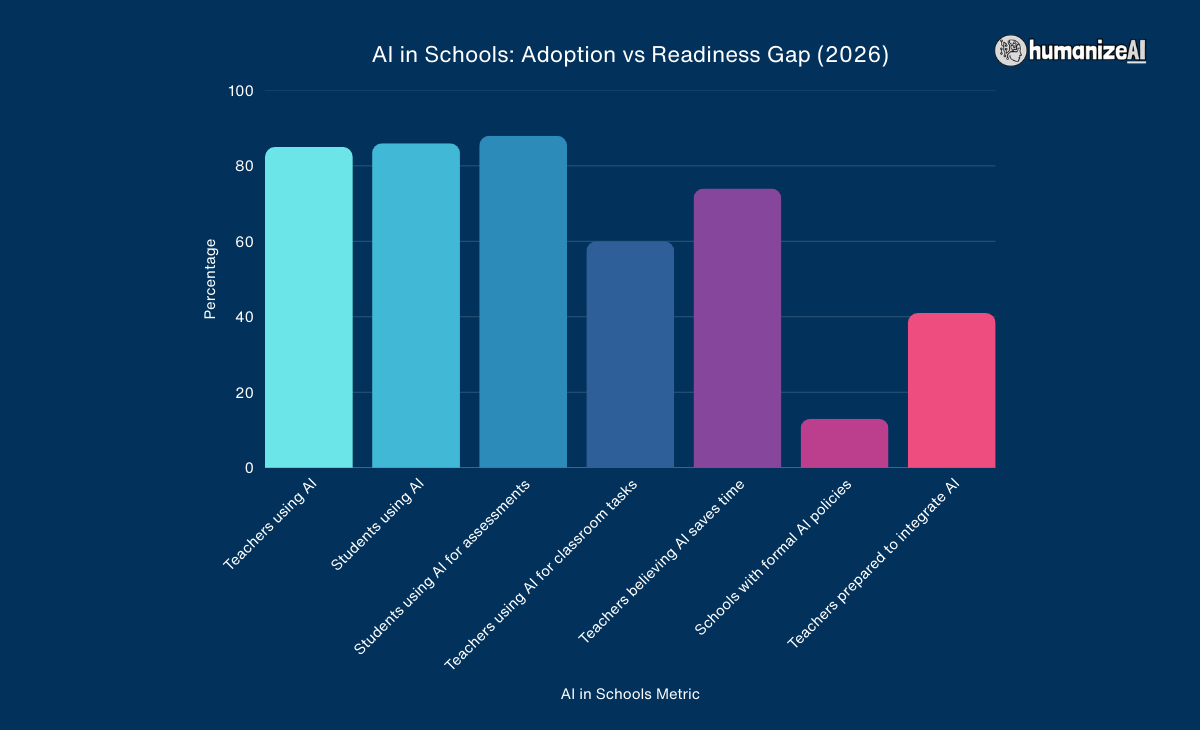
- 85% of teachers and 86% of students depended on AI during the 2024- 25 school year.
- 57% of teenagers have used AI chatbots to either learn something new, get assistance, or help with their assignments.
- 88% of students now use generative AI tools like ChatGPT for assessments.
- Almost 74% of teachers believe AI saves time and allows them to interact with students better.
- 60% of teachers already use AI tools for routine classroom tasks.
- Only 13% of schools currently have formal AI policies.
- 41% of teachers say they are not prepared to embrace AI in the curriculum, highlighting a lack of training.
AI Adoption in Schools: How Many Students and Teachers Are Using AI in 2026
In 2026, AI is no longer a trend or a quick trick, but an integral part of our school life. Now, both our teachers and students are using AI, and not as some blind follower of a trend. But by depending on it for learning and educating, with all the ease of access.
Moreover, it is not some country-specific trend or good-to-know information. It is an actual change that is happening, which you can see in the following numbers:
A report released by CDT – Hand in Hand: Schools’ Embrace of AI Connected to Increased Risks gives a clear insight into this entire scenario, with detailed numbers:
- 85% of teachers and 86% of students reported using AI tools during the 2024–25 school year.
- 40% of teachers and 34% of students reported AI being used in “some” ways at school.
- 29% of teachers and 33% of students report AI being used in “many” ways.
- 80% of teachers who use AI for many school-related reasons agree that AI improves teaching methods and skills.
- 74% of the teachers agree that using AI frees them up and gives them more time to interact with the students.
This completely changes how we perceive AI’s presence in education and draw a few insightful conclusions:
- AI usage has gone beyond tech-forward classrooms and is now becoming a part of our daily education. It is already making room for itself in everyday school routines, from lesson preparation to homework support.
- However, even though the adoption is widespread, the schools are leaning more into its usage, there is one thing. Schools are at different preparedness levels when it comes to AI adoption. Needless to say, we are yet to achieve that perfect balance or a global framework when it comes to AI.
- These numbers directly contradict our fear that AI will replace educators. Instead, the data clearly shows that when used thoughtfully, it reduces workload, develops better student-to-teacher connections, and builds a thriving classroom.
How Students Are Actually Using AI in Schools (Beyond Homework)
We have a tendency to think that AI in school means our students will miss out on some important learning steps. But at this point, our students know better and more efficient ways of how they can use AI to learn, adapt, and retain knowledge better. And, it is not a scattered observation but a detailed report on how AI is used in work. Here’s a quick look:
A report by HEPI has pointed out this exact change in a detailed manner with detailed numbers and through research:
- “The proportion of students using generative AI tools such as ChatGPT for assessments has jumped from 53% last year to 88% this year.” The common usages include:
- AI to explain concepts
- Summarise articles
- And suggest ideas.
- The main reason students use AI is to save time (said by 51% of students), closely followed by improving the quality of their work (50%).
The numbers themselves are pretty telling. Artificial intelligence in school has now evolved into a setup that helps kids learn. We might think of it as a shortcut compared to traditional learning, but it is designed to offer way more than just speed.
Moreover, and most importantly, AI bridges the gap between learning and disability. With AI’s easy access, we are able to include more students in the conversation on a global level. A report by VOA English Learning highlights the case of Makenzie Gilkison (among many others ), who overcame the challenges posed by Dyslexia with the help of AI.
How Teachers Are Integrating AI Into Teaching (Without Losing Control)
Contrary to popular belief, AI is not there to replace teachers. In fact it was never the true goal. If you are still sceptical about AI in education, you have to acknowledge and understand one simple thing: AI brings in good news.
Let us look at the numbers reported by the World Economic Forum and understand this in detail as a concept:
- 71% of teachers agree that “Artificial intelligence (AI) tools are essential for students' success in college and at work.”
- Artificial intelligence (AI) tools are essential for students' success in college and at work.
- It further discusses a report by Forbes that says that 60% of teachers are already using AI in their classrooms to handle routine tasks like
- grading multiple-choice assessments
- tracking student progress and
- generating practice exercises.
In other words, AI is not intended to replace teachers or to make accommodating them inconvenient in the long run. But, it is quite the opposite, actually. It is designed to make things easier for our teachers and act as a helping hand.
More than anything else, it is about understanding that with AI, teachers are active decision makers and not passive users.
The Gap Between AI Access and AI Readiness in Schools
Even though all this progress seems great and we have the numbers to show for it, there is one critical thing. Our adaptation to AI doesn’t necessarily mean our schools are ready as well. Simply put, AI in school doesn’t really mean someone logs into ChatGPT and starts learning.
A research by Science Direct called “Preparing for the AI era” points this out with some eye-opening numbers:
- Only 13 % of schools have formal AI policies despite high teacher interest (87%).
- Only 41 % of teachers internationally report adequate preparation for effective technology integration.
- Among teachers from smaller schools, 3 out of 4 (75%) expressed concerns about their ability to implement AI tools effectively.
These striking numbers point towards a few concerning things, which include:
- AI is being used largely through individual initiative rather than the schools stepping forward.
- Teachers are willing, curious, and experimenting, yet the framework is yet to catch on.
- To be honest, the issue here is not resistance or the unwillingness towards AI but the genuine lack of taking responsibility and structure.
- The concern is more evident in smaller schools where limited access to training, technical support, and funding can widen this gap further.
Conclusion: The Future of AI in Schools: What Growth Looks Like Beyond 2026
The future of AI in school is very clear, especially with the numbers we have seen. It clearly shows that the move is now about “Are we using AI?” to “Are we using it the way we are supposed to?”
Simply put, the importance of AI in school is now a major part of digital literacy. Just like we taught our students about responsible internet usage, it is now time to discuss how to prompt responsibly, verify outputs, identify bias, and use AI ethically.
To be honest, the future of AI is about understanding that AI in school is not about giving something to our students for their amusement. It is not a quick hack or a replacement option. But it is an integral part of the curriculum.
At this point, AI is more of a skill that every student needs to master, but by following a structured guideline. To sum it up, this also means schools will gradually move from restricting AI to formally teaching students how to use it wisely.