
Before AI, launching a SaaS company meant having a dedicated team and quick strategies above all else. Then came the financial pressure and the constant need to watch over every SINGLE detail. Even one candidate's interview follow-up or a weekly email update needed human intervention.
But now you can launch a product, onboard people, send emails, keep up with your meeting commitments, plan your financials, and do much more within one setup. It’s not that our founders have become better planners or that the pressure has eased. We now have AI taking over the conversation.
This is what the data published by Better Cloud says: “Startups that automated operations using SaaS management platforms saw a 40% increase in visibility and manageability”. It has gone beyond simply adding a nice-to-have feature in the tool to taking over the entire launch operation. From development ideas to support, sales, and scale, it is now doing it all.
Read along as we understand this shift in practical terms, discuss relevant data, and see how founders are using AI to spend less and move faster. But in an easy, digestible, and quick-to-quote data points!😎
Where SaaS Founders Are Actually Using AI?
We might think that AI in SaaS is all about adding a shiny feature that makes your life easier. You know that instant fixing of a text, button, or dedicated multi-language assistance, and so on. But in real life, AI goes way beyond just adding features. Here’s a quick look:
Research done by Fortune Business Insights says that SaaS companies are increasingly relying on AI for:
- Business applications such as customer relationship management
- Enterprise resource planning
- Human resource analytics and cybersecurity operations
It further adds that it's not that companies are not building AI from scratch, but using ready-made AI models that are already trained for specific industries or tasks. In turn, making the entire process less technical effort with fewer delays and lower costs.
So what does this actually mean from a user standpoint? Well, simply put, these numbers are a clear indication of how AI is now evolving as a major business function. This is how it has now become a helping hand instead of just being a good-to-have shortcut:
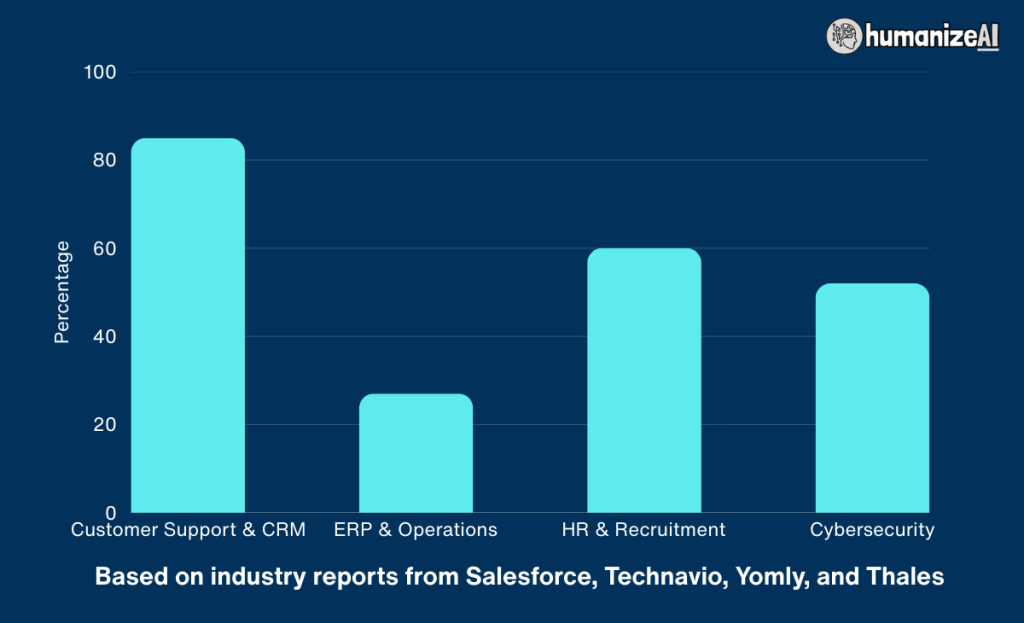
- The Times of India reports that Salesforce CEO Marc Benioff has revealed that artificial intelligence (AI) is now responsible for handling 85% of the company's customer interactions. Therefore, saving time with automation and quick resolution. However, he also asserts that AI is not the ultimate option and nothing can replace human compassion.
- AI has now started to shape and support the backbone of the company. As it efficiently takes up finance, billing, procurement, inventory, and overall business planning in one integrated setup.
- This is exactly what the research by Technavio highlights.It shows that AI-powered, cloud-based ERP tools are growing at around 27% every year. This clearly indicates that SaaS companies now rely on smart systems to manage and optimize their operations. And this is not a short-term trend.
In simple terms, it means:
🟪Most companies are not installing ERP software on their own servers anymore.
🟫Instead, they are using cloud-based SaaS ERP tools that already have AI built into them.
🟧Now companies prefer these because they are easier to set up, cheaper to maintain, and obviously quicker to scale.
- A report by Yomly suggested that by 2025, 60% of organizations will use AI for end-to-end recruitment, from sourcing to onboarding.
In other words, the SaaS space is relying on and efficiently using the accuracy of AI and its insights to screen, hire, and interview candidates, all the while saving time and money. Along with that making significant changes and optimizing operations accordingly.
- When it comes to security, AI is reshaping how SaaS companies protect their platforms and their customers with utmost sincerity. Since it is a non-negotiable, considering the vulnerability of a SaaS platform, founders are now all the more dependent on AI to take care of any loopholes.
This is exactly what data published by Thales points out. It says that “ Over half (52%) of respondents ( of their research sample) said they are prioritizing AI security investments over other security needs.
Why These AI for SaaS Statistics Matter
To begin with, we have to understand one simple thing: SaaS is no longer about selling an AI-powered product. But it has now become a network or a space that utilizes AI to enhance basic company operations.
So, if you wish to thrive in the SaaS space as a founder or marketer, or simply know the present situation, you need to acknowledge the numbers. It is the only way you will be able to assess how deeply Artificial Intelligence is now intertwined with SaaS.
Let us consider another perspective. A data published by Zion Market Research says that the SaaS market size is expected grow to $2973.14 billion by 2034 with a CAGR of 38.40% between 2025 and 2034. Now this kind of growth doesn’t only happen due to overnight effort or an “optimized” team.
It happens when businesses have access and can compare:
- Measurable returns
- Operational improvement and
- Long-term scalability.
In other words, AI-powered SaaS is no longer a niche category but has now become the default version. It promises growth, potential, and a new way to measure actionable insights.
AI Is No Longer an Experiment But A Priority
There was a time when founders used to consider investing in AI as an experiment or maybe a new thrill to pursue. Since we weren’t fully aware of the many possibilities of an automated and integrated setup.
However, things have now changed. Every business decision now evolves around investing more in AI in order to have better financial control. And this is not some assumption, but now a well aligned practice.
This is evident in a Deloitte technology survey that shows that 57% of companies now allocate between 21% and 50% of their digital transformation budgets to AI initiatives. Moreover, nearly 40% are actively investing in agent-based AI systems.
Now, for SaaS founders, this is a clear example of a change in mindset. We are no longer relying on our gut or instinct with AI or waiting for things to be played out on thier own.
Investing in AI now clearly means:
✔️AI helps SaaS founders clearly see where money is being spent, what is working, and what is not.
✔️AI is no longer an optional tool. It now works quietly in the background, supporting daily operations, automation, and scaling.
How AI Is Helping SaaS Launch Faster These Days
Has AI only made managing our project easy, or only helped with writing, or has it now become something bigger? When it comes to SaaS, AI has now completely reshaped the way SaaS functions.
While discussing the security and durability of relying on AI for coding, DevOps reports that by 2030, “95% of code is expected to be AI-generated” based on a report by Black Duck’s survey. Now, a significant change like this means:
SaaS products can be built and launched much faster than before:
Since developers are not writing the code from scratch, it speeds up development, reduces delays, and helps SaaS teams move faster.
Smaller teams can now build what earlier required large teams:
As AI takes over the tiresome yet critical tasks like coding, testing, and setting up, small budget companies can do more with a limited team.
Faster iterations lead to quicker feedback:
Since AI speeds up coding and other developer workflows, SaaS teams can release updates more frequently. In other words, you get the bugs fixed faster, features are improved quickly, and there is a better adaptation of the products
AI brings in a better competitive edge:
When AI handles a major part of development work, everyone specially the founders, can focus more on planning a better strategy. They can actually think about making the user experience better and not push it for later. Moreover, it gives them the space to test ideas and assess the risks, a non-negotiable in today’s time.
The Future of AI in SaaS: What Founders Should Expect Next
At this point, it is safe to say that AI is not only an integral part of SaaS but more like it will also define it. The future of SaaS is all about knowing, assessing, and understanding how AI will take up a major space in this conversation.
- Gartner predicts that more than 80% of SaaS applications are expected to have AI-driven capabilities built directly into their core workflows. Not as some ads ons, or a part of the premium plan.
- Another report by Emburse says that by 2028, over 70% of new SaaS product launches will be AI-first. Meaning, AI will be an active participant in the product development stage itself. It will not be something that is added later, but a major driving factor around automation, prediction, and intelligence.
In simpler terms, it means that:
Founders will start depending on AI from the very beginning. It will be used to shape how products are designed, automated, and improved over time. In other words, it will no longer be regarded as a shortcut or an automation technique.
Secondly, with every product, AI will be integrated into how they work, not added later as an extra feature or upgrade.
Conclusion: AI Has Become the Foundation of Modern SaaS
At this point, AI can be regarded as the very foundation of modern SaaS and how it carries on its entire workflow. As we have seen, the data says that AI is no longer limited to improving features or speeding up small tasks.
But, it has evolved into something bigger, critical, and more insight-oriented. It now drives how SaaS products are developed, how teams operate, how costs are controlled, and how businesses scale. From ERP and HR analytics to cybersecurity, coding, and customer support: AI is now designed to do it all.
From a SaaS founder’s perspective, this shift changes the rules of the game. Success no longer depends only on having a strong idea or a skilled team. But it means understanding, accepting, and implementing how well AI is integrated into everyday workflows and long-term strategy.
The future is not about who uses AI but how they use it and how efficiently they adapt to the fact that AI is now building SaaS from within.