
An article posted by Brookings raises one of the fundamental questions of our times: Can journalism survive AI? It begins by highlighting how, in the US alone, 2,700 jobs were slashed in a single year.
The thing is, a number like this can send anyone into a frenzy. It makes people wonder if the era of great journalism is now coming to an end with AI. More than anything else, this often leads to panic, speculations, and a feeling of impending doom.
This is exactly what we are deep diving into in full detail today. Read along as we understand the impact of AI on journalism, with detailed numbers and context. As we decode the impact of newsroom automation and the extent to which we can blame AI for all this. 🤐
Key Takeaways:
- 3,434 journalism jobs were cut across the U.S. and U.K. in 2025 alone.
- Google search traffic to publishers has dropped by 38% in the U.S.
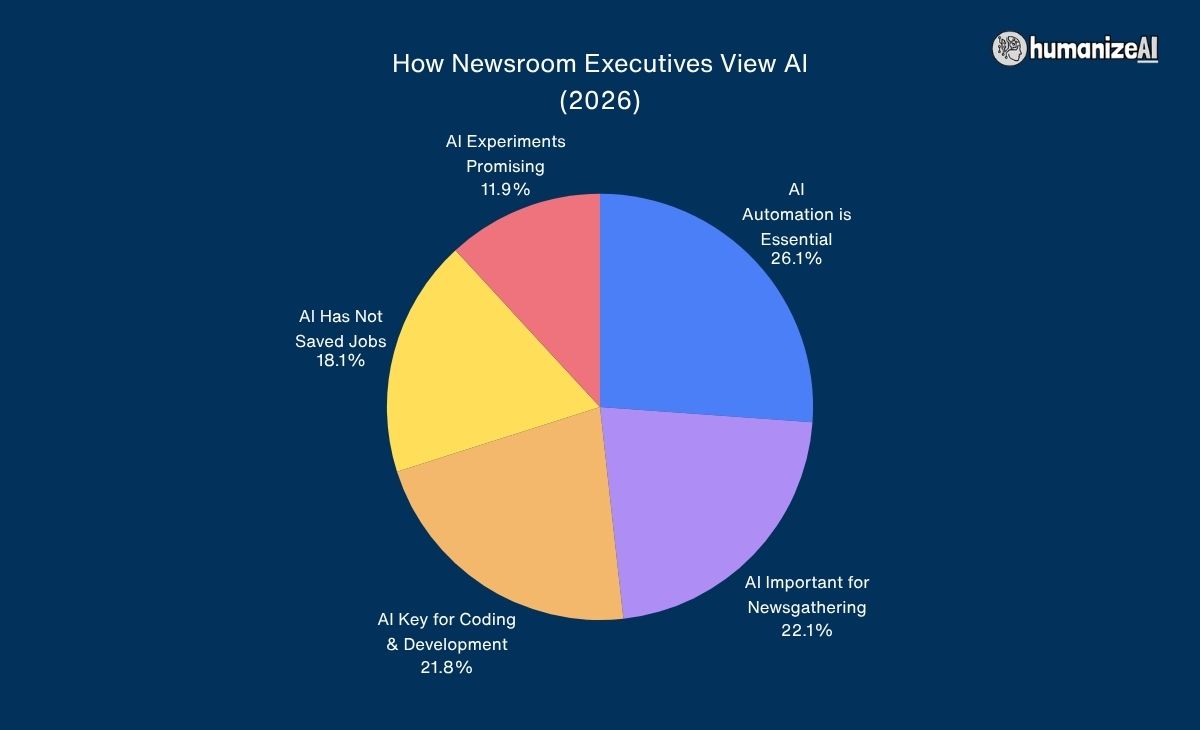
- 97% of newsroom executives say AI automation is now essential to how they operate.
- Yet 67% of those same executives say AI efficiencies have not saved a single job so far
- Journalist and reporter job postings declined 22% in 2025.
- 92% of ProPublica union members voted to strike, partly over job security at the time of AI.
- 58 newsroom union contracts now include AI-related clauses.
- 41% of companies worldwide expect AI to reduce their staffing levels in the next five years.
- 76% of publishers now want their journalists to behave more like creators.
- Yet, The New York Times added 310,000 digital subscribers in Q1 2026, and that is proof that great journalism still sells.
What’s Really Happening to Journalism Jobs in the AI Era?
In recent times, whenever we see a massive job cut, we tend to blame it on AI. Part of it has always been true. However, if we need to understand the full impact of AI on journalism jobs in 2026, we need more. We need to understand what exactly is happening in the job market and then make a conclusive decision. Here’s a quick look:
Journalism Job Losses Started Before AI, But 2026 Is Accelerating the Crisis
- U.S. newspaper jobs have seen two-thirds of the jobs being cut.
- The Washington Post had proposed cutting nearly one-third of its workforce.
- In 2025 alone, there were 3,434 journalism job cuts across the U.S. and U.K.
- In 2024, the journalism industry saw at least 3,875 layoffs.
- The Atlanta Journal-Constitution announced job cuts affecting 15% of its employees.
- Politico reduced its staff by 3% at the beginning of 2026.
- One major media merger reportedly removed around 10,000 jobs, which was nearly 8% of the combined workforce.
- More than 500 journalism jobs disappeared within just the first three months of 2026.
- Entertainment and media layoffs increased by 18% in 2025, with more than 17,000 jobs cut across television, film, broadcast, news, and streaming industries.
- Since 2018, average yearly job cuts in the media industry have reached 14,298, compared to 7,305 per year between 2010 and 2017.
Source: The Media Copilot
AI Is Reshaping Newsrooms, But It Has Not Fully Replaced Journalists
- 97% of newsroom executives feel back-end AI automation is now important.
- 82% of respondents said AI is now important for newsgathering.
- 81% said AI is playing a growing role in coding and product development.
- 44% of news executives described newsroom AI experiments as “promising.”
- 42% said the results of newsroom AI experiments have been “limited.”
- Two-thirds (67%) of executives said AI efficiencies have not saved jobs so far.
- Only 16% reported slightly reducing staff due to AI efficiencies.
- Meanwhile, 9% said AI adoption actually created new roles and additional costs.
Source: Nieman Lab
Publishers Are Now More Worried About AI Disrupting Traffic Than Replacing Writers
- Google search traffic to publishers has declined by 33% globally.
- In the United States, Google search traffic has fallen by 38%.
- Google Discover traffic has dropped 21% globally.
- More than 75% of news executives expect AI browsers and agentic apps to have a “large” or “very large” impact on their publishers.
- 70% of newsroom executives said creators are taking away audience attention from publishers.
- 39% worry they could lose top editorial talent to the creator economy.
The most interesting aspect in all this is the fact that 76% of publishers now want journalists to behave more like creators.
Source: Nieman Lab
Journalists Are Now Demanding AI Protections at Work
- Around 150 ProPublica journalists participated in a 24-hour strike tied partly to AI job protection demands.
- The strike authorization vote passed with 92% support from union members.
- Another thing that defines this entire dilemma well is that at least 58 newsroom union contracts now contain AI-related provisions.
- A World Economic Forum survey found that 41% of companies worldwide expect AI to reduce staffing levels over the next five years.
Source: Metaintro
It is evident from these numbers that AI is not the only disruption for the journalism job market. However, as AI digs its claws deeper, it only exposes a setup that was already hanging by a thread. Scraping from the bottom for attention, surviving in the era of instant internet, and so on. However, with AI, it is now a blend of automation, layoffs, traffic decline, and creator culture overriding the others.
So, What Is AI Actually Doing Inside Newsrooms Day-to-Day?
If we need to know if AI is actually capable enough to influence and impact the journalism jobs in 2026, we need clarity. We need to break down and understand what exactly AI brings to the table. Let us understand this with data points from some of the biggest media houses of our time.
AI Is Automating Repetitive Newsroom Work, Not Replacing Journalism Entirely ( For Now)
- Reuters Institute’s 2026 forecast identified “automation and agents reshaping newsrooms” as one of the defining trends of modern journalism.
- It also found that 97% of newsroom professionals now believe automation has become an important part of how modern newsrooms can or should operate.
- According to the IBM report, AI is already being used for:
- Organizing and tagging content
- Suggesting headlines and SEO titles
- Editing and proofreading copy
- Managing comment sections
- Sorting newsroom research
- Creating metadata
- Now the same report highlights how Associate Press is currently using AI for a better systematic approach:
- Translating weather warnings into different languages
- Transcribing videos and interviews into text transcripts
- Sorting through newsroom email pitches, automatically
- Identifying important keywords from meeting transcripts
Now AI has cemented its presence in brands that have previously changed the legacy of journalism forever. ESPN now uses AI to identify video highlights and automatically generate sports recaps at scale.
AI Is Becoming a Research Assistant for Journalists
Reuters Institute predicts that AI will “further empower data journalists” in 2026.
- The New York Times built an AI-powered investigative tool called Cheatsheet that can scan large datasets using preset workflows for:
- Pull out important quotes
- Summarize large amounts of information
- Translate content
- Organize and classify data
- Detect hidden patterns and connections within datasets
- AI has reached a point where it is now even being used in investigative journalism. One NYT investigation used AI to analyze a list of 10,000 people registered under a Puerto Rico tax break program.
- The same report highlights how, by early 2026, approximately 300 newsroom users had already tested Cheatsheet internally.
- Bloomberg developed its own large language model trained on financial documents and Bloomberg Terminal data to improve:
- Understanding whether financial news has a positive or negative tone
- Organizing financial information into categories
- Identifying important names like companies, people, and organizations from reports and datasets
- Reuters has also found that AI-generated highlights and summaries help reporters search archived videos faster.
Publishers Are Now Building News for AI-Driven Audiences
This is where things start becoming genuinely concerning or disruptive when it comes to the impact of AI in journalism.
The Reuters Institute’s 2026 report repeatedly suggests that publishers are no longer just adding AI to journalism. They are now trying to do it the other way. They are redefining journalism to fit the AI way.
- Ezra Eeman, Strategy and Innovation Director at NPO, described this shift as moving from:
“AI in Media” to “Media in AI.”
- Reuters Institute experts repeatedly warned that audiences are increasingly consuming information through:
- AI chatbots
- answer engines
- AI-powered browsers
- Conversational search interfaces are making it the trusted source for news instead of the traditional channels.
- Olle Zachrison from BBC News noted that tools like:
- Google AI Mode
- ChatGPT Atlas
- Microsoft Copilot is already reshaping how people consume news online, and the news dynamic that we know today is now changing.
- This is exactly where the warning from the Reuters Institute starts making sense as it warns the publishers of the changing dynamic.
Needless To Say, AI Is Also Reshaping How Readers Consume News
- BBC spent nearly 18 months testing AI tools before publicly rolling them out in 2025.
- Its “At a Glance” feature now generates AI-powered bullet-point summaries for long news stories.
- The BBC created a tool called “Style Assist” that automatically rewrites local newsroom reports into the BBC’s writing style before editors actually review them.
- The Washington Post partnered with ElevenLabs to turn written newsletters into AI-generated audio files.
- The Financial Times has been testing AI chatbots that answer reader questions about news stories and current events.
- One Swedish newspaper found that AI-generated summaries made readers spend more time on articles.
These numbers, trends, and changing patterns point out something concerning. AI is slowly and gradually taking charge of how we see news publications as a whole. Even though it might seem like a quick, easy, and accessible solution. There are always concerns about accuracy, bias, and so much more.
But Human Journalists Still Sit at the Center of the Process
Despite all the automation, almost every newsroom experimenting with AI keeps repeating the same thing: human oversight will always be the ultimate ingredient.
- Reuters Institute identified verification and fact-checking as one of the biggest priorities for journalism in 2026.
As Joshua Ogawa from Nikkei pointed out. At this point, deepfakes and AI-generated visuals are making it harder than ever to verify what is real online.
- Shuwei Fang from Harvard Kennedy School said audiences may soon expect systems that can instantly answer one important question: “Is this real?
- The New York Times has clearly stated that it does not use AI to write articles. Instead, it uses AI for:
- Summaries
- Metadata
- Recommendations and
- Translation support
- Reuters also noted that the biggest challenge with AI is that it still struggles with breaking news because facts keep changing in real time.
Moreover, it is necessary to acknowledge that almost every news platform acknowledges the importance of real-time journalists. They are the ones responsible for:
- Verifying information
- Adding context to stories
- Adding deeper context to stories
- Interviewing people and sources
- Building trusted connections with sources
- Making final editorial decisions
- Maintaining trust, accuracy, and accountability
Sources
- AI in Journalism [8 Case Studies] [2026]
- Journalism, media, and technology trends and predictions 2026: Reuters
- How is AI being used in journalism?: IBM
- AP leading with AI
The Real Question Isn't Whether AI Will Change Journalism. It Already Has.
As we scan through the numbers, there is one thing we must understand. We are now way past the phase of wondering if AI can impact journalism jobs. It already is a part of the conversation and is making changes as we speak.
But there is one thing we must remember. When we read something like "2,700 journalism jobs cut in a single year,” we don’t need to automatically assume the worst. AI just broke the version of journalism that was already broken and chases only views rather than the truth.
Great journalism has always been about the things that don't scale. It is about helping the masses stay informed, aware, and trusting human insight above everything else.
Journalism is about writing a story that takes eighteen months to investigate and leads through four different countries. The interview where the real meaning lies in the tension, the silence, and so on.
It is true that AI can generate an earnings report in seconds. But it cannot replicate the true essence of journalism, and this is where the future lies. Letting go of the kind of journalism that treats news as a content factory. And to be honest, journalists who understand that are not worried about AI. They are the ones building with it.