
Did you ever imagine that a machine could do your next diagnosis? Or there’s a robotic voice checking up on you after your surgery? What seemed like a grand plot for a science fiction movie is now our reality.
But there’s a dystopian twist to all this. If Amazon’s health chatbot is using AI, and so is our doctor during pre or post surgery, shouldn’t we be worried? How does one know if this is not another disaster waiting to happen?
Read along as we discuss this in detail with relevant data all around the world. We will understand AI in healthcare in 2026, how big the AI medical assistants are, and what does the trust dynamic look like. 😥
Key Takeaways:
- AI in healthcare is growing at a 38.90% CAGR, expanding from $36.67B (2025) to $505.59B (2033)
- North America held 54%+ market share, while software accounted for 46%+ of total revenue
- Machine Learning dominates the tech stack with 35% share, showing AI healthcare is not GenAI-led yet
- 79% of healthcare organizations already use AI, achieving ROI in 14 months with a $3.20 return per $1 invested
- Pharma & biotech lead adoption with 30%+ market share, driven by faster drug discovery timelines
- AI medical assistants are scaling rapidly at a 36.6% CAGR, growing from $1.86B (2025) to $8.85B (2030)
- 81% of doctors use AI.
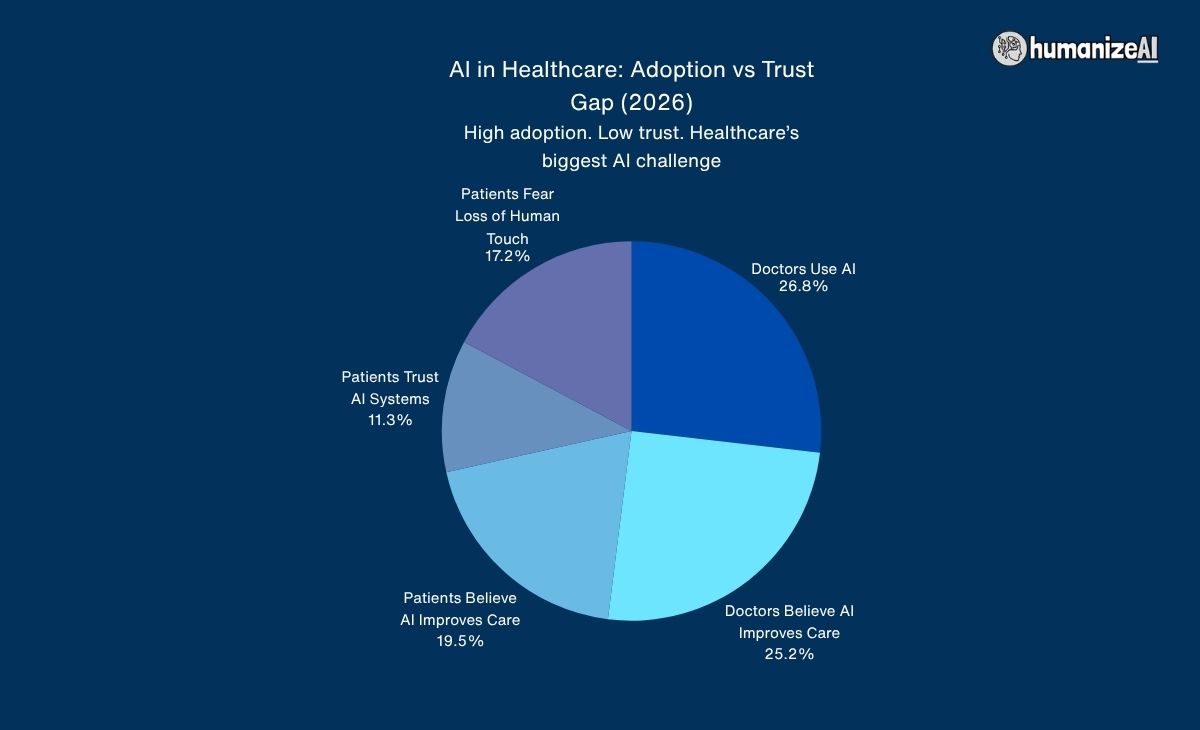
- 76% of doctors believe AI improves care, but only 59% of patients agree, highlighting the clear gap
- 66% of patients have low trust, and only 58% believe AI tools are safe, regardless of AI knowledge.
- 52% of patients fear losing the human touch, reinforcing emotional resistance to AI adoption
AI in Healthcare: A $36.67 Billion Market in 2026 That's Just Getting Started
As you wonder if trusting AI is even the right decision when it comes to healthcare, you will realize one thing. The market is already way past the testing phase. It is now growing into a sustainable business setup that is bringing in the numbers. Here’s a quick breakdown of the same from a report published by Grand View Research:
👉The global AI in healthcare market is expected to grow from $36.67 billion in 2025 to $505.59 billion by 2033, at a CAGR of 38.90%.
Market Growth Snapshot
- 2025 Market Size: $36.67 billion
- 2033 Projected Size: $505.59 billion
- CAGR (2026–2033): 38.90%
If we put things into perspective, this is a 13.8x market expansion in under a decade. Here are a few other significant details the report sheds light on:
- North America held over 54% market share in 2025.
- Software solutions accounted for 46%+of total revenue.
- Robot-assisted surgery led applications with 13%+ share.
- Pharma & biotech companies dominated with 30%+ adoption.
✅But there is one thing that is different when it comes to AI in a healthcare setup. The thing is, Machine Learning holds 35% share in the AI healthcare tech lineup. As in, AI healthcare today is Machine Learning dominant, not GenAI-dominant (yet).
✅ Secondly, it is not hardware-driven. The software demand accounts for over 46%.
As per the report, there is another notable trend:
- As per a March 2024 Microsoft–IDC study, 79% of healthcare organizations are already using AI, with a fulfilled ROI in just 14 months, generating $3.20 for every $1 invested.
- Most importantly, AI is reducing drug discovery timelines from 5–6 years to as little as 1 year. This is exactly why pharma and biotech lead the market with 30%+ share.
The Rise of AI Medical Assistants: From Chatbots to Surgical Co-Pilots
Up until now, we were looking at the numbers and assessing the progress. But this is the section where things actually get interesting. AI in healthcare has evolved and not in just market size. We no longer have a two-way simple chat setup but our systems are now run by fully automated AI Medical asistants. Let us undertand this with a report from MarketandMarket.
- The market was valued at $1.32 billionin 2024, grew to$1.86 billion in 2025, and is projected to reach $8.85 billion by 2030 at a CAGR of 36.6%
- This is a nearly 6.7x jump in six years.
Now, another dedicated report by Precedence Research elaborates on this and helps us understand it better. Here’s a quick look:
Projected Market Size (2035): $11.69 billion
CAGR (2026–2035): 19.80%
But what gives it a clear perspective is how it highlights the growth drivers:
- Demand for 24/7 healthcare support
- Rise of remote patient consultations
- Need to reduce the administrative burden on clinicians
Now it further elaborates on some major key achievements, which include:
- Rapid integration of AI into electronic health records (EHR) and medical records (EMR)
- Enables seamless access to patient data
- Improves care, coordination with teams, and documentation, and real-time decision-making
Along with that, it further talks about the rise in multimodal interfaces, which include:
- The growing dependency on text, voice, video, and image-based interactions.
- Creating a more reliable and accessible system for both the patients and doctors.
Most importantly, the report addresses something of more crucial importance. It highlights how AI in healthcare is not just one tool that may or may not be handy. But it has now become a part of the system that helps patients on a daily basis. Moreover, it is building a pathway or channel to ensure the daily conversation and interaction with patients is more human, natural, and reassuring.
So, if we have to sum up these two elaborate reports, we can see how evolved our present medical interactions are. These high-end AI Medical assistants are not just scheduling appointments, but:
- Checking your symptoms even before the doctors step in.
- Writing clinical notes while the doctor is focused only on taking care of you.
- Checking in on patients after surgery, from their own homes
- Keeping chronic disease patients on track with medications
- Most importantly, offering mental health support
If you look around, we are actually living in a space that is automating medical care. In January 2026, Amazon launched an AI health chatbot for One Medical members using patient records for guidance, scheduling, and prescriptions, and by March 2026, expanded it to Prime.
In the same month, OpenAI acquired Torch to integrate “unified medical memory” into ChatGPT Health, aggregating labs, medications, and visit data.
Earlier, in October 2025, Heidi Health raised $65M in Series A to scale its AI medical scribe globally, automating clinical documentation using large language models.
At this point, we have gone beyond experimenting and seeing real time implication of how the entire AI medical assistant environment works. But there is one little problem.
Despite all of this, only 19% of medical group practices currently use AI chatbots or virtual assistants for patient communication. That means over 80% of establishments have not even thought about all this. In short, the market is not saturated; it is waiting for its momentum. (Source: MGMA Report)
81% of Doctors Now Use AI. So, Why Are Patients Still Cautious?
The AMA survey highlights how 81% of physicians use AI professionally (conducted across 1,692 physicians in January–February 2026). At this point, it means the number of AI use cases per physician rose from 1.1 to 2.3 from 2023 to 2026.
They are using it for:
- Summarizing medical research & standards of care: 39%
- Creating discharge instructions, care plans, or progress notes: 30%
- Documenting billing codes, medical charts, or visit notes: 28%
- Generating chart summaries: 28%
- Assistive diagnosis: 17%
The interesting thing in all this is that physician confidence is rising alongside AI adoption.
- 76% of doctors now believe AI improves patient care (up from 65% in 2023).
However, things are not this hopeful and praiseworthy when we flip the coin. The patient's side of the story is gloomy, sceptical, and filled with second thoughts. Research published by the National Library of Medicine helps us understand this better with three significant key points:
🚨66% of U.S. adults report low trust in their healthcare system to use AI responsibly
🚨Only 58% believe AI tools would not harm them
🚨AI knowledge and health literacy have no significant impact on trust levels. As people can be well aware of AI and still be sceptical about the whole process. They would rather put their trust in the existing system.
The Philips Future Health Index 2025, the largest global study of its kind (covering over 16,000 patients and 1,900 healthcare professionals across 16 countries), highlighted this divide further:
- 79% of healthcare professionals are optimistic that AI can improve patient outcomes
- But only 59% of patients share that optimism.
- 52%of patients worry about losing the human touch in their care
So, what exactly are patients worried about? And if so, is there a way to navigate around this divide? Another groundbreaking study by the JAMA Network, as featured in the National Library of Medicine, helps with a perspective.
Surveying 3,000 U.S. adults, the report identified the key trust drivers:
- The patients need an FDA approval of the AI tool
- Presence of a clinician alongside the AI
- National certification of the AI system
- Use of representative, unbiased data
- The AI needs to have credible performance reports.
Therefore, the answer to the question is simple and yet complicated. The trust or mistrust in AI is not only about AI. It is about how we use control or implement it. In other words, it is about governance and, most importantly, credibility. No one is against technology; they just demand a bit of accountability.
Conclusion: AI in Healthcare 2026: The Infrastructure Without Trust
A report published by STAT News highlights one simple and obvious thing. The overexcitement for AI is leading to mistrust in the U.S. healthcare system. Even though the organizations spent $1.4 billion on AI tools in 2025.
So even though we have the numbers that hype us from an infrastructure point of view, there is a looming instability. The $3.20 return per dollar invested sounds great, but only if everyone is on board with it.
We are yet to figure out how to achieve a middle ground and help patients lean into a more AI-oriented setup. Secondly, there is another tension. AMA has repeatedly asserted one thing: physicians are not worried about doctors using AI. They are worried about patients using AI to interpret complex medical results.
So, as we dream and project grand numbers like reaching a $505 billion market by 2033, there is always a concern. The inevitable and apparent tension of how to bridge this trust gap. Because the market cannot thrive on its own, it needs people’s trust as its biggest investment.