
When was the last time you had directly connected with a human while talking to customer service? Let me guess, you don’t remember. It is always a chat agent or a voice agent taking over the conversation beforehand.
This is when you know that AI has been widely adopted for customer service on a global level. In Infact, a report published by MarketsandMarkets predicts it will reach $47.82 billion by 2030, growing at a compound annual growth rate of 25.8%.
Read along as we dive into the details and understand the statistics of AI in Customer Service in 2026. We will look at adoption, ROI, chatbot trends, and provide a comprehensive guide with all the numbers! Hang tight. 🤭
💡Key Takeaways from this Article
- 59% of consumers expect generative AI to change how they interact with businesses in the next two years.
- 75% of users who have tried generative AI believe it will significantly impact their customer service experience soon.
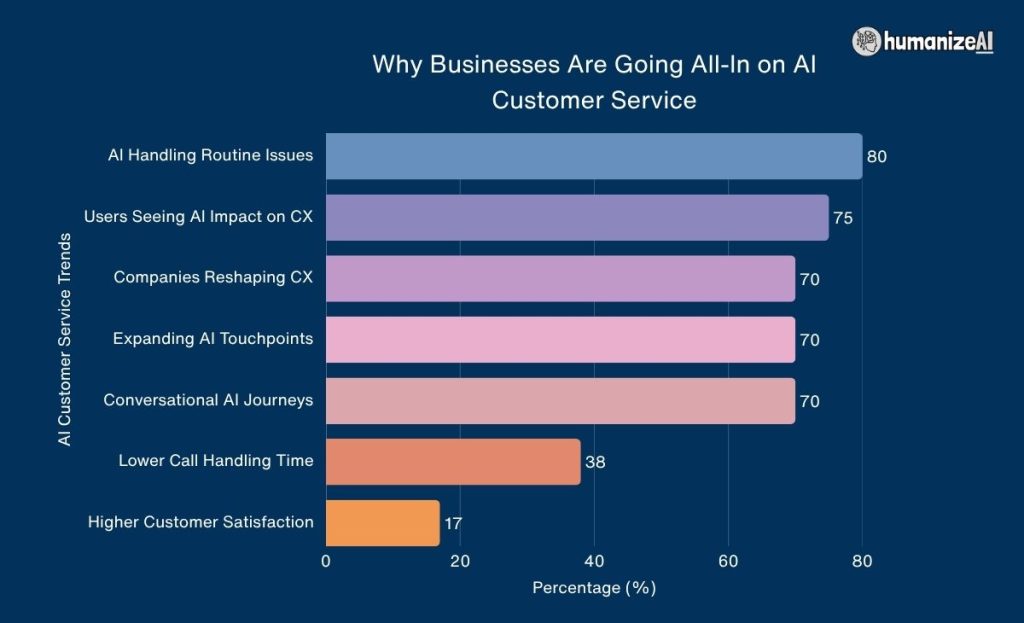
- 70% of businesses say they are already reshaping their business with the influence of AI.
- 57% of customer service leaders expect chat-based support to be heavily guided by AI in the near future.
- 62% of heads feel internal pressure to adopt generative AI, highlighting the urgency of competition.
- 70% of companies plan to integrate AI across multiple customer touchpoints within two years.
- 80% of routine customer service issues could be handled autonomously by AI by 2029.
- By 2028, 70% of customers are expected to start their service journey through a conversational AI interface.
The Widespread Use of AI in Customer Service
Even before AI took over our daily lives, it had a massive influence on customer service and changed its trajectory one day at a time. But now it is growing more than ever. Zendesk reports that leaders in customer service mainly adopt AI to automate service, assist agents, and optimize workflows. It further highlights how it will only grow more significant and points out:
- Nearly 6 in 10 consumers (59%) expect generative AI to reshape how they interact with businesses within the next two years.
- Among people who have already used generative AI, three out of four (75%) believe it will soon play a major role in shaping their customer service experiences.
- More than half of CX leaders (56%) are actively looking into new generative AI vendors to upgrade their customer experience tools.
- A significant 70% of CX leaders say generative AI has already pushed their organizations to rethink how they design and deliver customer experiences.
- Over half (57%) of CX leaders expect chat-based support to be strongly influenced by generative AI within the next two years.
- The report also further highlights 62% of CX leaders feel growing pressure within their teams to adopt generative AI technologies.
- Around 70% of CX leaders plan to roll out generative AI across multiple customer touchpoints over the next two years.
Most importantly, the report also highlights how 56% users think that AI helps them to better understand a product. Secondly, 51% of them are comfortable interacting with an AI agent for an immediate response during an emergency.
How Exactly Is AI Being Used In Customer Service?
Many of us live under the impression that using AI for customer service means having an automated voice pick up a call. But things are not this straightforward, and AI has evolved to do way more than we think.
Gartner reports that by 2029, agentic AI is expected to independently handle up to 80% of routine customer service issues, without requiring human support. This means not only a reduction in costs but also overall effort and investment as well.
In another report, it further elaborates how “by 2028, at least 70% of customers will use a conversational AI interface to start their customer service journey.”
A report by MarketandMarket elaborates on this further and highlights a few key points:
- The thing is, right now, AI Agents are the fastest-growing product category. Especially where AI assists human agents in real time is projected to grow the most. This assures that the winning strategy in 2026 is humans and AI working together, not AI working alone.
- This growth is mainly driven by increasing demand for automation, faster response times, and a need for 24/7 customer support. This is why businesses are now slowly moving past the traditional model and building a new automated workflow.
- But more than anything else, the biggest shift that’s happening is how big businesses are dealing with the customer’s problem in the first place. They are no longer reacting but are taking ample measures to prevent it from even happening. This is why they are relying more on Generative AI, multilingual assistants, sentiment analysis, and smart ticket routing, etc.
AI Adoption in Customer Service (How Fast Is It Growing?)
The numbers so far tell a very impactful story. At this point, more companies and brands are moving towards an AI-enabled customer service setup. And why not? AI in customer service is all about instant results, scalability, and less investment that guarantees long-term results. To add on to this, Salesforce reports, “AI can manage large volumes of customer requests without requiring additional resources.”
In other words, AI saves money, gives instant resolutions, and is scalable. Moreover, it is always data-oriented and, as the report further says, “Can handle repetitive enquiries, allowing your customer service reps to focus on higher-value tasks like cross-selling.” Therefore, businesses all over are gladly accepting this new upgrade, and it is evident with the numbers detailed by Grandview Research:
- The global market was valued at USD 13,012.4 million in 2024.
- It is projected to reach USD 83,854.9 million by 2033, reflecting substantial growth over the decade.
- The market is expected to expand at a compound annual growth rate (CAGR) of 23.2% between 2025 and 2033.
- North America held the largest market share in 2024, leading overall adoption.
- Meanwhile, the Asia-Pacific region is anticipated to be the fastest-growing market during the forecast period.
It further highlights a detailed analysis that says:
- Machine Learning & Deep Learning are the most widely used technologies in AI customer service and will continue to lead in the coming years.
- Also, Natural Language Processing (NLP) is also growing steadily, as it powers chatbots and helps AI understand and respond to human conversations.
It further states that the BFSI sector holds the largest share of AI in the customer service market in 2024. Now, here is a quick look at the overall estimate for other industries as presented in the report:
| Industry | Approximate Share % ( Of AI in Customer Service) |
| BFSI | 20–22% |
| Retail & E-commerce | 17–19% |
| IT & Telecommunications | 14–16% |
| Healthcare | 11–13% |
| Media & Entertainment | 9–11% |
| Travel & Hospitality | 7–9% |
| Government | 6–8% |
| Utilities | 4–6% |
| Other | 5–7% |
Note: Percentages are approximate ranges derived from the facts presented in the Grandview Research report cited above.
It further helps us with another key insight. As per the report published collectively, these organizations hold a major portion of the market and help define how the industry evolves:
- Ada
- Amazon Web Services, Inc.
- Freshworks Inc.
- Google LLC
- IBM Corporation
- Microsoft
- Mistral AI
- Salesforce, Inc.
- ServiceNow
- Zendesk
Now it’s time to ask an important question: Is implementing AI in customer service a wise move? Are the companies actually getting what they wanted? Let us find out.
AI in Customer Service ROI Statistics
Harvard Business Review reports that without AI in customer service, you have to be prepared for some major setbacks. Especially when the world is moving to a more automated approach. It argues that without the help of AI, customer service can look like:
- You cannot give your customers the experience they deserve simply because you are restricted by team size, especially when growth requires continuous hiring, onboarding, and training of new agents.
- Without integrating AI into customer service, companies are already falling behind. As their competitors move faster based on a more efficient, quick and more reliable yet affordable support system.
It further highlights that the ROI when it comes to Customer Service is not just about cost reduction. It is about increased bandwidth, efficiency, scalability, and so on. Here’s a quick look through the lens of various reports:
- AI-dominated customer service setups have a 17% higher customer satisfaction percentage. (IBM)
- A dedicated AI setup accounts for 38% lower average inbound call handling time. (IBM)
- A major UK retail and commercial bank implemented an AI system that understands natural language queries and responds in chat. It resulted in 150% increase in satisfaction for the users.
- The AI-powered experience can increase customer satisfaction by 15 to 20%, boost revenue by 5 to 8 %, and reduce the cost to serve by 20 to 30%. ( McKinsey and Company).
Up until this point, all this looks great, and we feel like we are making great progress with AI. But then comes the concern and questions. Is it okay to trust AI to deal with a frustrated customer? Especially when it comes to healthcare and financial concerns. Let us understand.
Do Customers Trust AI? Ethical Concerns in AI-Powered Customer Service
As businesses look for easier and more convenient solutions with AI to improve their overall customer interaction, there lies a bigger challenge. Not many people prefer interacting with a robot, especially when there is an urgency. Let us understand this through a detailed study by SurveyMonkey.
- 79% of Americans will prefer talking to an actual human instead of an agent.
- 61% of people feel human agents better understand their needs.
- The report further highlights how “ Additional insights from Kinsta also revealed that 84% of consumers believe human agents are more accurate than AI.”
- Along with that, we have more than two-thirds of consumers who are uncomfortable using AI for critical areas, such as medical advice (69%) and investment decisions (68%).
- The same research indicates that people are far more open to using AI for simpler tasks, such as ordering food and drinks (65%), handling returns (59%).
The report further highlights some critical numbers that strongly highlight that not everyone is comfortable with automation. But not all hope is lost if you are an AI enthusiast looking to implement some serious changes.
Sabrina Leblanc, senior vice president for sales and customer success at SurveyMonkey, solves this dilemma with one efficient approach. They highlight how human connection will ultimately determine loyalty. In other words, AI can speed up the process, but empathy, trust building, and assurance are where we need to rely on strong human connections.
Something as similar as what we believe here in HumanizeAI.io. AI is great and keeps the ball rolling, but only if it is supported, cared for, and nurtured by human insights and inputs.
AI Is Transforming Customer Service But With Human Insights
To be honest, we have achieved a significant feat when it comes to AI in customer service. At this point, it is already replacing how businesses interact with their customers and guide them to a solution.
At this point, it is not just about scalability but accuracy and efficiency as well. However, as users, business owners, or AI enthusiasts, we have to remember one simple thing. AI in customer service was never about AI vs. humans or replacing agents.
As AI brings in speed and clarity, it is critical to understand that trust and loyalty are still human-driven. While AI can automate processes and enhance efficiency, it cannot replace empathy, reassurance, and emotional understanding.
In other words, it is about a sustainable setup that encourages a joint effort from both ends and ensures every customer feels heard and seen!