
Have you ever had this feeling that if only you could talk to Google? Make it explain the query you have in your head, ask follow-up questions, and so on? Well, all that is now a reality. With Google’s AI Mode, you get the best of Google and answer all your queries, all while having a conversation.
Sounds like a dream team, right? Actually, it is. For anyone looking for information in the vast sea of the internet, it is a much-needed relief. But here is the thing: Google’s AI Mode takes away the traditional blue links and gives you a combined summary.
Or, in other words, your users get all insights from your content itself, without even visiting once.
So, should you start worrying? Look for other ways to market your content? How are other brands dealing with this dynamic shift? Read along as we discuss all of it in detail and help you navigate. However, here’s a quick secret: the brands that are aware and upgrading themselves along with this shift are already winning!
What is Google AI Mode?
Google’s AI mode is a new AI Chat interface that helps you brainstorm with Google. Simply put, if you have a query, you no longer need the top ten websites. All you do is go into Google’s AI mode and ask Google to find relevant answers; ask follow-up questions, create images, and so on.
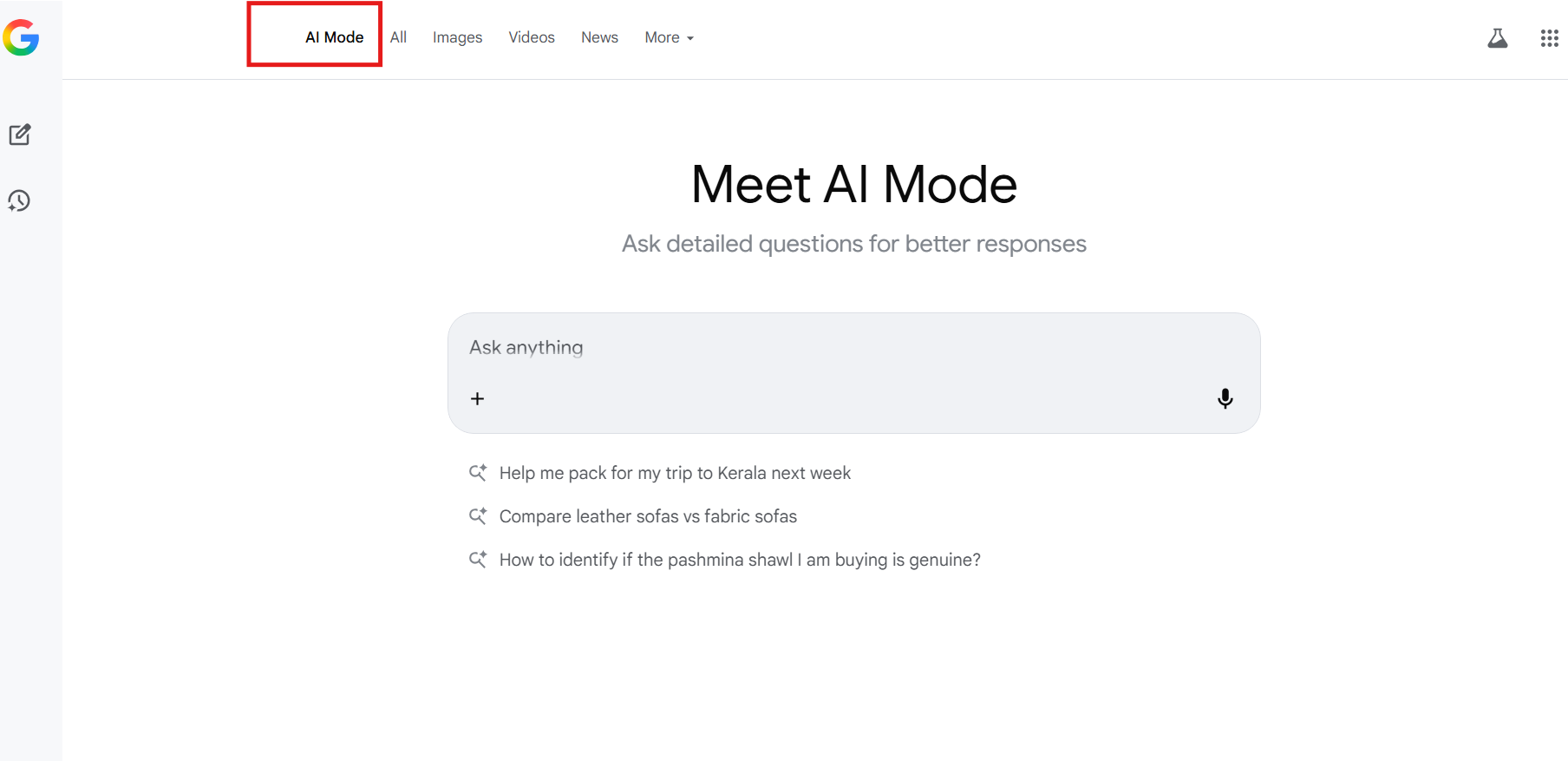
| A quick heads-up, according to 9 to 5 Google more than 100 million people in just the U.S. and India are now using AI Mode each month. |
As a product, it is a brilliant upgrade on Google’s part, since it adds layers of convenience and ease of access to the age-old search. However, as a business, this can be a bit worrisome. Here's why:
- Google’s AI mode is completely different from its traditional search; there are no links to click on.
- You get everything in a combined answer, so in most cases, you won’t even notice the websites it is being quoted from.
- Since it is a conversation model, users can quickly jump from one query to another in seconds.
- Google adds its own insights to make sure it gives the users exactly what they want. The downside? No one actually goes to your content and reads what you are trying to say.
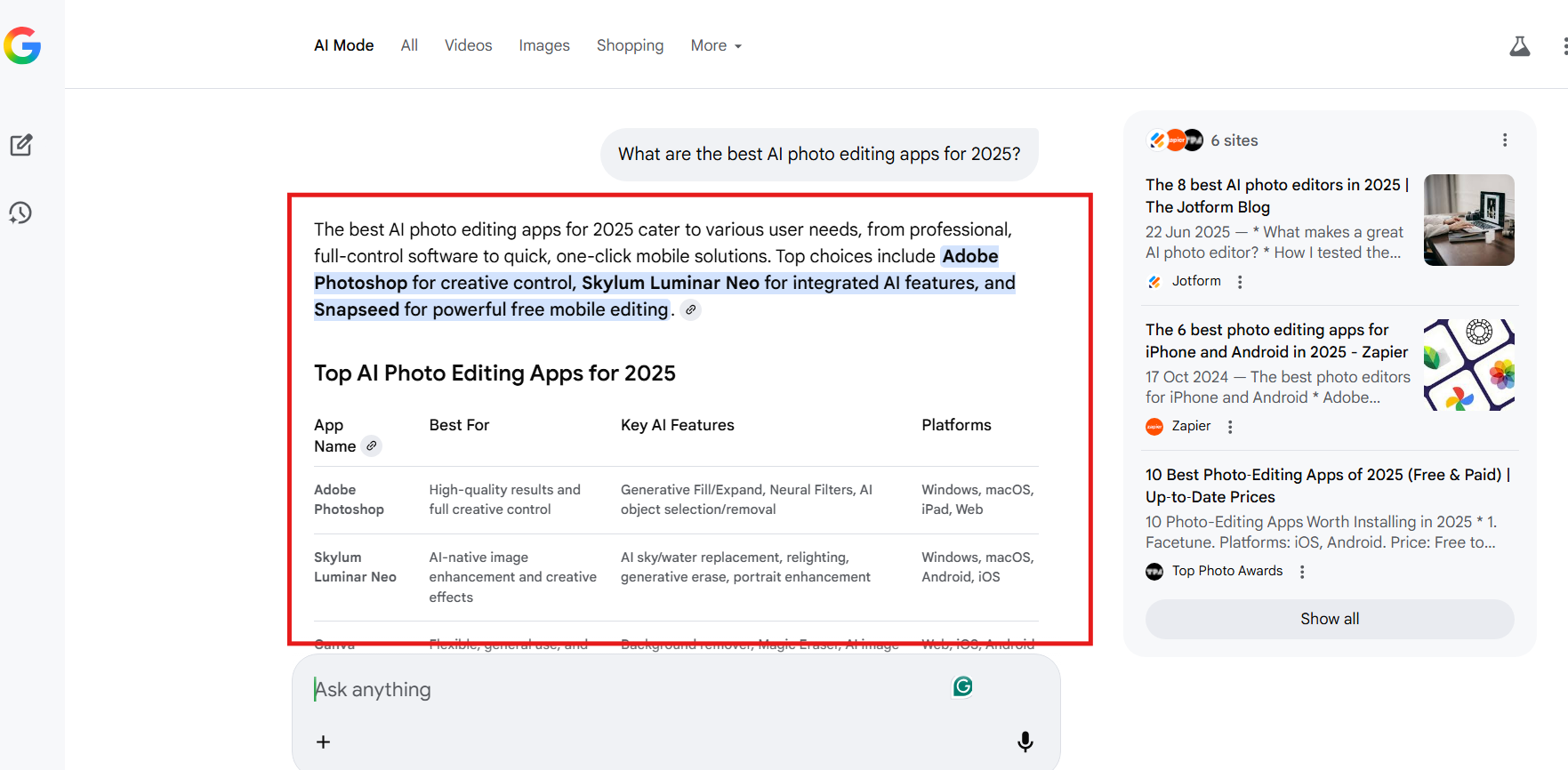
➡️ As you can see here, you don’t need to go check multiple websites to find the best app, Google lists it for you.
➡️You can ask follow-up questions and do way more as compared to the traditional search.
➡️Now the critical question here is will you as a user really browse or even notice the websites that are being quoted in the side? In most cases, not really. This is where the hysteria begins, and brands have already started to freak out.
How Big the Shift Really Is – Usage & Reach of Google AI Mode
The discussion here is simple: is it really a big deal, or are we just assuming things for no reason? There are still many users who will prefer relying on the traditional search as compared to AI-generated results. But we still can’t deny the fact that a change is happening. Moreover, it is not one-sided; we are actually adapting to a completely new search pattern.
A study by the Pew Research Center will help you understand this gradual shift better:
- It says that when Google shows an AI summary, people click on links much less often. Only 8% of users click a regular search result (compared to 15% when there’s no summary).
- Hardly anyone clicks links inside the AI box (1%), and more people just stop searching altogether (26% vs. 16%).
If you think about it, these numbers are concerning, given the fact that the AI Mode was launched only a few months ago (August 2025). Moreover, more than anything else, it is also a clear indication of how we interact and rely on Google; our search habits are now also changing. Therefore, to truly understand why this is happening, we need to look at what’s going on behind the scenes.
Behind the Scenes: How Google AI Mode’s ‘Query Fan-Out’ Algorithm Works
Google has been very clear about the intended purpose of its AI mode. It wants you to have the best of Google in one simple click. If you think about it, all this makes Google a more trusted option compared to the other leading AI models.
Not only do you get the best from all the top-ranking websites in Google, you get them handpicked and especially curated for your query.
➡️Imagine you are making a smoothie for yourself. It is only natural that you will pick the flavors you like and the best fruits, fresh honey, yogurt, and so on. Or, in short, you will make sure it has the best taste as you combine all the ingredients. This is exactly how the Query Fan-Out Technique works. It gathers bits of information and blends them to give you the best answer.
- It picks up all the unique aspects of every website and gives you the best answer to your query.
- Hence, when you look for the “best AI writing tools”, it scans through multiple sites, sees which tool has the most ratings, reviews, and pricing advantage, and then generates the answer.
- In short, the Query Fan-Out Technique is like getting a personal assistant handpicking your research for you.
What This Means for Businesses and Content Creators
Now that we know all about Google’s AI mode, the real question is, what does it mean for you and your business? Our traditional pattern of typing a query> getting the top 10 results> and browsing through each result is now slowly breaking. Since our search pattern is evolving, our metrics, the way we frame our content, and everything else are also slowly changing.
Drop in Click-Through Rates
People are no longer clicking on the website links. Since everything is given to them on a platter, nobody really bothers to click on links anymore. In fact, a recent article published by Yoast suggests that “Google’s top organic results saw a 32% CTR drop after AI Overviews launched, plummeting from 28% to 19%.”
The Rise of “Zero-Click Content”
This is something you can use in your favor if you are strategically ready. To begin with, Zero Click Content is when you add value to a search result, but users don't really visit your site. This is when Google shows full answers, summaries, and comparisons directly on the results page.
Here is a quick example :
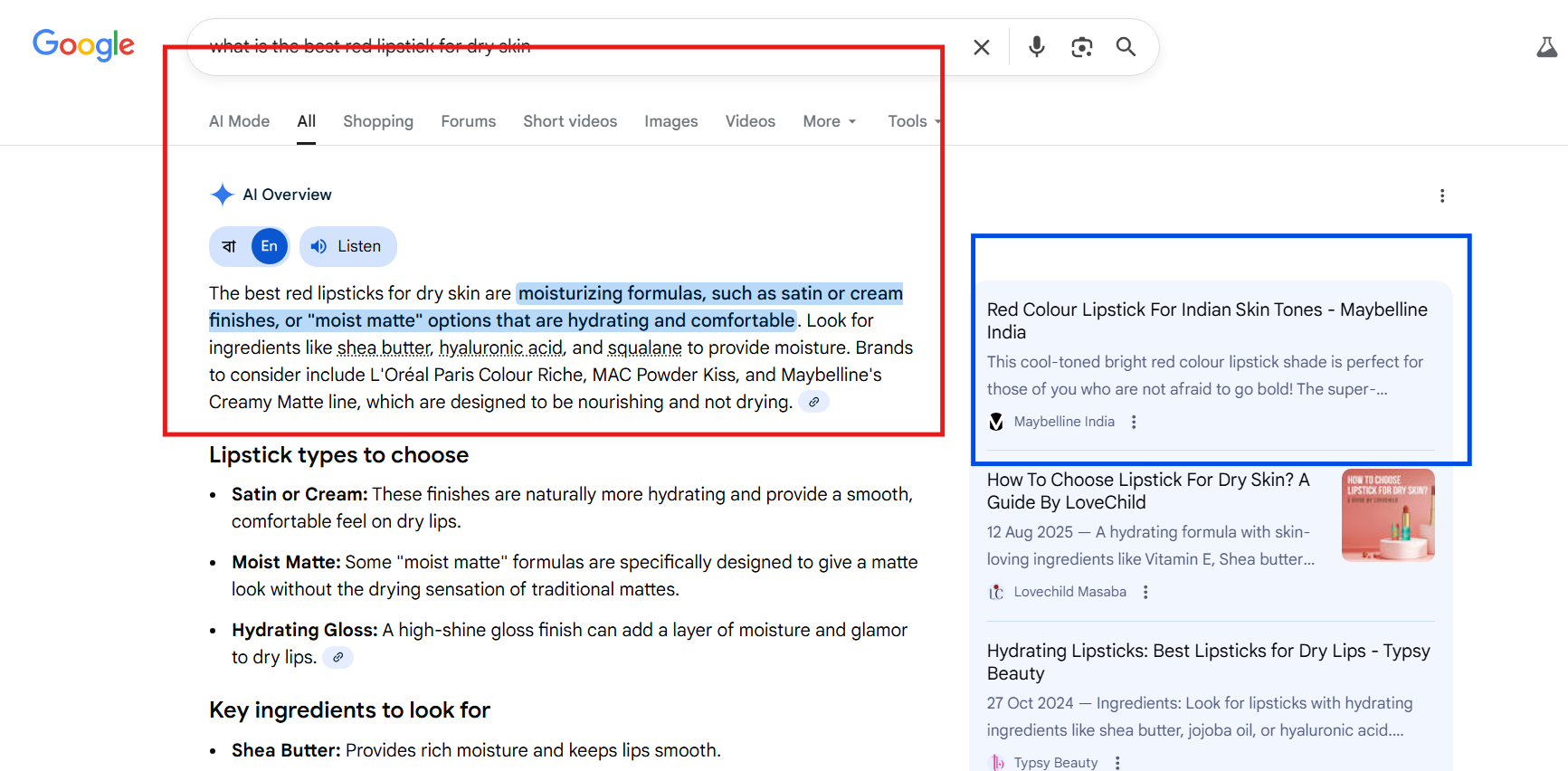
If you can see here, I really don’t have to click on Maybelline India’s link to get an answer to my query. However, the fact that Google suggests it as the topmost relevant answer, even in its AI overview, does work in the brand’s favor.
Competition Moves from Ranking to “Citing”
With our search patterns going through a massive change like this, our performance metrics will also evolve. We will no longer focus on a single keyword or try to rank on the first page. In other words, we will be more focused on being cited and picked by Google for every blog that we write.
The future of content writing will be more of taking Google’s E-E-A-T principles more seriously. We will be moving past generic, robotic content as we present our readers with research, context, expertise, and well-structured writing.
How to Optimize for Google AI Mode (Without Losing the Human Touch)
As a business dependent on one content marketing and blogs, you must understand one thing. There is no AI overview, no Google without “You”. Every information, suggestion, and overall result you see on Google is nothing but a joint effort. Google doesn't write, market, or sell; it is just another platform to do all of it.
So, the good news is that this shift doesn’t mean the end of SEO or content marketing, but it is simply that the rules are changing.
Use Structured Data to Stand Out
The first step in the process is simple: your content should be easy to read and decode. When you start relying on schema markup (FAQ, HowTo, Review, Article), bullet points, captions, and other writing designs, you make things easier. The results? Google’s AI is able to understand, assess, and cite your content.
Prioritize E-E-A-T (Experience, Expertise, Authoritativeness, Trustworthiness)
It is the same as it was before. Google’s AI Mode also favors verified, expert-driven content. So, must ensure that when you are writing about the“ top editing tools,” you have actually used them. Any generic content that only chases keywords will eventually be frowned upon by Google and its AI.
Focus on Context, Not Just Keywords
The search no longer favors brands or blogs that keep stuffing keywords. One of the basic things you need to be cited by AI is to make sure you are giving your readers what they need. In other words, you cannot keep repeating “best AI tool” every now and then without discussing the features. Google no longer rewards keyword stuffing, as users have become more aware and the competition has become more intense.
Humanize Your Content
You must remember that the sole purpose of this entire upgrade is to make things easier for the users. Therefore, content that comes from a place of authenticity, reliability, and originality will always be rewarded.
At this point, the added pressure is on you to make sure you not only impress your users but also Google’s AI. This is exactly where HumanizeAI.io’s approach comes in. It helps you refine, reshape, and mold your robotic content for better user connection while ensuring that Google’s AI recognizes and values your brand’s voice.
The Future of Search Is Human + AI
As Google search continues to evolve with AI becoming an integral part of the setup, you must remember one thing. The future of content marketing, and especially writing, is all about a symbiotic relationship.
Or simply put, the way forward is not really resisting AI or panicking about what comes next. But, building a setup that sees a perfect mix of AI’s swiftness and human intelligence and emotions.
You must also keep in mind that at the end of the day, Google’s AI Mode is still powered by human insight. It is you and every other writer, creator, and strategist who make the web a reliable place to search. Embrace this shift, move forward and make the best out of not artificial but humanized intelligence.