
Remember the time when nothing existed beyond page 1 of Google’s search? If you were on the second page of the search results, it used to raise alarms! But the SEO parameters, ranking guidelines, and search as we know it have now evolved.
The most interesting yet confusing aspect of all this is that AI overviews can still cite a website with zero traffic. Secondly, being preferred by AI doesn’t really guarantee anything. So, what does all this mean?
At this point, it is only normal to wonder how do you track what doesn’t rank? Measuring visibility in AI search can be a daunting task for many. But not anymore. Read along as we break it all for you in a quick and simple guide. Let us begin by understanding what exactly is happening.
What Does “Doesn’t Rank” Even Mean in 2026?
Think about it this way: when your ghost-written article gets viral, who gets the actual credit? It is obviously your ghostwriter, right? This “doesn’t rank” concept is all about acknowledging the ghostwriter.
To begin with, you are now the ghostwriter for Google. It can take your content and shape its answers for the AI overview. In other words, “it didn’t bother showing a link, even if it used your content.” The search as we know it has changed in massive ways, and this is what it looks like:
- Answers replace rankings: Along with looking for a spot in the search results, you also have to assess if Google relied on your content to answer the query.
- Search intent is taking up the space: If you wish to understand the relevancy of your content, you must consider the search intent. Keywords no longer assert dominance. For example, a blog that actually discusses the challenges of writing, pricing plans of the tool, and so on, will do much better compared to your blog with multiple sprinkles of only the word“ best writing tool”.
- AI reads like a human: This is currently the biggest challenge we face, as AI doesn't read your content like old-school crawlers. If your page genuinely solves the problem and explains the nuances, AI will cite it.
▶️This is fundamentally what shifting in “ranking” means!
You are now competing for inclusion inside an answer, not a numbered position on a SERP.
- Being visible doesn’t mean being credited: The next leg of the challenge is knowing that being visible in search doesn't really mean you will get the credit. Yes, there will be clickable URLs, and that is it. In other words? Google won’t really tell your users that “yes, this is the site I found this answer from.”
Take a look at this quick snippet of a random search on dry hair shampoo I did. You will realize two things:
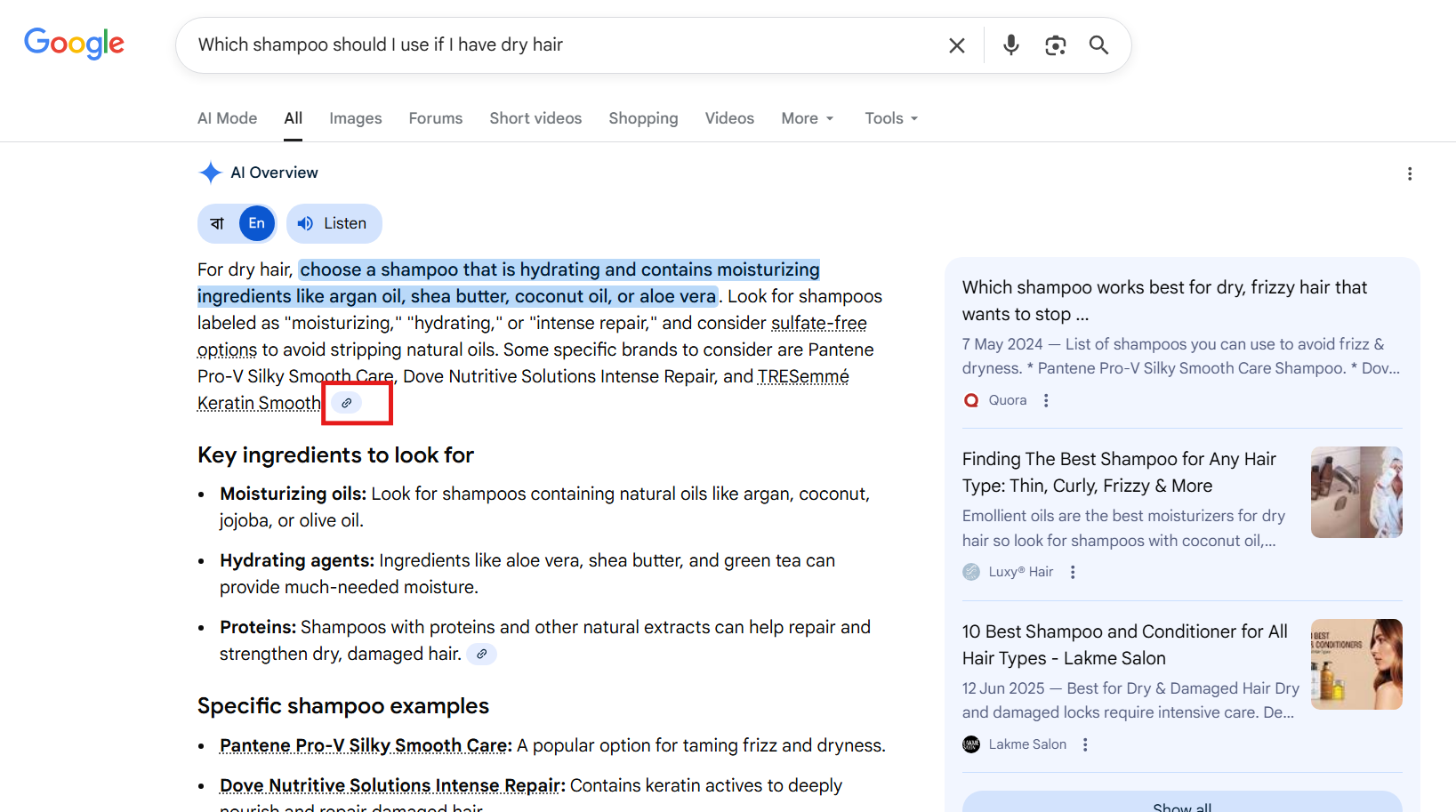
🚨 I didn’t browse through multiple links to get an answer to my query. It was all right here with one simple click.
🚨Even though the website link was provided, there was no need for me to click on it.
Needless to say, as a business, this means trouble. You are losing out on clicks and organic traffic. But this also means that you are getting visibility and brand awareness. So, where does this take you from an SEO standpoint? The answer is simple: you need to assess:
- Where your ideas appear
- Where your explanations and research show up
- Where your frameworks are borrowed by AI
- Where your facts reappear to prove a point by AI
- Where your tone or phrasing is used to explain.
Or, in other words, “doesn’t rank” in 2026 simply means your traditional metrics can’t see your real influence.
The New Visibility Model: Presence → Dominance → Result
So one thing is now clear: we are not chasing rankings anymore. But then what do we look for? Think about it this way: have you ever read a book where no one actually talks about but is actually good? You will surely recommend it to your friends and family, right? Well, Google is doing the same thing right now.
It doesn’t matter if you are ranking or not; if your content is good and is coming from a credible source, it will be picked up by Google. So your tracking parameters should include:
Presence: Are you in the answer? As in:
- quoted directly
- paraphrased
- summarized
- blended with other sources
Dominance: How much does your content influence the answer?
- Did AI use your facts and figures to shape the answer?
- Your stats reappear
- Your definitions form the backbone of the answer
- Your framework becomes Google’s explanation
Result: What happened when you were there?
- increase branded searches
- strengthen trust in your brand
- Your name is being recognized
- Mentions on social forums, etc.
- Did it influence any purchase decision, and the list goes on.
Now that you know what exactly the “non-ranking” factors are, let us see how you can measure them:
How to Track AI Visibility (Even When There’s No Ranking)
Now that you know your traditional methods won’t work, you have to do something different. To begin with, you have to build your own DIY audit structure so that you can get ahead of the “what doesn't rank” factor. This is what it should look like:
Answer Share (AS%)
The most trustworthy trick in the book, it is knowing how many times does AI actually refers to your answers. This will give you a clear picture of what actually is happening. Here is a simple way to do this:
Take almost 20 or 30 variations of a given query and check;
- Did Google follow your answer model?
- Could you find the examples you used?
- Did the AI mention or cite you?
If 12 out of 30 answers show your influence, your AS% is 40% and so on.
Citation Density
Check how many times your website was cited for all the multiple searches that you did. Was it only how your research shaped the answers, or could you see a visible link? It is a clear indication of how Google trusts your site and relies on you to help and formulate its answers.
Paraphrase Overlap
In AI search or zero-click search lingo, it means how many times Google quotes your content without giving you credit. For example, if you wrote a 5-step method, and AI uses the same step, but in a different way, that is a paraphrase overlap right there.
This is exactly where the concept of ghost visibility also comes in. You may not get the deserved credit directly, but it has surely helped Google to frame its answers. Moreover, it shows your influence, even when your name isn’t mentioned.
Brand Imprint
How strongly does Google associate your brand with a topic? This is one of the strongest indicators of winning Google’s trust. In simple terms:
👉 Does Google’s AI think of you when someone asks about a topic that your brand is known for?
Imagine you run a brand called “HairCare” and when someone asks for a hair care tip, Google comes up with an answer like "HairCare recommends…” This is when you know that Google trusts you and not random keyword-stuffed pages. Also, access like this also makes sure that you have long-term visibility.
What AI Actually Uses to Generate Answers (The Part No One Explains)
Now the next question is, how does AI actually know that what you have written is relevant out of all the other answers? You have to keep one thing in mind: all Google wants is the best set of suggestions for its users. Therefore, it will go to the depths of the internet to fetch you an answer. It does all this in a few simple ways:
- Google now searches for context: It doesn’t matter how many times you add a keyword, be it in your conclusion or the introduction. All it checks are a few critical things like:
- Whether your content answers the question.
- Does it include all the relevant H2s for it to be a complete answer?
- Is your writing giving helpful context?
- You are someone who can be trusted
- AI Breaks Down Your Content Into “Blocks”: As we were discussing earlier, AI reads like us. We start looking for answers the moment we start with the introduction, and this is exactly what happens with AI. This is also why you will see the AI overviews are a blend of multiple content from all over the internet. This is what happens: AI doesn’t copy your whole blog; it picks the parts it needs:
- A definition from your intro
- Step from your how-to section
- A statistic from your main explanation, and so on.
- AI loves Structured Writing: One of the many reasons why some websites keep showing up frequently is that they have a well-defined structure. You will see they have clear subheadings, step-by-step lists, bullet points, examples, and so on.
- AI Leans Toward Authority and Consistency: It is not necessary that your content will always be picked if you have a high domain authority. But it can surely help a lot. Google always leans towards content that comes from a place of consistency, expertise, and experience.
Think about it this way: when your friend asks for a restaurant recommendation, won’t you include the most popular ones in your suggestions?
- AI Favors Unique Information (Your Secret Weapon): Why will AI keep citing you for the answers when you have nothing new to add? Consider this blog itself; all of us are now in the initial stages of figuring out how to accommodate the zero-click searches in our routines. So any blog that discusses keywords, SERP results, or any other backdated search precursors will not really be useful for Google for now.
To sum it all up in one line: Google cares about what is useful and not what is optimized or is according to the previous set of search standards.
How To Make AI Not Ignore You
Before you dive right into your new analytics and tracking options, you must remember one thing. Not being cited by AI doesn’t really mean that your content has failed. It simply means your perspective on search and content needs a new approach.
You are no longer fighting for the top spot but for inclusion, influence, and impact within the AI overviews. It is not about who appears first anymore but who contributes the most and gives the users what they are exactly looking for.
The good news in all this is, like your rankings, you can always improve your AI visibility without much hassle. All you have to take care of is your context, structure, consistency, and so on. Or, in simpler terms, you are not chasing the algorithm but becoming a source that it trusts.