
A lot is happening with our trusted old friend, the traditional search. It is getting a makeover, and the confusion, predictions, and assumptions are now at an all-time high. With people making bold claims about SEO, the future of blogging, marketing, and so on.
But an upgrade in our search pattern doesn’t necessarily mean it is hostile to existing businesses. In other words, instead of panicking, we must understand what the focus areas are as AI transforms search.
Read and align as we trace the entire development while focusing on seven key areas. Along with that, also discuss what the customer journey will look like in 2026.
Before the Shift: What’s Really Changing In Search
What exactly is happening to our search? You must be thinking, “Wasn’t AI supposed to make things easier for us?” Well, that is the problem, actually. It made things way too easy for us.
Let us first understand what doing a Google search looks like for us now. It is no longer the traditional way of checking and scrolling through the top ten links. AI has made our job much easier; we get instant summaries and insights now.
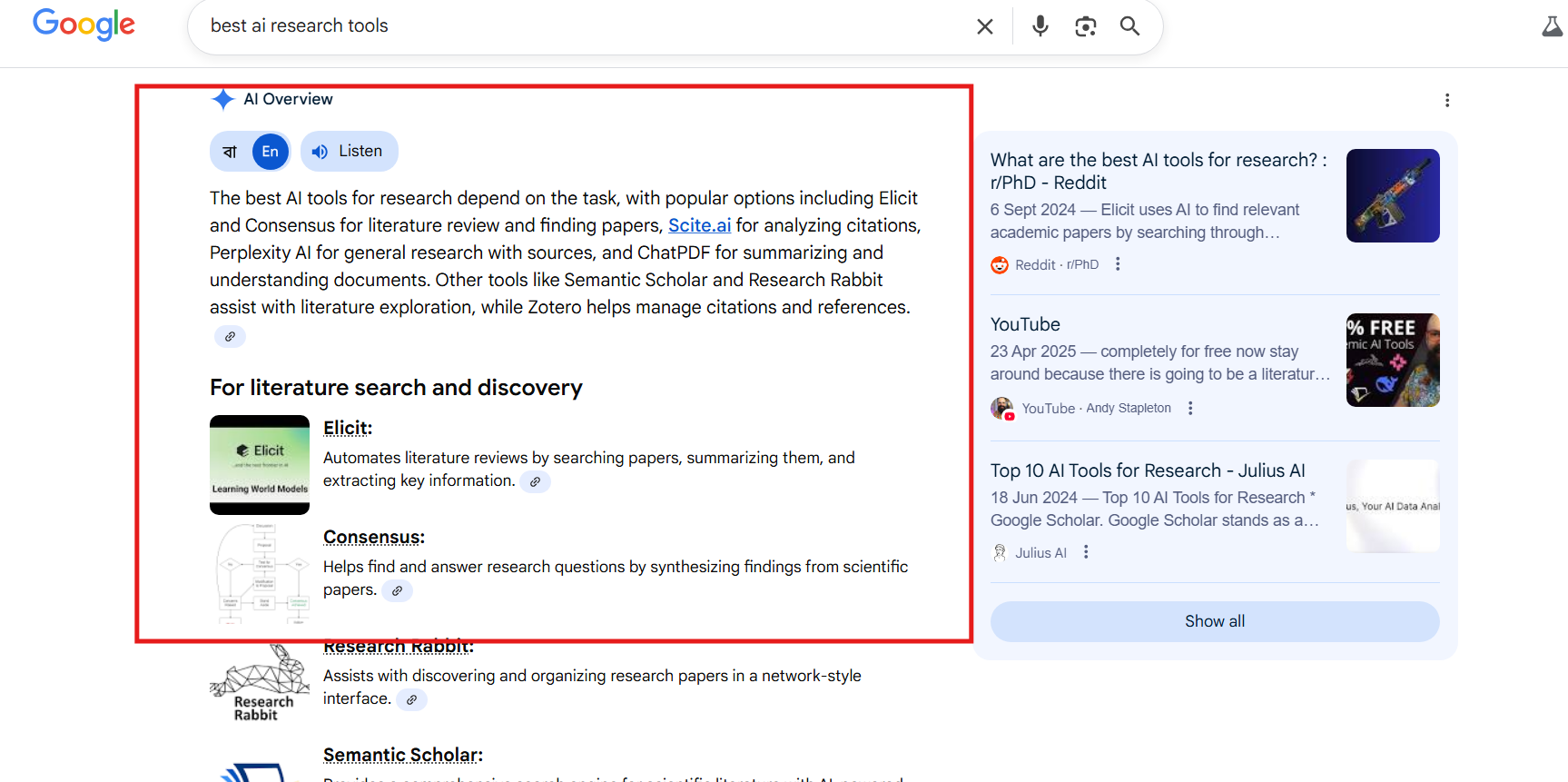
➡️As you can see here, you can get the best of all the websites summed up in a quick overview so that you don't have to keep on scrolling. You get your results in an instant and without any tiring research.
But here is the thing: it is not that search has evolved into something advanced; it has expanded as well. We now have two other dedicated channels that help us with our queries:
- The AI Mode: Launched in August 2025, it is Google's new innovation where you have a conversational interface to answer all your queries. Ask your questions, do a follow-up, and discover instant and quick answers, all in seconds.
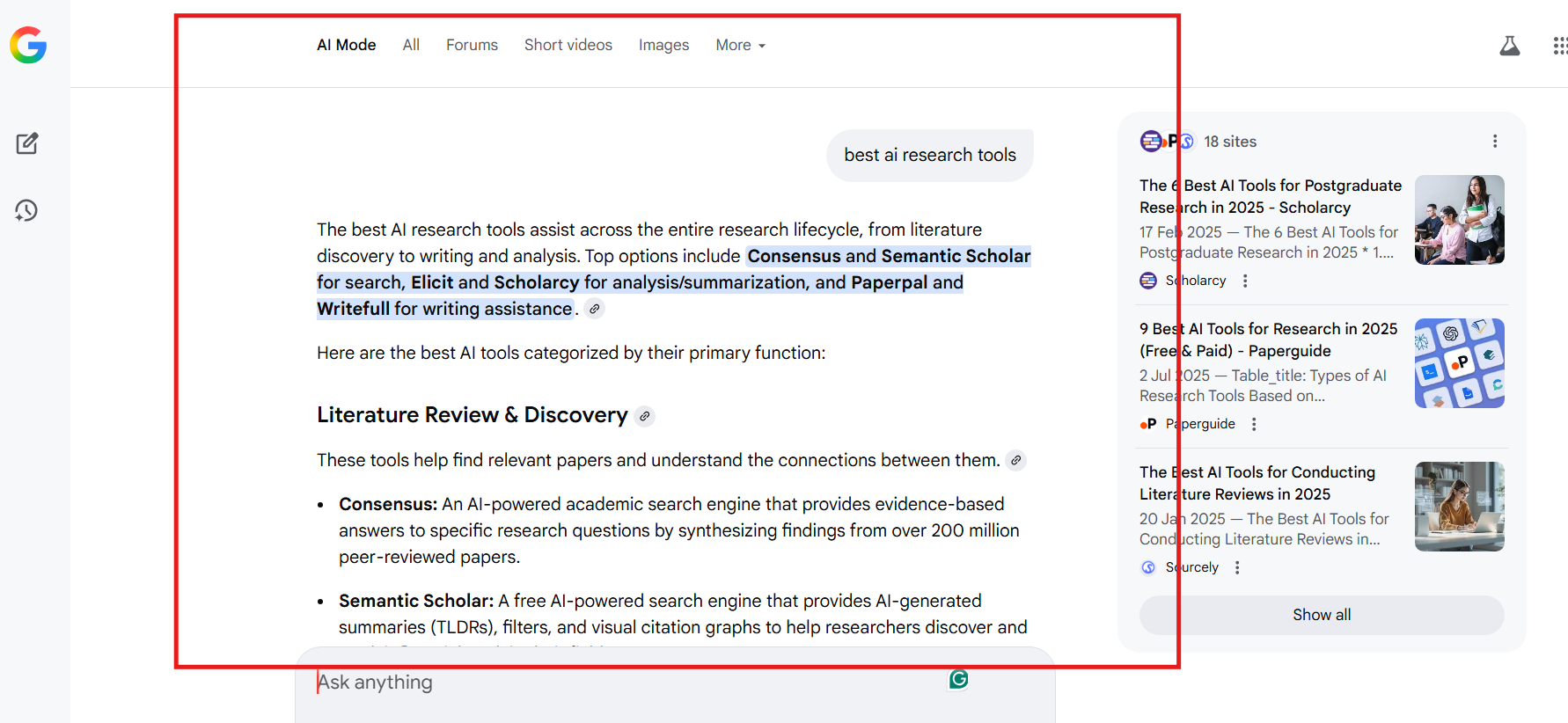
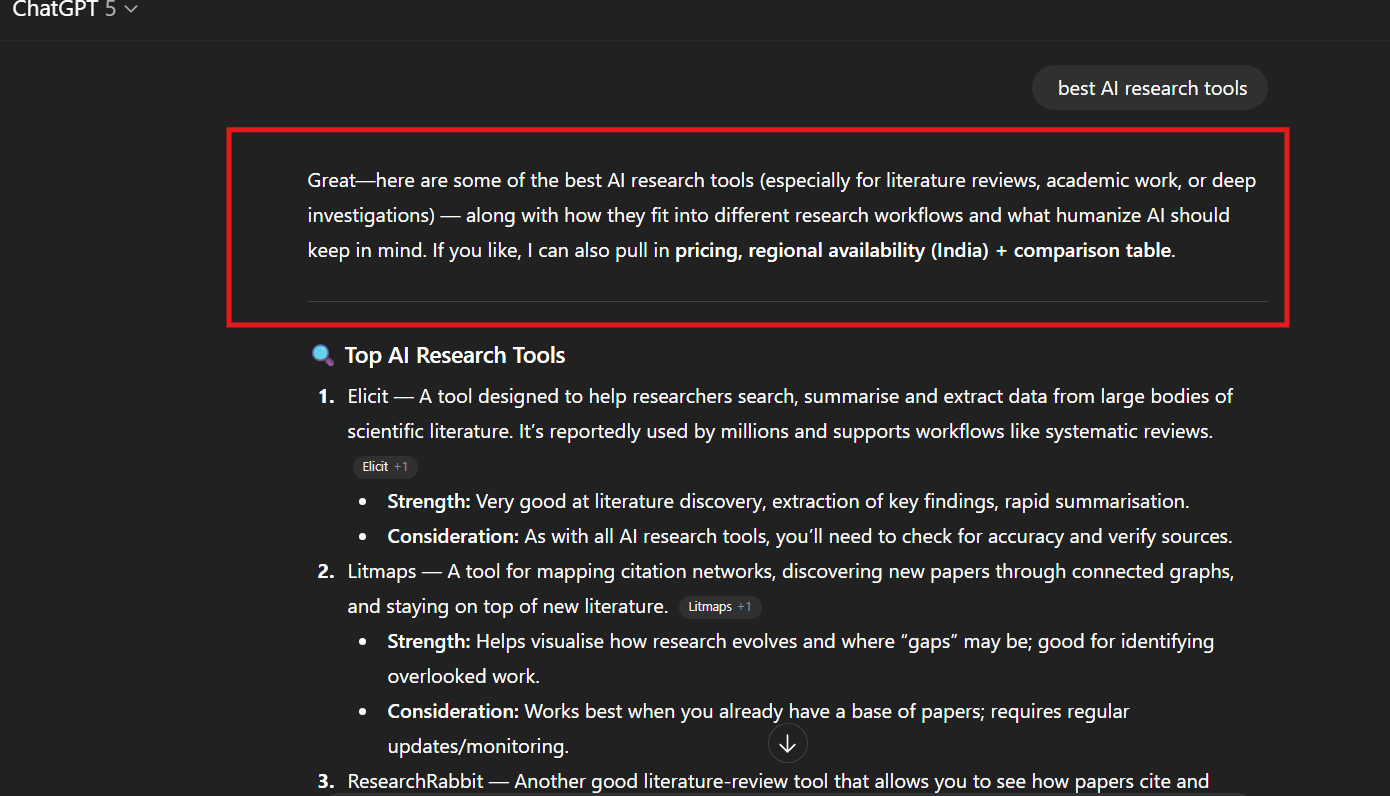
- The reliance on leading AI tools for search: Our need for convenience has reached a point where sometimes we simply rely on AI to do it all. We brainstorm with leading tools like ChatGPT, Claude, Perplexity, Gemini instead of going the traditional way.
In fact, Pew Research Center found that AI Overviews cause users to click far less often, dropping click-through rates from roughly 15% to 8% when an AI summary appears, with only 1% of users clicking through to a cited source at all. (Source: SEO Sherpa)
However, there is a flip side to all this ease and access. As you can see in the search snippets pasted, we no longer need to go website hunting. Everything is organized in one simple summary, which also means:
Less organic traffic, with people being satisfied with the AI overview, AI Mode, and AI assistants. Even though your content might help answer a given query, your brand rarely gets the visibility it deserves. AI assistants blend insights from multiple sites, which often leads to your work being paraphrased, reworded, or reinterpreted without proper credit.
But, this doesn't mean we would stop publishing content or not put in the effort like we always used to. It only means that we need to shift our key focus areas and build a new setup that accommodates AI as well. What does it look like? Let us find out:
Where Do We Go From Here? The 7 Focus Areas That Define the Future of Search
Needless to say, we have now reached a point where search has gone beyond just finding information. It has become more personalized, backed by understanding context, behavior, and intent. As we step into 2026, we must realize that these focus areas are no longer a good thing to have. But it is necessary if you wish to keep up with the AI revolution.
Optimizing for AI Assistants, Not Just Users
As we write content from now on, we must remember there are now two intended readers. Apart from our target audiences, we have to accommodate the AI assistant as well. Instead of typing out a query, people ask ChatGPT, Perplexity, or Gemini to do the searching, comparing, and decision-making for them. We need to make space for the assistants reading, understanding, and picking up our content.
AI-Centric SEO: Aiming for Citations & Not Clicks
In 2026, the plot is all about being obsessed with context and accuracy as compared to chasing keywords. As traditional SEO taught us how to incorporate trending keywords into our search, AI-centric SEO demands something intense. It is about precision, authenticity, and genuine value.
In fact, you will be surprised to know that a study published by Conductor.com says that AI-search citations are often from users with higher intent who are looking to dive deeper into a topic after reading the AI summary. Or, in other words, if we give the users exactly what they are looking for—clear, well-researched, and trustworthy insights the AI tools surface our content, leading to stronger, more meaningful traffic.
Structure Your Content for Machine Readability
We have reached a point where we need to convince the machines we are good even before we connect with our users. Be it for Google’s AI overview or our favorite AI tools, our content should be ready to pass their test. The best way to do it? Your content should be formatted in ways that make it easy for AI to understand what you are talking about. Be it clean headings, concise summaries, schema markups, bullet points, and so on. Bring your best structured, clean game in the market and see how things change.
Quick Fact: A study published by Semrush says that “according to the 2025 Previsible AI Traffic Report, traffic coming from AI tools like ChatGPT, Perplexity, and Copilot has grown by 527% in just one year.”
Fresh Updated Information
Be it Google or your favorite AI tool, the future of search is going to be dominated by brands and websites that are always updating their content. Think about it from a product standpoint: when a user asks a question, the AI wants to pull the most recent, reliable, and verified piece of information available. Outdated data, broken links, and irrelevant information will put you out of the race instantly.
You have to remember that when people are relying on AI for their search, they are usually in a hurry or are in general tired of the traditional search. Moreover, the popular AI tools will never lose face in front of their users.
Verified Sources and Author Credibility
The ironic thing in this entire discussion is that you will never find AI quoting another AI-generated article. The thing is, AI takes the credibility of your content very seriously. Or, in other words, the stronger the verification of your information, the more AI systems can easily trust and reference your work.
So, if you wish to be on the good books of your favorite AI assistants or Google in general, you must include your name, role, and credentials in every post and link them to reliable author pages.
Moreover, adding citations, data references, and credible external links adds bonus points to your credibility and makes the entire thing easier.
Conversational Intent Optimization
When you are using your favorite AI tool or talking to Google’s AI mode, do you really talk in keywords or in phrases? Is it not always like having a conversation with a friend or a colleague?
You don’t only write “best research tools” as I have shown in the example above, you go beyond. It is usually on the lines of “show me AI tools that will make research easier” or “which AI tool can help with instant citations”, and so on.
Therefore, your content must be ready to keep up with the conversational aspect of our searching pattern. Or, in other words, your content should sound natural and aligned with how real people speak.
How can you do that? You have to be smart and start using conversational subheadings, Q&A sections, and semantic variations of queries and so on.
Building an AI-Friendly Brand Ecosystem
In 2026, your website alone won’t make you visible. AI assistants get their information from the entire ecosystem rather than from single posts. For your brand to be found, it has to be part of credible networks like industry blogs, knowledge panels, verified listings, and trusted publications. Guest posts, collaborations, and digital PR will help AI see your brand as one of the players that is there to dominate the AI ecosystem.
From Clicks to Citations: Your Roadmap for Visibility in the AI Era
The rise of AI Search has taught us one important thing. We have to think beyond the box. There is no relying on the old set of rules and particular keywords for the ultimate results.
At this point, being cited, referenced, and trusted by AI assistants is the ultimate goal. Or, in simpler terms, as businesses, creators, and marketers, we must evolve the way we are currently sharing information.
Our obsession with keywords and backlinks has to be backed by credibility, structure, and how we communicate with our users. The thing is, the more genuine and useful your content is, the more likely it is going to be picked up by Google and, in turn, quoted by AI assistants.
If you think about it, in the coming years, search will not only be about discovery. It will be about representation. Your content being quoted by AI is also a reflection of its own quality.
So, you have to be the one who shows up, speaks clearly, stays updated, and most importantly, contributes meaningfully to the entire ecosystem.