
At this point, the world is obsessed with how AI is making things easier. We get to do days of work in seconds, and efficiency, speed, and scalability are at an all-time high. But there is another side of the story that no one ever talks about.
If AI is doing our jobs in seconds, what happens to the void it leaves behind for real-time workers? The added pressure to be as efficient as a robot or eventually lose the job? It can be quite detrimental to mental health.
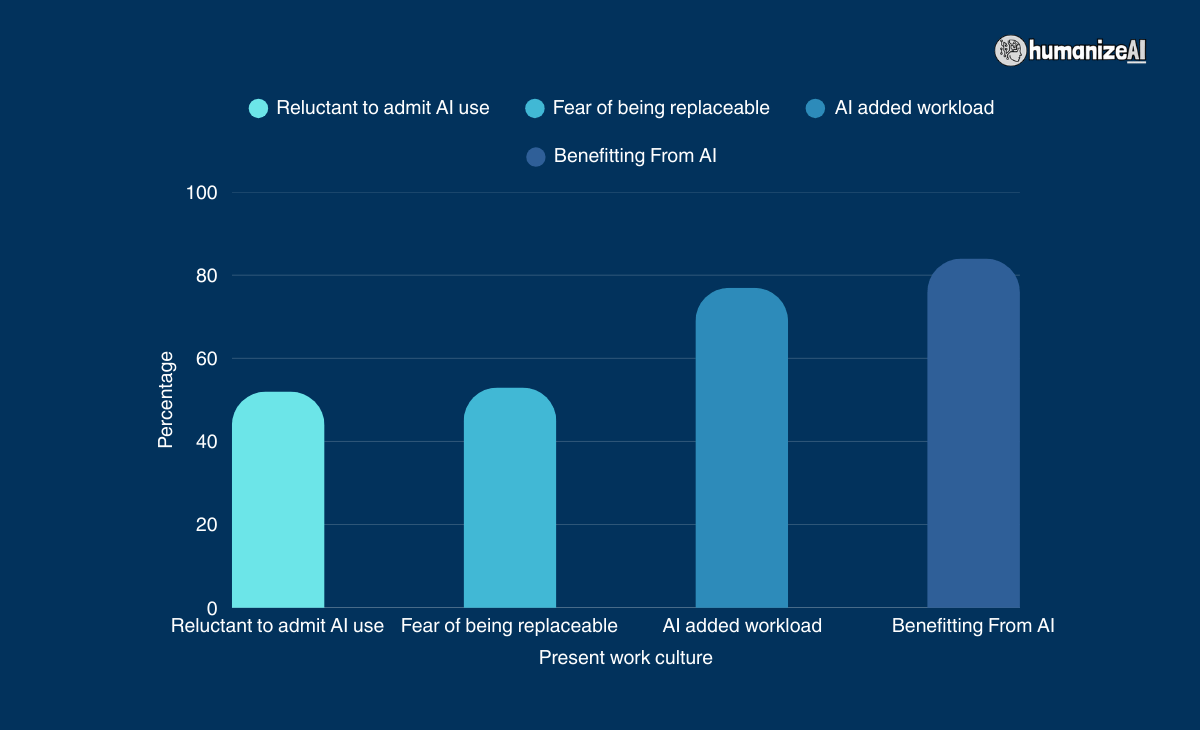
Forbes reports that "77% of employees using AI say it has added to their workload and created challenges in achieving the expected productivity gains.” Read along as we discuss AI and mental health work and where exactly all this is going.
We will talk about real-time data, timelines, and whether AI is actually the problem or if we are yet to accept and work around it. Yes, today we are going all in, hold tight.😧
How AI Has Changed the Pace of Work (Not Just the Tools)
Before we start to discuss this, let us look at two important numbers as reported by Microsoft:
- 52% of people who use AI at work are reluctant to admit to using it for their most important tasks.
- 53% of people who use AI at work worry that using it on important work tasks makes them look replaceable.
At this point, mental health concerns about AI workplace usage are not about a new shift in routine or workflow. It runs way deeper and goes beyond personal struggle. These numbers clearly point out two simple yet critical things:
- AI’s impact is not just limited to faster execution or smarter tools, but it is reshaping how we perceive, measure, and judge our work.
- We know that AI makes our work easier, but this also makes us replaceable.
In a more grounded or practical level, it means something more layered:
- Faster delivery is no longer a bonus; it is now a mandate.
- High-quality output is expected regardless of time spent.
- Most importanly effort is becoming less visible than results.
But on a personal front, the reality is a bit concerning. When tasks are completed faster with AI, employees worry that their contribution appears less, thier skills go unnoticed, and the fear of being replaced keeps haunting them.
Burnout in the Age of AI: Are We Working Less or Just Faster?
To understand the impact of all this progress on our mental health, we need to break it down into layers. To begin with, let us understand what exactly we are talking about and how exactly AI is responsible for all this.
When we talk about burnout, we don’t really mean someone is tired after working one extra hour. But we are talking about a system that systematically overworks its employees in the name of urgency.
At this point, you must be wondering how someone can burn out with AI and automation in place? Well, burnout in the age of AI looks very different, and this is exactly where the confusion starts. Let us once again look at two value points:
- A report by Psychology Today, based on the study by Quantum Workplace Survey, suggests that frequent AI users report 45% higher burnout, showing that tech can exhaust us.
- But at the same time, a detailed report by SurveyMonkey suggests that “84% of professionals had seen some benefit from using AI.”
So, which one is true, or should we consider that impacts us on a real-time basis? Well, to be honest, both the numbers here are relevant, and we need to talk about them. The ideal way to begin is to acknowledge that yes, AI does reduce our effort, but at the same time, it also increases expectations. Here’s why:
- Today, tasks that once took days are completed in hours. Emails, drafts, reports, and taking important data-driven decisions now happen instantly.
- Burnout today is less about physical exhaustion and more about mental overload. It comes from constantly monitoring AI outputs, making quick decisions, switching contexts, and fearing that AI will replace us.
To sum it all up, yes, AI does make things easier, but it can only help with the burnout if our expectations around it change. So, how does it exactly look in different areas of work? Let us understand.
How Different Roles Experience AI Stress Differently
If we really wish to know about the impact of AI and mental health at work, we must dive into a sectional analysis. A healthcare worker who is always on the frontline is differently wired than a writer or a marketer, and they all experience mental health differently. Now, with AI in the picture, let us see what it looks like for them.
Writers, Marketers, and Creatives
AI is now a staple and irreplaceable chunk for writers, marketers, and creatives. We know that if we do not hop onto the AI train, we will miss out significantly. Be it for brainstorming, writing, or even image creation, AI can guide and also produce more content faster.
But as we have seen, with that speed comes expectations. Here are a few quick data points that you need to look into:
- Salesforce reports that 71% of marketers use generative AI to inspire creative thinking.
- HubSpot further says that AI floods the market with content, and brands without a clear point of view are getting lost. In 2026, growth is increasingly driven by distinctiveness, trust, and relevance.
- But at the same time, Adobe State of Creativity Report says that, as such, they are more fearful about the potential risks of generative AI use even though 83% of current users believe it has helped them to do their work more efficiently
AI lowers the time it takes to generate drafts and assets, which is true. However, it is also intricately dependent on our human creativity, craft, and intelligence.
It comes in when the work shifts from “create from scratch” to “edit, humanize, and optimize AI output.” Therefore, the editing plus pressure to produce more variants for channels is always an added load.
Developers, Engineers & Analysts
Well, we are made to believe that the developers, engineers & analysts are the most to gain from AI making its presence known. You know, with code completions, test generation, and faster data analysis. We think AI has made life easier for them. Well, it is true to an extent, but it has also brought in a new kind of stress.
- A report from the 2025 Stack Overflow Survey suggests that "84% of respondents are using or planning to use AI tools in their development process, an increase over last year (76%).”
- Yet, 66% developers report low trust in AI outputs. The report further quotes that "AI solutions that are almost right, but not quite," which often leads to the second-biggest frustration: "Debugging AI-generated code is more time-consuming," as cited by developers.
Customer Support & Frontline Service Roles
The customer service sector is going through a massive revamp with AI. At this point, chatbots and AI agents are handling routine queries that make things way easier. However, human agents are still summoned for urgent queries. From a distance, it might seem like a perfect setup, but let us analyze it:
- A report by Gartner reveals that “85% of Customer Service Leaders Will Explore or Pilot Customer-Facing Conversational GenAI in 2025”.
- However, another Gartner report points out that “64% of Customers Would Prefer That Companies Didn’t Use AI For Customer Service.”
Now this is where the entire concept collapses when it comes to assessing it from a mental health perspective. Now, if companies implement AI-driven customer service systems and the customers want human interaction, there is bound to be a clash. An angry, frustrated, or worried customer who doesn’t want the AI in between will eventually lash out at the service agent.
So, do these numbers mean that all this progress in AI can ultimately backfire? Are we supposed to sacrifice our mental health in all this, or are we not looking at the bigger picture?
What Actually Improves Mental Health When AI Is Used Well
If we look at the numbers discussed in this blog, we will realize one simple thing. AI is not really causing us any burnout or exerting unnecessary pressure. It is we who are trying to catch up with a high-end tool whose whole purpose is speed, efficiency, and accuracy. We are not stressed because AI is here; we are stressed and anxious because we do not know what to do with it.
If we are being honest here, when thoughtfully used, AI can actually reduce cognitive load and mental fatigue.
- Based on Microsoft’s Work Trend Index research, employees who feel they have clear guidelines on how AI should be used at work are 31% less likely to report feeling overwhelmed.
- Secondly, WHO points out that digital technology should enhance mental well-being by acting as a tool for support rather than a source of surveillance.
Therefore, it is safe to say that AI and mental health can work and grow hand in hand when:
- We reset our expectations around AI and not raise it.
- Speed and scalability are treated as added advantages with AI and not the baseline for success.
- We take the important decisions where there is no pressure for a certain scale of output.
- AI is used as a helping hand to write, research, develop, manage, and interact better and is not made the center of the entire process.
Final Takeaway: What These Mental Health Statistics Tell Us About the Future of Work
All the data across burnout, productivity, efficiency, and cognitive load point out one simple and important truth. As AI reshapes how we work faster, we as organizations need to understand the impact it can have on our employees.
To be honest, it is true that AI in the workplace has helped us with quicker solutions, automated repetitive tasks, and, as the numbers suggest, shown us new ways of working. It has changed our perspective altogether. But on the other hand, it has also exposed how vulnerable employees are in this entire setup. For the sake of results, we tend to sacrifice basic critical measures, creating performance pressure and many other long-standing issues. So it is safe to say that, at this point, mental health challenges in the workplace are not simply because AI has suddenly entered the picture. Rather, it highlights how we have refused to acknowledge the various leaks in our entire structure.
At this point, mental health challenges are not emerging because AI exists. They are emerging because we are refusing to acknowledge our work processes around it and how to grow around it responsibly.
If you analyze this article closely, you will see that the numbers consistently show one clear pattern:
- When AI is treated as a replacement, stress increases.
- When AI is treated as an assistant, workers accept it, and outcomes improve.
Therefore, it is safe to say that the future needs to have a perfect balance where we not only rely on AI for efficiency and speed but also set honest boundaries with its use in return.
Companies that do not focus on clarity, trust, and sustainable workloads will always consider AI as a threat and push their employees to the point of burnout. However, companies that take note of the many challenges of AI, including mental health, are the ones that will make it through.
As we move forward into 2026, the main distinction is clear. Organizations that do not sacrifice their people for the sake of some numbers and consider their well-being as well are the ones that win.