
For people outside the industry, AI and Architects in the same sentence feels like an overreach. But, the numbers well, they say otherwise. Research published by Anthropic says that AI could potentially help speed up about 85% of architecture and engineering work. ( Yet, it currently uses only around 5% of that potential.)
So, are architects gradually accepting AI? Or, they are still hesitant to catch up with the growing trend. Let us find out! Read along as we discuss AI’s impact on architects' jobs from the perspective of design automation and industry trends for 2026. 🤔
How Many Architects Are Using AI in 2026?
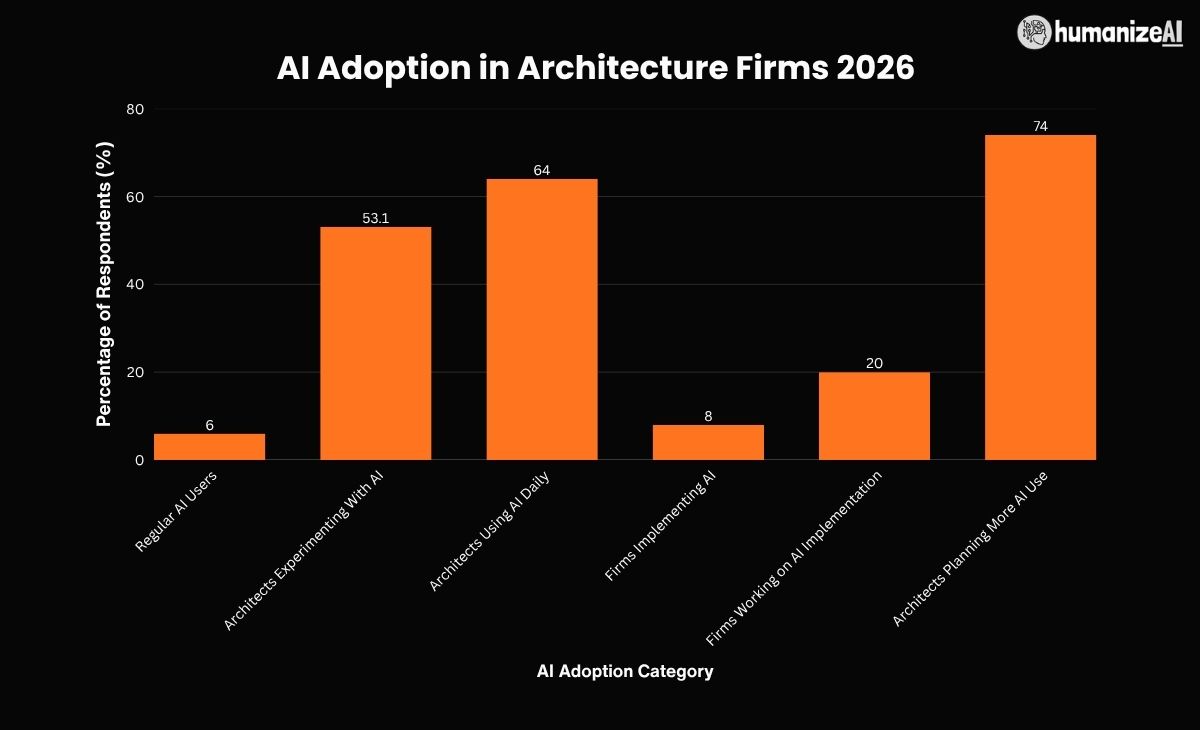
Are architects actually using AI? Well, not really if you compare it to the global widespread use of AI in other fields. The numbers say that only 6% of architects in the United States regularly use AI tools in their professional work. Here’s a detailed look at some of the important numbers:
- When it comes to experimenting with AI in one way or another,there are 53.1% architects trying their hand at it.
- Around 64% of architects report experimenting with AI tools in their daily workflows.
- However, only 8% of architecture firms have fully implemented AI solutions for their daily workflow.
- But a good 20% of them are now actively working on implementing AI solutions.
- One in five firms, or once again 20% of them, say they have fully embraced AI across multiple architectural processes.
- Between 73% and 93% of architects expect to increase their use of AI tools over the coming year.
- On the other hand, 74% of architecture professionals say they are likely to increase their AI usage in the next 12 months.
Sources
- AIA: Artificial Intelligence Adoption in Architecture Firms: Opportunities & Risks (2025)
- Anthropic / Monograph analysis
- ArchDaily / Architizer Survey 2026
- Chaos Industry Survey 2026
How Big Is the AI Architecture Market?
You can see the influence of AI slowly growing over the daily workflow. But what does it mean for the present market? Is generative AI in architectural work now a thing? To begin with, the global generative AI in architecture was valued at $1.47 billion in 2025.
- It is expected to grow to $2.07 billion in 2026 and is projected to reach $8 billion by 2030.
- The forecasted CAGR for the market is around 40.9% between 2025 and 2026.
- Infact, Long-term growth is expected to continue at a 40.2% CAGR through 2030.
- In 2025, North America held the fort with the largest regional market, and Asia Pacific was the fastest-growing region for the forecast period.
Sources
How Much Time Are Architects Saving With AI?
If we are being honest, the concept that AI and Architecture can go hand in hand is still a bit futuristic. Can the AI tools actually take up such a mammoth? Are they actually capable enough to save time? Or, are we talking about the same old generative tools that help with the productivity aspect? A quick look:
Well, 86% of architects say that AI helps by speeding up thier workflow. Whereas almost ⅓ of them have seen major efficiency and improvements the moment AI enters the picture.
- This is where the numbers get more interesting! More than half of architects save at least five hours per week using AI tools.
- Some firms report saving more than 15 hours per week through AI-assisted video and content workflows.
- Around 25% of respondents say their biggest time savings come from material selection or asset generation.
- Another survey found that 85% of architects report being more efficient after relying on AI.
Sources
Where Are Architects Using AI the Most?
This is more of a fundamental question: where does AI actually step in the workflow? Is it the designs? The calculations? Or, there’s something more? Well, according to 43% of architects, concept and pre-design work is the area where AI delivers the greatest value.
- Architects increasingly use AI-generated imagery during concept development.
- Text-to-image tools have become one of the most common AI applications in architecture.
- Also, AI is frequently used to enhance and refine architectural renderings.
- Many firms now use AI-generated visual assets for presentations and client communication.
- 48% of respondents report that they save the most time with concept design and the entire ideation process.
Sources
What Architectural Tasks Are Being Automated With AI?
You will be surprised to know that the most common AI applications among architects are chatbots, image generators, and grammar or text-analysis tools. Instead of high end AI powered designed tools. Here’s a quick look at the details:
- Less than 10% firms use AI for highly efficient tasks related to the job, like product-list updates, estimation, complex specification writing, and product research.
- On the other hand, more than 20% of firms use AI for client communications, even though many architects already consider it an efficient process.
- As we have also discussed before, 84% of architects believe AI can help automate manual tasks and save time.
- 74% believe AI can improve product research and information gathering.
Sources
How Exposed Is the Architecture Profession to AI?
We don’t really talk much about the dangers of AI in the architectural setup. I mean, if you think about it, the discussion is always about how AI impacts the creative job roles. So, is architecture as a profession at risk with the growing use of AI?
Well, to begin with, another exposure model cited by Anthropic estimated that around 70% of architecture and engineering work could be affected by AI.
- But as we have seen earlier, despite high theoretical exposure, actual AI usage in architecture remains around 5% observed exposure.
Infact reports say that architecture and engineering recorded the largest gap between AI potential and AI adoption among all the industries studied. Not to mention, it also found that AI remains far from reaching its theoretical capabilities across the labor market.
Sources:
Is AI Replacing Architects?
Well, it is too early to even answer a question like this one. The study by Anthropic found no systematic increase in unemployment among workers where AI is used on a widespread basis. Therefore, it can take a while for AI to catch up in a space where it is just making its presence felt.
- Researchers found no impact on unemployment rates among workers in the most AI-exposed professions.
- There is tentative evidence that hiring has slowed among workers aged 22 to 25 in highly exposed occupations.
- Anthropic noted that occupations with higher observed AI exposure are projected to grow more slowly through 2034.
- The study concluded that high exposure has not yet translated into measurable job losses.
Sources:
What Do Architects Think About AI?
Let us understand this from the horse’s mouth itself. As an architect, is the growing impact of AI a good sign or a bad one? Well, 84% of them are optimistic that AI will be able to solve complex problems. But, here are a few other details:
- Nearly 90% of architecture professionals express concerns about AI. And the most common concerns include accuracy, unintended consequences, security, authenticity, and transparency.
- 61% of architects who are not using AI say they feel pressure to adopt it.
- But 35% of them have held thier ground and say they will only adopt AI when it clearly delivers value.
- 48% identify poor output quality or unreliable results as their biggest challenge.
- 69% describe themselves as only somewhat satisfied with current AI output quality.
- Around 70% believe AI-generated visuals generally reflect their design intent.
- 60% say AI improves parts of their workflow despite occasional errors.
Sources
Which Architecture Firms Are Leading AI Adoption?
So, who exactly is leading the battalion for this one? Is it the small businesses relying on AI due to overwhelming work pressure? Or, is the big firms opting for an easy way out? If you look at the numbers 60% of survey respondents came from firms with up to 19 employees. Moreover, the AIA found that larger firms with 50+ employees are leading AI implementation efforts.
- 27% represented firms with between 20 and 99 employees.
- 13% worked at firms with more than 100 employees.
- Younger architects are significantly more likely to experiment with AI than older professionals.
- Most importantly, architects aged 35–50 are more likely to use chatbots, while architects under 35 are more likely to use image-generation tools.
Sources
AI and Architecture: A Tool, Not a Takeover
If we are being honest here, AI still has a long way to go if it wants to replace the person who spent years learning how to balance structural logic with visual design. But here is the thing: the numbers present a very clear case. Adoption is growing, and a significant number of architects are already seeing real-time savings.
But the gap between what AI can theoretically do and what is actually being used in practice tells you that architects are not rushing. If you look at the bigger picture, architecture is not a mail you send, a copy you brainstorm with your client, or a customer you talk to. One wrong move and it can have real-life implications. Hence, the hesitation makes sense.
The 35% who say they will only adopt AI when it clearly delivers value are not being old school or stubborn. They are simply being architects. So, to sum it all up, it is not really about whether AI will replace architects. It is about whether we will ever find a sustainable way to use it without risking and sacrificing what the entire work is all about.