
I think by this time, all of us know that there are almost 600 million blogs that exist online. No matter how many reels we scroll or TikToks we watch, blogs are always going to be the ones topping the list.
And to be honest, it does make sense. Think about it this way: without blogs, there are no AI Overviews, no citations by the popular AI search tools. In short, there’s no visibility or traffic. However, even after all this, there’s a strange disconnect, especially towards our approach for blog writers. Reason? AI can write one in seconds.
So, even if the entire internet ecosystem is running on blogs, there is always panic and fear of being replaced. Read along as we understand this disconnect with detailed numbers. We will look into AI’s impact on blogging jobs and what it looks like in 2026 with statistics, trends, and monetization perspectives. 👀
How AI Changed Blogging Jobs Between 2023 And 2026
To begin with, we must understand that when we talk about AI’s impact, we mean two things. One, how AI is replacing writers, and two, how AI overviews and AI search tools are changing the way we write. Let us understand what exactly is happening with a few numbers:
The Blogging Industry Became AI-First Between 2023 and 2026
- Between 2024 and 2026, there were more than 600 million blogs among 1.9 billion websites worldwide.
- The United States continued to dominate the blogging space, with a 43.29% traffic share on Tumblr and around 9.3 million WordPress websites.
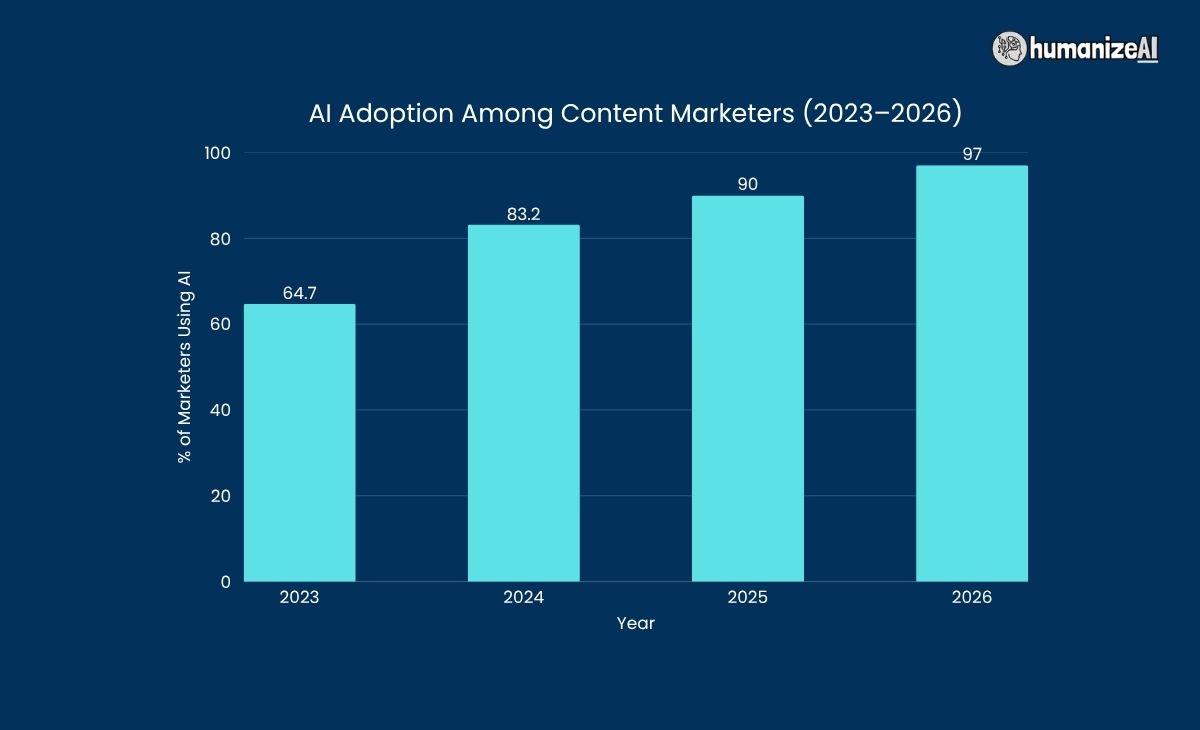
- According to Siege Media and Wynter, 97% of content marketers planned to use AI in 2026. That number was 90% in 2025, 83.2% in 2024, and 64.7% in 2023.
- Around 44% of marketers use AI tools to generate content, while 47% use them for design ideas and creative inspiration.
- Along with that, almost 54% of people believe that AI can help improve the quality of content, provide ideas, or lend a hand during editing and updating old articles.
AI Became a Part of Everyday Blogging Work
- In 2026, 74% of content marketers used AI for content ideas, making it the most common use of AI in blogging.
- Another 61% used AI to create outlines, while 44% used it to draft blog posts and articles.
- Interestingly enough, the number of marketers using AI for editing doubled in one year. It increased from 19% in 2025 to 38% in 2026.
| However, here’s something you should take note of. Even with this growing dependence, only 1% of content marketers said all of their work was fully generated by AI. |
- The Washington Post used AI-assisted reporting to publish more than 850 stories during the Rio Olympics.
- According to Salesforce, 76% of marketers already use AI for basic content creation. Another 76% use it specifically for writing ad copy.
- A Statista survey found that 82% of PR professionals use generative AI for brainstorming and idea generation.
- The same survey showed that 72% use AI to write first drafts, while 70% use it to edit or improve existing content.
AI Tools Started Showing Real Results
- Marketers using AI-generated content saw a 36% higher conversion rate on landing pages, according to Zebracat.
- AI copywriting tools improved ad click-through rates by 38% and reduced cost per click by 32%.
- AI-assisted blog writing tools reportedly increased organic traffic by 120%—that too within six months.
- In 2026, ChatGPT became the most trusted AI tool among marketers, with an 80% selection rate, followed by Claude at 55%.
- According to Siege Media and Wynter, 25% of content marketers spent less than $100 per month on LLM measurement tools, while 24% spent between $100 and $249 every month.
Source:
But Google Also Started Warning Against AI Content Abuse
However, all this growing dependency on AI raised some high alerts for Google. It was flooded with AI-generated content, and the quality started to dip. Therefore, Google had to act fast and soon.
- Google started warning publishers about low-value AI content.
For example, according to Google Search Central, using generative AI tools to create large numbers of pages without adding original value may be treated as “scaled content abuse.”
- Google also warned that AI-generated content created mainly to manipulate search rankings instead of helping users could be treated as spam under its search policies.
Therefore, from the end of 2025 to now, 2026, we are heading towards a workflow that has AI’s scalability backed by human creativity. So, what exactly does it mean from a blog writer’s perspective? Let us look at the numbers.
What Did AI Do To Blog Writing Demand?
To answer this question, we will look at two detailed studies and understand the present disconnect. On one hand, we have the growing dependency on AI-powered writing. On the other hand, we have Google watching over us like a strict warden. So what are businesses doing to keep up with AI and yet impress Google, and how is it impacting the jobs? Here are a few numbers:
Blogging Demand Did Not Disappear After AI
- Even though there was a growing dependency on AI, 80% of businesses still use blogs as a marketing tool. Highlighting the demand for blog writers.
- 91% of B2B businesses and 86% of B2C marketers still use content marketing as part of their strategy, showing that demand for written content remains strong.
- Around 36% of marketers said blogs are still their number one marketing channel, even with reels, TikTok, and so on.
- As we have seen earlier, more than 600 million blogs exist online, and nearly 6 million blog posts are published every day. This shows how content production still saw an explosion, even in the AI era.
Businesses Still Depend on Blogs for Traffic and Leads
Contrary to popular LinkedIn narratives, blogging is still relevant and continues to drive business growth. Companies that blog can increase website traffic by 55%.
- Businesses that actively blog also see 94% more links to their websites, 126% higher lead growth, 97% more inbound links, and 434% more indexed pages on search engines.
- B2B companies that publish blogs generate 67% more leads than companies that do not blog.
- Around 76% of B2B marketers generate leads through blogging, proving that blogs still bring commercial value even after AI changed content creation.
- Small businesses that focus on blogging get 126% more lead growth compared to businesses that do not.
- Most importantly, the report also highlights that businesses that prioritize blogging are 13 times more likely to see a positive ROI from their marketing efforts.
Blog Writing Still Performs Better Than Many Marketing Channels
Most importantly, blogs now have conversion rates three times higher than paid search. Therefore, negating all claims and establishing that audiences still trust long-form written content.
- Around 61% of online consumers in the United States made at least one purchase based on a recommendation from a blog post.
- Not only that, but around 70% of consumers said they prefer learning about companies through articles. As compared to advertisements, showing even with AI informational content still evokes trust.
- B2C blogs receive 9.7 times more shares than B2B blogs, proving that written content still performs strongly across audiences.
The numbers at this point assert or point out one simple thing. Even after this massive AI adoption, blogging demand did not disappear. Businesses still rely heavily on blogs for traffic, leads, conversions, and brand visibility.
Most importantly, organic search didn’t collapse after AI. Instead, search became more competitive, refined, and organised to the point. Leading to a more intense dependency on writers who can actually understand search intent.
SEO-Focused Blog Writing Became More Important
With AI in the picture, what changed is how we publish content. It is no longer about who does more. But, who is more relevant, accurate, and most importantly, updated? Or, in other words, a content plan or setup that values human oversight as the most important wins the race. Here are a few important numbers:
- Around 75.5% of marketers use keyword research before creating content, showing that SEO-focused blog writing demand still remains high.
- Long-form content is still critical. Blog posts between 1,800 and 2,200 words reportedly perform best for organic traffic and lead conversion.
- More than 70% of bloggers update old posts regularly, showing that one needs constant human vigilance to keep things in order. Not only that, but bloggers who refresh old content reportedly get 270% better results than those who do not.
SEO Traffic Did Not Collapse After AI
A large-scale Graphite analysis using Similarweb data from more than 40,000 U.S. websites found that organic search traffic was down only 2.5% year over year. It is the same report that challenged the idea that AI tools like ChatGPT are completely replacing traditional search and destroying SEO traffic. (And in turn coming for the jobs of blog writers and SEO experts)
- Search engine traffic overall actually grew by 0.4% in 2025, while Google traffic increased by 0.8%.
- The largest websites continued to grow after AI adoption. The top 10 websites saw organic traffic growth of around 1.6%.
- Most importantly, organic search still drives around 90% of clicks, while paid ads account for only about 10%.
- Actually, the sharpest traffic declines were mostly seen among mid-sized publishers ranked between the top 100 and 10,000 websites.
AI Overviews Changed SEO But Did Not Kill It
AI Overviews reportedly reduce click-through rates by around 35% when they appear in search results. This prompted the businesses to rely on writers who can scan, understand, and satisfy the search intent without much effort. Also:
- Commercial and transactional keywords are reportedly much less affected by AI Overviews.
- Organic search results still generate nearly 10 times more clicks than paid advertisements.
- The report also found that Google ads are not replacing organic traffic at the scale many people expected.
Blogging Demand Became More Competitive After AI
Lastly, the report suggests that SEO demand did not disappear after AI, but competition for visibility became much harder. And this is the true impact that most people usually miss out on. We are so consumed by the fear that AI is coming for our jobs that we usually miss out on what exactly it is planning to change. In this case, as per the studies:
- Informational content now competes with AI summaries, SERP features, forums, and AI-generated answers for user attention.
- The study concluded that SEO strategy matters more than ever as search becomes more scattered yet search intent-oriented in the AI era.
Source:
- 23 Business Blogging Statistics of 2026; Demandsage
- Organic search traffic is down 2.5% YoY, new data shows; Search Engine Land
The Verdict: AI Didn't Kill Blogging. It Made It More Aggresive
600 million blogs. 6 million posts are published every single day. And yet we keep wondering if blogging is dead. But the moment we take a close look at the numbers, we realize something important.
AI didn’t actually kill blogging or replace the writers. All it did was raise the bar a little higher. The writers who were producing thin, keyword-stuffed, zero-perspective content? That work got replaced, and honestly, it was long overdue.
However, the demands for the blogs that rank, convert, build trust, and satisfy actual search intent? That is up now more than ever. The numbers are clear. 91% of B2B businesses still use content marketing. Companies that blog see 126% more lead growth. Organic search still drives 90% of clicks. SEO traffic overall grew 0.4% in 2025.
Therefore, to sum it all up, the shift was never really about shift isn't writers vs AI. The shift is from generic content to intentional content. AI handles the volume. Humans handle the judgment and the search intent.