
With ChatGPT, Claude, and other AI writing tools taking over the conversation, the freelancing writing jobs have been hit the hardest. The clients demanded instant results, and some even started relying on AI completely.
So, what exactly does the freelance writing space look like in 2026? Does it need more writers, or are they getting replaced? Read along as we discuss AI’s impact on freelance writing jobs, the recent trends, its effect on the rates, and the ongoing demand and competition. With numbers, detailed studies, and a comparative discussion. 🧐
The Freelance Writing Market in Numbers ( Before and After AI)
In order to understand the exact impact of AI’s growth on freelancers, we need to rewind a bit. It is critical to analyse what the situation was like before, only to understand how it is now. Let us understand this with two detailed studies and some highly crucial numbers. Here’s a quick look:
The Freelance Writing Market Before AI
Initially, before AI, the freelancing market was a booming sector. Clients were willing to pay extra as long as the job was getting done on time. To begin, it was more of a content mill situation where the pay-per-word strategy used to dominate the entire narrative.
This is why the disruption with AI impacted the freelance writers the most. Presently, the freelance market has reached $7.6 billion in 2025 and is projected to grow to $13.8 billion by 2033.
The impact of AI started to show mostly on generic SEO blogs, affiliate articles, listicles, and website content. The aspects of writing that dominated freelance writing before AI came into the picture. Here are a few numbers:
- Platforms like Upwork and Fiverr made freelance writing more accessible than ever before AI entered the market.
- Around 84% of companies outsourced content creation, making freelance writing a mainstream business service.
- By 2023, nearly 64 million Americans were freelancing, representing 38% of the US workforce.
- At this point, around 55% of freelance writers depended on writing as their main source of income.
But, amongst all this noise, disruption, and confusion with AI. There is another thing that happened. The number of freelancers in the US grew by 90% between 2020 and 2024.
What Happened to Freelance Writing After AI
This is where people started hitting the panic button. Within 8 months of ChatGPT’s launch, freelance writing job demand dropped by roughly 30% across 61 countries.
🚨Researchers described it as the largest decline among all freelance job categories studied. This is what it looked like:
- Writing projects on Upwork declined 32% year over year in 2025, the biggest drop across the platform.
- The entry-level writing positions and gigs for freelancing fell below 9%, compared to 15% the previous year.
- A 2026 Ramp study found freelance marketplace spending dropped from 0.66% of company budgets to 0.14%, while AI spending rose to 2.85%.
Now, text-heavy freelance services like proofreading and copyediting saw nearly 2% monthly declines in new contracts and around 5% drops in monthly earnings.
However, the study also points out something interesting! The onset of AI tools also made it easier for more freelancers to enter the market. However, it did steepen the competition.
The Freelance Writing Market Split Into Two
Now, for freelancers and the freelancing market, this is where things get interesting and more detailed. As AI started to grow its roots deeper into the freelancing scene, the market itself got split into two.
While generic writing jobs declined, specialist writing became more valuable. In other words, the client no longer wanted generic writing; there’s now an AI for that. They focused more on specialised writing that will set them apart from every other competitor. And it is not some random observation. Here are some quick data points:
To begin with, businesses still needed writers, but they increasingly wanted writers with:
1. Subject expertise
2. Strategy
3. Editing skills
4. And dedicated AI workflow knowledge
- Upwork reported that AI-related freelance work crossed $300 million by the end of 2025.
- Freelancers working on AI-related projects earned 44% more per hour than freelancers working on non-AI projects.
- Around 58% of businesses said they now need AI proficiency when hiring freelancers.
- Yet at the same time, 39% of businesses said they still do not fully trust AI accuracy. All the more assuring us of the fact of how relevant and visible the market split is.
Simply put, the demand shifted from “writers who can produce content fast” to “writers who can produce trustworthy and relatable content.”
Freelance Writing Rates After AI
This will help you understand what exactly AI has changed in the freelancing world. Was it all a social media panic, or was the pay actually disrupted when AI entered the picture? A quick look at the present-day numbers:
- At this point, around 48.6% of freelance writers earn under $2,000 per month.
- Just only 3% of freelance writers earn more than $10,000 monthly.
- More than 50% of freelance writers charge below $0.10 per word.
Therefore, it is safe to say that the average freelance writer was clearly affected after AI entered the market.
Generic Freelance Writing Saw the Biggest Decline
- A Harvard and Imperial College study found that freelance writing jobs dropped by 30.37% after ChatGPT had launched across 61 countries.
- Researchers also found a 21% decrease in freelance job posts related to writing and coding.
- Brookings reported that freelancers working in AI-exposed writing jobs saw:
- Nearly 2% declines in contracts
- Around 5% drops in earnings.
It further highlights that the biggest impact was seen in jobs like
- Generic blog writing
- SEO filler content
- Product descriptions (simply because these became easier to automate with AI)
Specialist Freelance Writers Continued Charging Premium Rates
However, specialist writers continued charging premium rates even after AI disruption. This once again reminded and reinforced the fact that the market actually is split into two different segments for freelancers.
- Medical writers charge between $60 and $150 per hour.
- Fintech writers can earn up to $0.95 per word.
- White paper specialists often make $6,000 or more per month.
- Finance writers still averaged around $73,000 per year despite the AI disruption.
- This clearly showed that clients were still willing to pay more for:
- Expertise
- Industry knowledge
- Research-based content
- Human perspective or personalisation
AI-Related Freelance Work Started Paying More
Upwork reported that freelancers working on AI-related projects earned 44% more per hour than freelancers working on non-AI projects.
- AI-related freelance work on Upwork also grew by 60% year over year.
- The number of clients buying AI-related freelance services increased by 42%.
- AI-augmented freelance services now demand 30% to 40% higher rates than traditional services.
Freelancers Who Adapted to AI Started Earning More
Upwork Research Institute found that:
- 31% of skilled freelancers now position themselves as AI-enabled freelancers
- 54% reported advanced AI skills
- 82% said they now have more work opportunities than a year ago.
- LinkedIn also found that freelancers posting regularly about AI received:
- 3.5 times more profile views
- 2.8 times more inbound inquiries.
Therefore, to sum it all up, one can say that the biggest difference after AI was not just writing skills. It became expertise, industry knowledge, and a deep sense of personal style.
Source:
Key Trends Shaping Freelance Writing in 2026
We now know what exactly happened when AI started to uproot the existing freelance writing setup. The market, as we know, got split into two, and niche writers started to get their due recognition. But where does all of it lead us to? What exactly do we mean when we say freelance writing trends in 2026? Here’s a quick look at the numbers:
AI Started Replacing Highly Repetitive Freelance Tasks
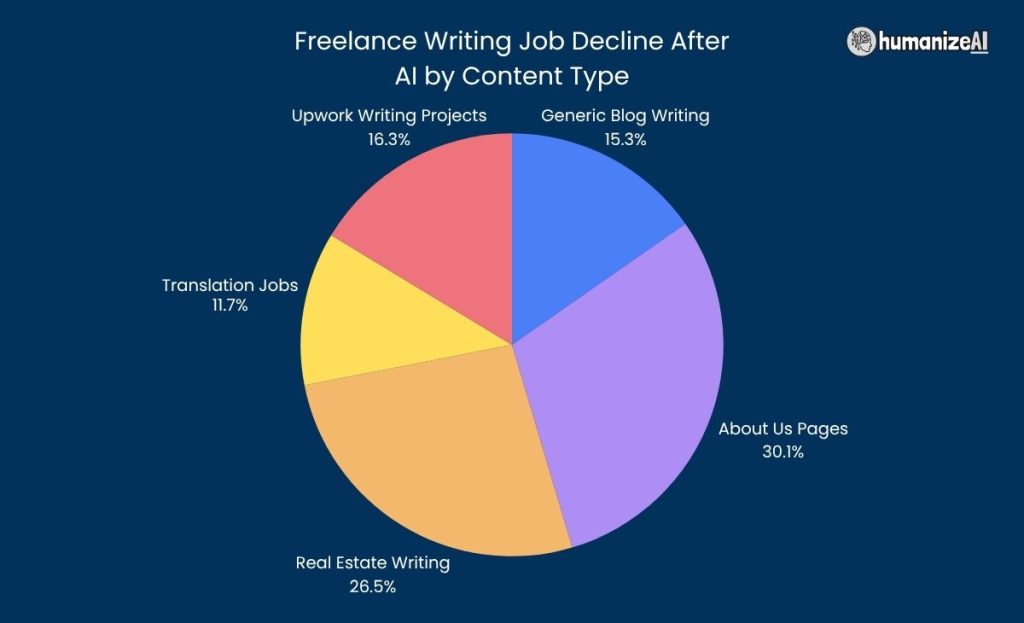
A 2025 study found that nearly 10% of freelance job postings could already be replaced by generative AI tools. Now, it is not an isolated event or as such. Here’s a quick look at the details:
- Researchers found that demand for AI-substitutable freelance work dropped between 20% and 50%, especially in short-term projects.
- Real estate writing jobs declined by 52%.
- While the “About Us” page writing dropped by 59%.
- Translation-related freelance jobs also declined sharply, especially Western European language translation work, which dropped by 23%.
AI Chatbot and Machine Learning Projects Are Growing Fast
At this point it is safe to say that businesses are increasingly searching for freelancers who understand:
- AI systems
- Automation
- Chatbot workflows
- Prompt-based operations.
- AI chatbot development nearly tripled after ChatGPT launched, growing by 179%.
- Machine learning-related freelance demand increased between 24% and 29%.
- Researchers identified more than 900 freelance job listings directly asking for ChatGPT-related expertise.
Clients Are Now Expecting More Skills From Freelancers
The study further highlights how competition across freelance platforms increased sharply after ChatGPT launched. Along with that, it also pointed out that applications per freelance job posting increased by 8.57%.
The number of required skills per freelance listing also increased by 2.18%.
At this point, the trend is quite simple and easy to understand. Clients are increasingly hiring freelancers who can combine:
- Writing
- SEO
- AI workflows
- Editing
- Intent research
It is not that jobs are shrinking. It is just that freelancers who offer multiple skills are becoming more valuable in 2026.
Long-Term Freelance Projects Are Becoming More Stable
However, there is one angle to all this detail. Researchers found that the biggest decline happened in freelance projects lasting 1 to 3 weeks. Since short-term freelance content gigs have become easier to automate using AI tools.
- Longer projects involving:
- Planning
- Editing
- Expertise
- Business understanding remained comparatively more stable.
- This is also one reason why retainer-based freelance work is becoming more common in 2026.
To Put It Simply: Freelance Writing in 2026 Is About Expertise, Not Speed
In 2026, freelance writing is no longer only about producing content quickly. It is increasingly about offering expertise, trust, and a strong personal perspective. Studies also showed that AI performs best in repetitive and predictable work, while strategic and judgment-based work still depends heavily on humans.
Researchers found that demand for novice freelancers declined after ChatGPT launched, and the demand shifted towards those who bring something more than writing.
Therefore, freelancers offering:
- Niche expertise
- Consulting
- Research-driven content
- Strategic services are surviving the AI shift far better than generic writers. As in the jobs are there, but now the market expects you to evolve to a certain standard to get the ball rolling.
Source