
Let me guess, you have lost count of how many times you have seen a post that says “SEO is dead.” No matter if you are just starting with your SEO journey or someone who has been in the industry for years, it is nonetheless an alarm.
Is SEO really a thing of the past? What do the numbers say? Is writing good content enough to see this through? What do the numbers say?
Read along as we discuss AI’s impact on SEO jobs for 2025, the ongoing trend, how it is reshaping our industry, and the current demand. We will not discuss theories but break down numbers and form an objective opinion. 🧐
Key Takeaways
- 69% of SEO specialists are expected to be impacted by generative AI. But "impacted" and "replaced" are two very different things.
- The global SEO services market crossed $108 billion in 2026, growing 16.8% year over year. Dead channels do not attract billion-dollar investments.
- Google still sends 345 times more traffic than ChatGPT, Perplexity, and Gemini combined. AI accounts for less than 1% of total web referral traffic.
- 86% of enterprise SEO teams have already integrated AI into their workflow, and 83% report better performance because of it.
- 90% of open SEO roles are at companies with 250 or more employees, and 40% pay $100K or more. The bigger the organization, the more they invest in human SEO talent.
- New titles like AEO, GEO, and LLMO specialists are being actively hired by Fortune 500 companies with salaries ranging from $75K to $174K.
- 76.1% of AI Overview citations come from pages already ranking in Google's top 10. Therefore, you cannot win search without SEO.
The AI SEO Job Panic Is Real: What Do The Numbers Say?
Let us first understand what exactly is happening. Are SEO experts being replaced by AI on a mass scale, or is it just an ongoing trend that we are seeing? A detailed report by Demandsage helps us with the direction. Here’s a quick look:
Here’s what the report has to say about the ongoing panic that eventually led to all the “SEO is dead" posts that you see:
- At this point, nearly 86% of enterprise teams have integrated AI into their SEO setup, and 82% plan to invest more.
- 56% marketers have already integrated SEO into their workflow.
- The report further highlights how AI-driven SEO can boost organic traffic by 45% and conversion by 45% for any e-commerce website.
Even though these numbers seem like a great win for the SEO team, this is where things become concerning.
- Nearly 69% of SEO specialists are expected to experience a change or be affected by the use of generative AI.
- Most importantly, this is not an ongoing trend or an internet obsession but a pattern and a new reality. The report further says that the AI SEO tools market will grow from $1.2 billion in 2024 to $4.5 billion by 2033, with a CAGR of 15.2%.
The report further highlights another important parameter. It says that, and I quote, “72% of marketing roles will be impacted by generative AI, including 69% of SEO Specialists.”
Therefore, more than half of SEO professionals are going to see a change or uprooting in their job patterns. Which, at this point, is genuinely concerning.
But, before you stop reading and start panicking about the impending doom, here is a counterargument from the horse’s mouth itself. Sam Altman has said in a recent interview that “I don’t know what the exact percentage is, but there’s some AI washing where people are blaming AI for layoffs that they would otherwise do.”
In other words, he believes that AI gets the blame for human incompetence. So, is it really true or do the numbers say otherwise? Let us find out.
SEO Tasks AI Has Automated and What Humans Still Do Better
People who don't know SEO think it is just some magical hack for better ranking. But needless to say, SEO is not a hack but the very backbone of content. Without SEO, there is no structure, no visibility, or website.
Things like keyword clustering and intent mapping, meta tag generation, technical site audits, internal linking suggestions, content brief creation, schema markup, first-draft generation, etc., etc., are not just fancy names. But, the core of your website, and even though AI has slowly and aggressively tried to be the better alternative, there are things it still can’t touch. Let us understand this with the help of some detailed numbers.
- According to hillwebcreations.com, as cited by Harvest, AI tools cut keyword research time by 80%. And we all know that with one phrase or word, you can get multiple relevant keywords in seconds.
- On the other hand, Tim Soulo, the CMO for one of the biggest SEO giants in the world, says that “....strategy, creativity, and judgment? Still human territory” in one of the pieces he wrote on Medium.
In other words, like any other aspect of labour, AI has brought speed and efficiency in SEO. But it is still very much human and thrives on human expertise. Let us understand this with a detailed analysis done by Bruce Clay.
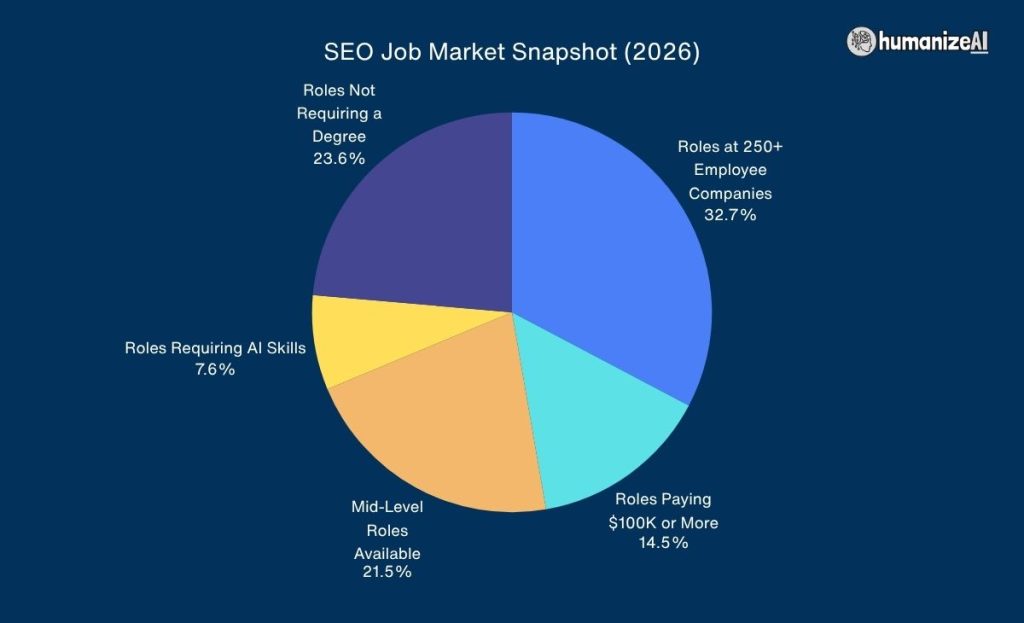
- Nearly 59% of open SEO jobs are now mid-level roles, showing that companies still need SEO talent.
- 90% of open SEO roles are at companies with 250+ employees. In other words, the bigger the company, the more they will invest in a human.
- 40% of open SEO roles pay $100K or more. (You don't pay six figures for a job you're planning to hand to a machine.)
- But, it is not that what others are saying is completely misguided. AI skills were requested in 21% of job listings, and that number rises to 56% in higher-paying roles between $250K–$300K.
- According to Robert Half, 78% of marketing leaders are willing to pay higher salaries to professionals with specialized skills, especially in areas like AI and advanced SEO.
Most importantly, the Previsible report found that nearly 65% of SEO jobs do not require a degree, while only 33% ask for a bachelor’s and just 2% require a master’s degree. In other words, when it comes to SEO, human skill, expertise, and perception are non-negotiable.
SEO Is Not Dead: It Just Got New Job Titles (And They Pay More)
Here’s the thing: AI didn’t kill SEO. And what is more convincing than the fact that the global SEO services market crossed $108 billion in 2026. (Growing 16.8% year-over-year). Think about it this way: will the companies pour a billion into a channel that no longer is relevant? ( Source: The Business Research Company)
They won't. And they aren't.
To begin with, organic traffic still drives nearly 53% of all measurable website traffic, which is more than paid ads, social media, email, and display marketing combined. Especially when it comes to B2B brands, it contributes to 44.6% of total revenue. Now, this is not a dying marketing channel but one of the biggest business growth engines on the internet, and SEO is what keeps it running.
(Source: Xpand Digital SEO Company)
More than anything else, here’s one thing we always tend to forget when it comes to the “SEO is dead” argument.
- Google sends 345 times more traffic than ChatGPT, Perplexity, and Gemini combined. So all this noise, chaos, and panic around AI is only 1% of the picture. The house is pretty much still in order. (Source: Ahrefs)
But, yes, something did change amidst all this, and it would be dishonest not to acknowledge it. Let us dive into the data published by BrightEdge and understand what actually changed:
- In April 2026, BrightEdge reported that AI agent requests had already reached nearly 88% of total human organic search activity.
As BrightEdge CEO Jim Yu explained, brands are no longer building only for humans browsing the internet, but also for AI systems searching, retrieving, and recommending information on behalf of users.
Now, a report published by Search Engine Land establishes this change further and says that AI assistants now equal 56% of global search engine volume.
This is the real shift. Search didn't shrink. It multiplied across surfaces. And that created an entirely new category of SEO jobs that didn't exist three years ago. This is why now we focus less on traditional SEO titles and dive deeper with AEO, GEO, and LLMO.
Now, these are not just buzzwords but live job descriptions with six-figure salaries attached.
- Experian lists an “AEO and SEO Manager” role paying between $100,649 and $174,459, focused on AI search visibility and discoverability. Source
- Odoo advertised a “Growth Marketing Specialist, GEO and AEO” role with a salary range of $75K to $95K for AI-driven search optimization work. Source
- ADT is actively hiring for a “Director of Discoverability AEO and SEO” role centered around conversational search and AI-powered answer platforms. Source
- Capital One has also posted a “Senior Digital Marketing Associate, AEO, GEO, and AI Search Lead” role focused specifically on AI search visibility. Source
Needless to say, we have moved past experimentation when it comes to these SEO roles. So, the narrative that SEO is dead is true, but for the limited or traditional SEO job roles. The demand for SEO didn’t die, and it never will. But it got expanded and diversified after AI entered the picture.
- The real opportunity lies in the gap between how fast search is changing and how people understand it. Nearly 31.3% of the US population is expected to use generative AI search in 2026, according to eMarketer. Therefore, brands are not looking for someone who knows how to optimize not just for Google, but also for AI search engines as well.
SEO Did Not Disappear, It Evolved
To sum it all up, thankfully, SEO is not dying, nor SEO jobs are irrelevant. It is just that with generative AI tools in the picture, it has become something more diverse, layered, and critical.
To shatter the illusion once and for all. SEO is not being replaced by GEO or AEO. If anything, SEO is the very foundation both of them rely on.
Ahrefs reports that around 76.1% of links cited in AI Overviews also rank in Google’s top 10 results, which proves one thing very clearly: you cannot ever earn AI visibility without strong traditional SEO underneath it.
Things like on-page optimization, technical health, content depth, authority signals, and E-E-A-T still matter just as much as before. The difference is that now they influence two things together: one, a traditional search, and two, your visibility across your favourite AI tool.