
We have a problem every time we think about writing; we reach for our favorite AI tool instead of Google Docs. Be it our marketing, sales, product, customer outreach, and support, the writing assistants are everywhere. And this is not some random passing fact; according to McKinsey, roughly 88% of organizations now use AI in at least one business function.
And why not? It saves time, a lot of money, and the unwanted hassle. But if only AI could have written like a human. + Relying on AI for important corporate content is reassuring, true. But there are a lot of repercussions.
Read along as we discuss AI writing assistants and their impact on corporate content quality, and what it means for you and your favorite writing tool. But before that, let us understand the basics and navigate our way around it.
The New Corporate Content Landscape: What Changed In 2024-25
Currently, corporate is under a strange kind of pressure. Content is no longer a simple marketing function but the basis of their very identity. Every communication that goes out needs to be original, relatable, fast, and yet very human.
Along with that, there is pressure to scale things with AI while keeping it a secret that it’s AI. One has to impress Google, the client, and the customers with blogs, emails, release notes, microcopy, scripts, and playbooks each time, that too with original content. And eventually, all of this led to a halt or a crack.
- Google and AI overviews changed the rules: Google doesn't mind you posting two blogs a day. Or, using AI to write it. What it cares about is:
- Is this original?
- Does it actually answer the query?
- Does it come from real expertise or real reasoning?
And it is not some SEO prediction or a guess. Google has been explicitly recommending creating people-first content that demonstrates first-hand expertise and depth of knowledge if one wishes to get noticed or rank.
- Brand voices started sounding… identical: When everyone started to sound the same, things began to go haywire. The writing became unforgettable, and Google stopped prioritizing the content.
- Content velocity spiked, but quality didn’t: We got stuck with the most basic question, “If AI is helping us create more content… why is no one reading it?” The answer was simple: even though we were producing more than ever, the insights were shallow, the tone was robotic, the concepts were repeated, and so on. In short, surviving the competition became difficult.
- Teams realized AI wasn’t the problem; their approach was: AI was good for speed, efficiency, and scalability, but without the human insight, all it said was the same thing. This created a new kind of crisis for businesses of all sizes, MNCs, startups, SaaS companies, and D2C brands to move past robotic content while keeping up with AI's speed.
What AI Writing Assistants Actually Do (And What People Think They Do)
Is buying the premium subscription to your favorite AI writing tool the solution to all your concerns? Well, this is where most businesses or teams tend to falter. We always think that AI is going to do it all for us:
- Write the perfect blog
- Understand our brand’s voice
- Talk about the user’s search intent
- Replace a human writer and so on
And this is where things go wrong; teams tend to forget that AI doesn’t have shared experience. It cannot think, feel, or assess something like we do. Hence, the content it writes keeps sounding the same and follows a repetitive pattern. With AI, you get:
- New language and no fresh insights.
- No added expertise that is not already known
- A generic tone that is usually the same for each type of content.
Now, if we keep our high expectations aside, this is what an AI writing assistant is designed to do:
✅ A smart AI assistant will help you brainstorm and generate ten different angles instantly.
✅ They help you with quick summaries, rewrites, variations, tone adjustments, and so on.
✅ You get cleaner and more readable writing.
✅ AI is designed to handle volume like emails, templates, customer support messages, and so on.
With AI, the main thing that is missing is personal experience and expertise, which Google prioritizes the most in 2025. Since AI doesn’t have lived experience, the companies need to have the perfect mix of AI- and human-driven workflow.
What High-Quality AI-Assisted Content Actually Looks Like
For far too long, we have been trying hard to somehow move past the robotic edges and strands left by AI. In most cases, we failed to achieve those ultimate results because of our lack of perspective. The focus should never be on hiding the use of AI, but on generating content that reads original. There is always a fine line.
The Corporate Content Workflow That Actually Works in 2025:
You have to have a set structure to make sure that not only you get the best out of your AI tool, but help you maintain the flow of content, make it read more human, and so on.
The idea behind it is simple: you let the AI do its thing as you guide the way:
- You are in charge: Depending on AI to ‘find” your brand’s voice is the biggest misstep in this entire situation. Think about this, AI doesn't understand that food also has a sentimental value for us. So, if you are someone selling online processed food from the forgotten times, you cannot rely on AI to craft the narrative. This is what it will generate if you do not take the lead:
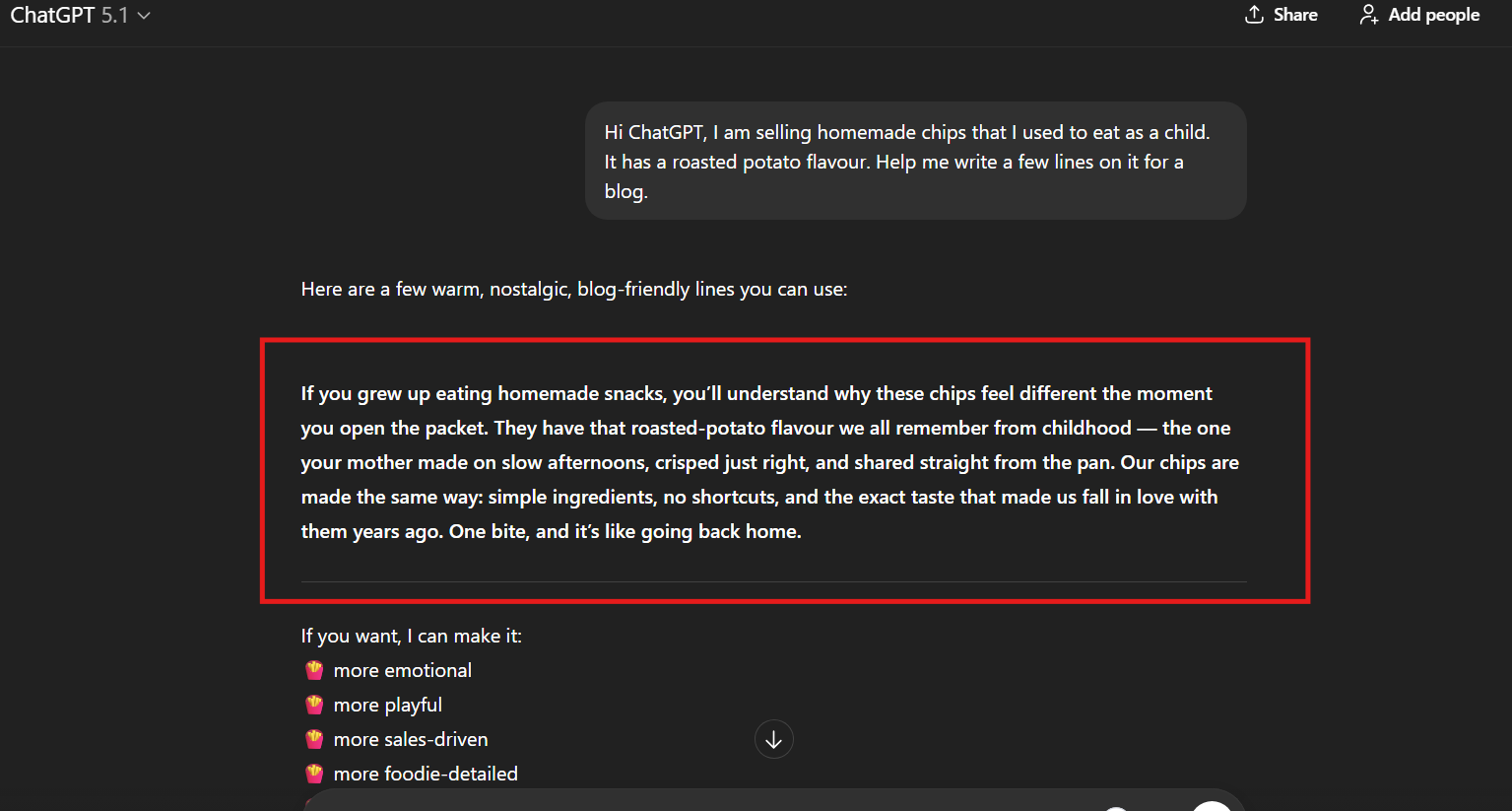
- Add Human Insight and Real Expertise: This is where you step in and tell AI or use a tool that lets you add personalized insights for more personalized results. It is about shutting down the same old, repetitive noise and giving your users what you truly mean and stand for. Or, in short, write your content in a way that will impress Google and AI answers.
- Use AI for Drafting (Not for Thinking): You can always rely on your favorite writing tool to show you the way. Use it to draft your sections, expand it, help with an outline, and so on. In other words, let AI take care of the technical aspects while you make sure you add the essence, feel, and the voice.
- Rely on HumanizeAI.io to to do it for you:
But doesn’t this go completely against what I have discussed so far? Not really.
The idea is to use AI for speed and efficiency, all the while preserving your brand’s message. No one wants another AI tool that takes over the entire thing in the name of speed and efficiency, only to disappoint Google.
That is why with HumanizeAI.io, you not only join the league of 12 Million+ users, but also get an overall writing assistant that does it all. Not only do you get to work with a powerful AI humanizer, but it also comes with an added set of writing tools designed to adapt to your tone, voice, and brand identity.
More than anything else, it doesn't require you to add elaborate prompts but to explain the idea in your head, in your words, and it will take it up. Even if you use it simply as a humanizer, you will realize that it preserves the main message, all the while getting rid of all the robotics undertones.
Or, to put it in simpler terms: It knows how to read humans. Sounds intentional. And carry real expertise. Not only that, but it also solves the biggest problem of the modern AI setups: the sameness of the robotic content and the same repetitive loop.
The Future: Using AI Smartly Will Set You Apart
To begin with, we have to acknowledge the fact that AI is here to stay. We cannot compete with its speed of scalability, and honestly, we don’t have to. It was never about AI vs. human when it comes to corporate content. But it is about realizing how to use AI in our favor, all the while keeping our brand voice intact.
The brands that will stand out in the coming years are the ones that treat AI as a tool, not a replacement. They will use AI to handle the technicalities, but rely on human insight to bring originality, depth, emotional intelligence, and so on.
This balance is exactly what Google rewards, and what AI overviews choose to surface as “helpful content.”
Here are a few things that will define the future:
- AI for Speed, Humans for Depth: The ideal workflow is going to be the perfect balance of efficiency and reasoning. The writing assistants can structure and speed up the work, but the real work, reasoning, and emotional depth still come from humans. This balance will be a non-negotiable in the coming days.
- Quality over quantity: Corporate has already started to realize that mass-producing content was never the solution. From 2026 onwards, it will all be about content that addresses, answers questions, and reflects expertise.
- Brand Identity will be Everything: People scroll past content in seconds, the moment you do not offer anything new. Moreover, with so many businesses using the same AI tool, a business that doesn’t prioritize brand identity goes for a toss.
At this point, it is safe to say that writing assistants on corporate content have shown us one thing very clearly: speed without authenticity is useless.
This is exactly where HumanizeAI.io also steps into the picture.
- You get AI’s speed, efficiency, and scalability backed by your authenticity, originality, and human essence.
- The all-in-one setup not only helps you to humanize your content but also to write, paraphrase, fix grammar, and do so much more.
- It ensures that your content sounds like it was written with experience, emotion, and intent, something that modern corporations, depending on AI, cannot ever create.
In simple terms:
AI writing assistants give you the draft. HumanizeAI.io gives you the quality, essence, and brand voice.
Bringing It All Together
Relying on AI to help shape our content was truly a life-changing affair every step of the way. Never did any of us think we could generate a blog in seconds or write the most appropriate email with a click. But like any great setup, it also had its pitfalls.
We all started sounding the same, lost our brand’s voice and identity, and our mission or purpose to be human, helpful, original, and scalable was lost in the way. AI writing assistants changed the pace of corporate content but also exposed its weaknesses.
Therefore, we have finally reached a point where we know that the future is no longer about choosing AI or choosing humans. It is about having a perfect blend of both and relying on a setup that helps us achieve so.