
If you never really warmed up to the looming presence of our new best friend, AI, I know what you are probably thinking. This is your “I knew it” moment, where you think AI needs biased and fabricated data for you to rank.
But hold on, before you start raging against our trusted companion. It is true that being right isn’t enough for AI visibility today. But! Not in a way that you think.
Think of AI as someone who is in constant panic of not being embarrassed by the sources it pulls. In short, if you wish to be cited by AI, you need to check all the boxes.
But what is this checklist all about, and how does it impact your content strategy? Read along as we break it down for you one step at a time. Spoiler alert: it is not your obvious list of asking to write with more context. 😝
The Internet Has a Correctness Problem (Not a Quality One)
The problem is very simple, actually; everyone is correct these days. We all do our research, we all get our facts right, and on a good day, we even consider the search intent.
But this is where the conflict begins. For AI, there are almost thousands of users telling it to trust them. Imagine an intense scene in some stockbroker’s office when the bidding is on. Everyone is screaming, saying, shouting for that one citation.
So, when there are:
- 50 blogs that say the same thing
- 25 are just rephrasing the same idea
- 20 are using the same old AI-generated content
- Now only 5 are accurate
Thus, AI never asks who wrote it best, but whose content is the safest to cite?
Or when so many sources say the same thing, AI chooses the one that is familiar or verified. In other words, the same way you select your citation or data for your paper or blogs.
This is where things get uncomfortable and difficult for one to accept. You can do everything right, the facts are detailed and correct, even the SEO score is fine, but you are nowhere on AI Overviews, ChatGPT, or Perplexity’s citings!
In short, the game has now changed. The criteria have now gone beyond visibility, and it is also about how skillfully the AI system can reuse, summarize, and push for your content without risk. And you have to be extremely careful about this, because “Gartner predicts that traditional search engine volume will drop by 25% by 2026 as users shift toward AI chatbots and virtual agents for answers.”
Therefore, it is not you who is skeptical of AI, AI is skeptical of you as well.
The Real Metric AI Cares About—CitationConfidence
To begin with, this doesn’t mean being right will take you nowhere. To be honest, that is the baseline from where the conversation starts. The discussion here is about how you have to do more than just being factually accurate.
The correctness metric is like having a stable internet connection. No matter the kind of setup you have, it is a non-negotiable. But no one really talks about it since it has now become invisible. Since every other site says the same thing, AI has to find the one that it can trust the most.
Consider this example.
- Imagine both sites A and B say that drinking water is good for dry skin.
✅ However, site A is a reputed website on skin care, may or may not have a high domain authority, but has genuine reviews, updated blogs, and a great website experience. It elaborates the query in a way that answers follow-up questions, makes a user think about the effects of dehydration, and is quotable.
❌ Whereas even though site B gives the same information as site A, the content is a bit rigid and robotic. Doesn’t talk about the side effects, the ideas make no sense, the last updated blog on the site is years ago, and the website experience is a bit lacklustre.
You already know what I am going to say next. No matter how many times site B asserts that one should drinkwater, untill and unless it elaborates on its content, AI will refuse to acknowledge it.
Let us see these results on a real-time basis. With a question as obvious as this one, you might think either a skin care blog or some skincare influencer will be at the top post. However, this is what it looks like.
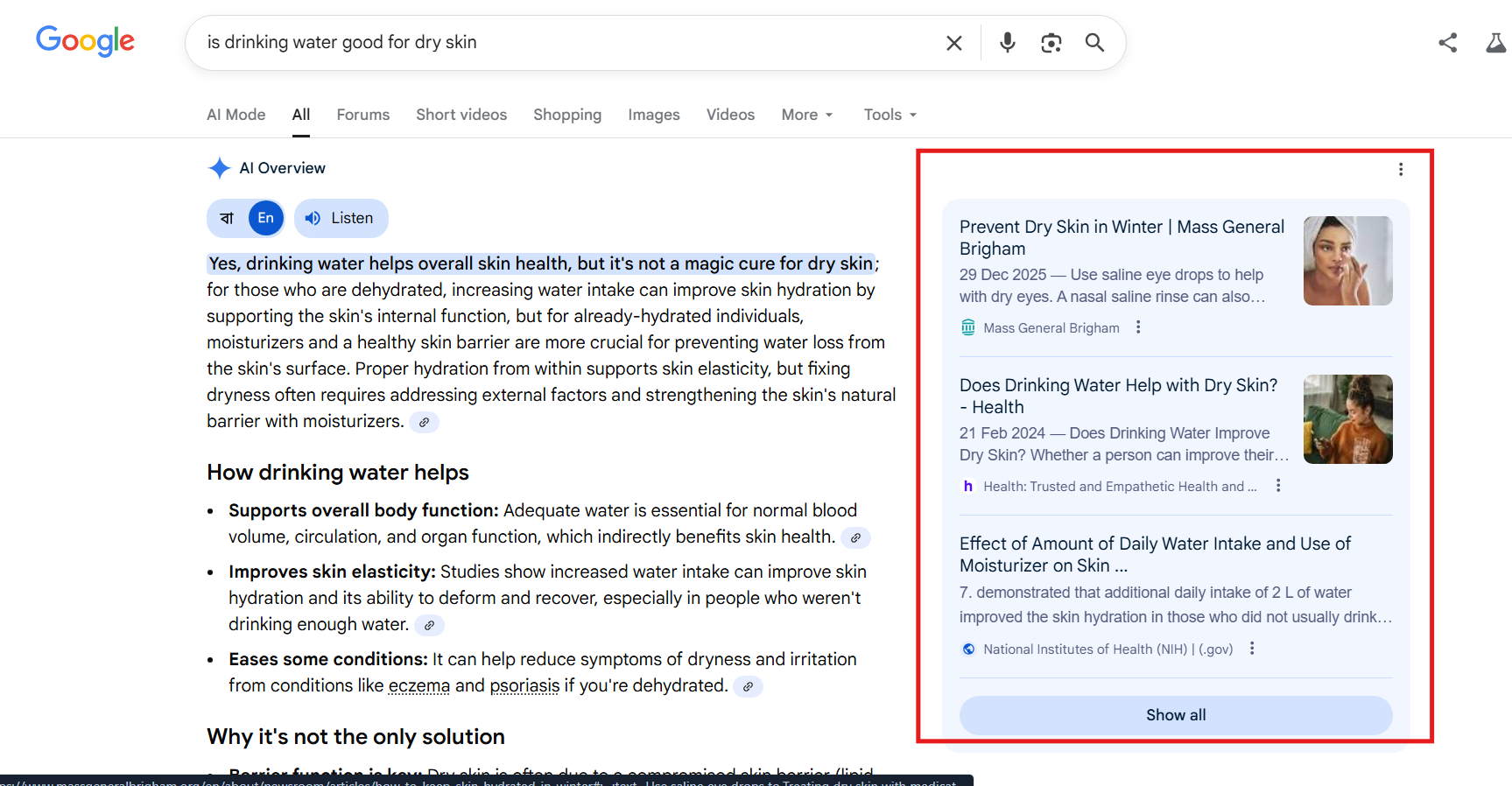
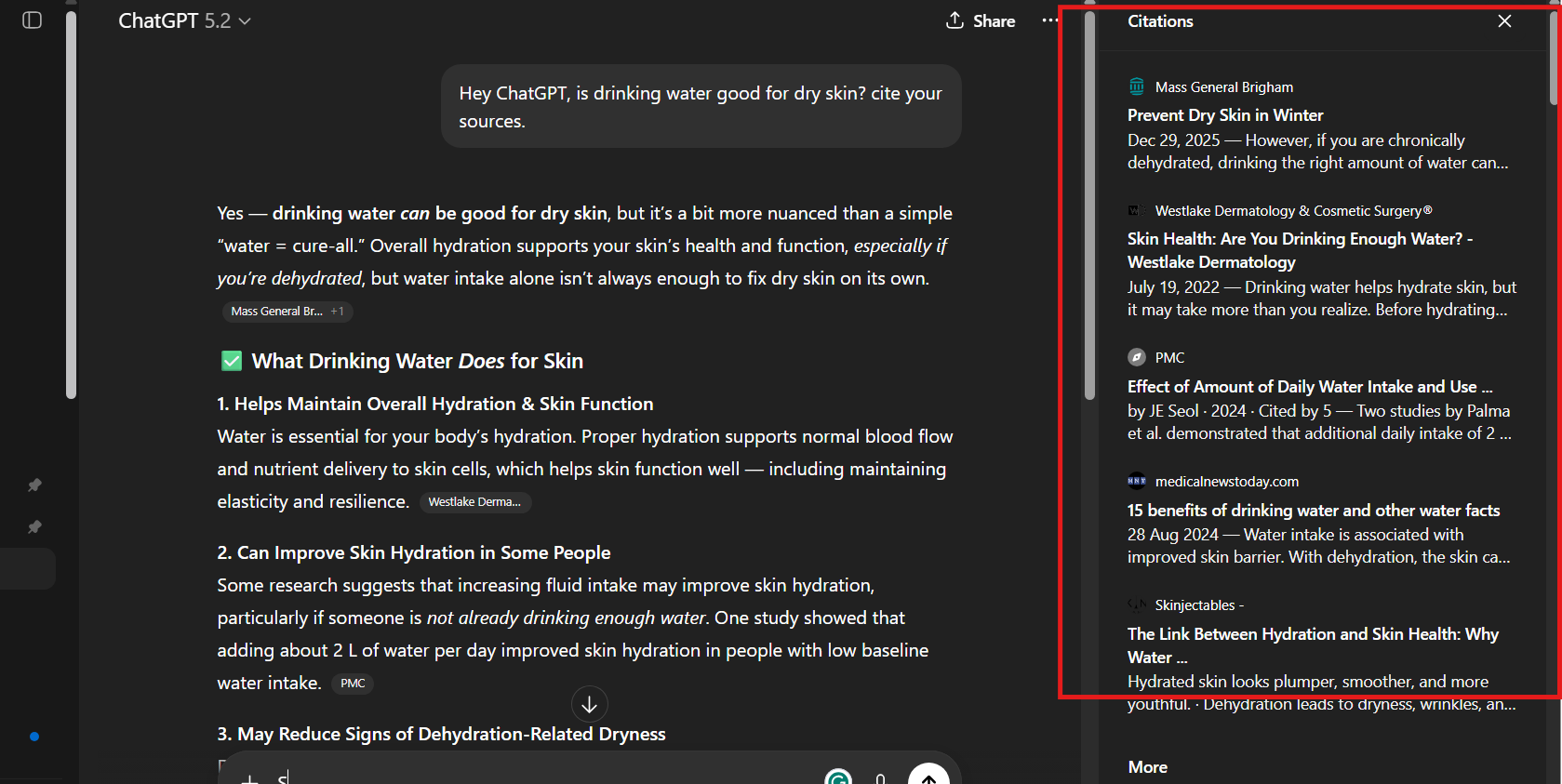
The conclusion here is obvious:
- AI is pulling information from sources that look safe, trusted, and will not embarrass it later.
- AI is not really discovering information here but conforming it.
- The answers are not dramatically different for each of the cited sources, and they have a balanced and structured conclusion.
Have you noticed one more thing? These are not the longest or most detailed articles available online.
Instead, they are:
- Medical institutions
- Dermatology clinics
- Government-backed research portals
Or, something that AI will not hesitate twice to quote or cite. This is where just being correct is not enough. It falls short because every link on the SERP says yes, it is necessary to drink water, but only a few get cited.
So, does this mean businesses that are just starting or have a lower domain authority will now fail? What exactly does one need to do?
What Citation Confidence Looks Like in Practice
Here is another important thing for you to keep in mind: AI will never ask who has the highest domain authority. It rarely cares. This is exactly what data published by Exposure Ninja says: “Only 12–15% of sources cited in AI-generated answers rank in the traditional top 10 organic results.”
All it asks is “Whose information can I safely reuse without needing to explain myself?” This is where most content strategies fail, and people run to some random LinkedIn guide for answers.
Here is a quick way to steer clear of all the confusion. It is about you understanding two crucial aspects:
❌ “You are small, so you won’t get cited.”
✅ “Your content needs to be safe to reuse.”
Citation confidence is not something that you can track or is another ranking factor. However, it is something equally crucial. It is a culmination of a few non-negotiables that convince AI that your content is safe to use:
Clarity
As you have seen, AI doesn’t quote your paragraphs as you intended it to. It reads the entire thing and summarizes the content to its users. Now, if your content only makes sense in a certain way, AI will not push it. No matter how well researched it is.
Stability: How long will this be relevant?
Think about it from AI’s standpoint here. Every product, model, or service on the market wants to give its users the best experience. That is why it will never allow itself to cite outdated or unstable information.
That is why blogs or content that answer every aspect of the query backed by credible facts win the round. It can never rely on predictions or uncertainty. In other words, when you ask, “Is drinking water good for dry skin?” It will only look for “yes” or “no” answers.
Verifiability
Here is a quick formula for you to remember this by: “AI verifies with authority, but cites clarity.” Or when you ask AI if drinking water is good for your skin or not, it quickly checks with the top medical websites. However, it relies on the one that explains the entire concept in the simplest terms. This is why being only right is not enough for today’s search world.
This is also why small brands are still cited, because AI doesn't need to be famous, all it needs is dependability.
What Increases Citation Confidence in AI Systems
Unfortunately, there is no button that you can use to increase the citation confidence. It is something that happens organically. This is exactly why you must first begin by asking the most basic question: What will make AI trust me?
- The main answer has clarity and appears early: AI likes it when you explain the core concept before jumping into the explanations. This way, it assesses what to expect and is also able to cite the relevant section appropriately.
- Your explanation is consistent: As you talk about drinking water for dry skin, you make sure you talk about the benefits of water, skin types, and so on. You cannot really discuss skin care supplements under this topic; it will disrupt the entire setup. In short?
- The central message does not shift
- Your supporting sections reinforce the same idea
- AI trusts content that knows where it stops: Imagine you are selling dry skin care products. As you write blogs, you keep explaining how critical it is to drink enough water along with following a proper skincare routine. This is where you begin to win AI’s trust.
Because AI has to compress the answer from various sources, it is critical that there be no exaggeration or unnecessary claims. So, when you say your skin care products can fix dry skin, that is a shaky claim.
It wants something more elaborate and tangible from you. Like “Our ABC cream is great for dry skin but does not replace the benefits of drinking water or heal underlying skin conditions.” This is why content that acknowledges limits is often cited more than content that sounds certain. Because then AI knows what exactly it is dealing with.
TL;DR Being Accurate Is Not the Same as Being Reusable
Think about it this way: if being quoted by AI is a concert, writing accurate content is buying the ticket. In short, the bare minimum. But what actually guarantees you the spot is being reusable as well. Now, reusable content doesn’t mean you copy other people’s work.
In technical terms or possibilities, reusable content means:
1. The message remains the same when it is being cited or quoted.
2. It remains accurate even when shortened.
3. You get a clear vision of the intended scope of the content.
This is why two pages can say the same thing, and only one gets cited. Therefore, in AI’s world, accuracy qualifies content, but reusability helps with citation.