
Nick Fox, SVP of Knowledge & Information at Google, made an announcement that Google sends “billions” of clicks to actual web traffic. For many, it might seem like an assurance. However, for a marketer or business owner, this is another set of confusion altogether.
Simply because the dashboard tells a different story. Ever since AI Overviews, the numbers seem to bleed, and website traffic is a myth. So, what exactly is happening?
Read along as we analyze and understand what Nick actually meant to say and what it means for me and you.🤔
What Google Actually Said
At a glance, Nick Fox’s LinkedIn post seems like a direct answer to our major worry. Is AI Overview actually helping me with organic traffic? In the first read, it feels like he heard all the commotion and decided to clear the confusion.
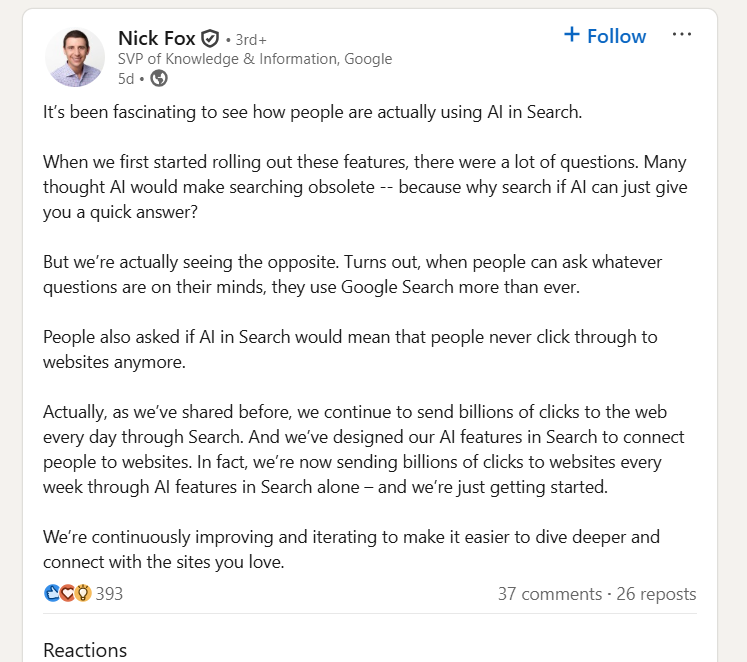
He answers that “Google is sending billions of clicks to websites every week through AI features in Search alone” and they are “just getting started.” Now, the reason it is creating such a buzz because it is the first time Google has published a weekly number.
Moreover, the number just says billions and gives no additional details, which is making people wonder and, at the same time, question the claim more. Here’s a quick look at the post:
The Real Problem: A Big Number With No Bottom
The moment you hear the word billion, it seems to ease your concerns instantly. But then come the obvious questions. The first concern is billion out of how many, and secondly, does it work the same for your competitors as well?
This creates confusion because without a total to compare it to, the number doesn’t really solve anything. If AI Overview is only sending a billion clicks to the website per fifty billion views, then it is just a negligible slice. However, if it is, say, two out of four billion, then that changes the entire story.
As Search Engine Land points out, it is more of a claim than a measurement. It is simply Google telling you Don’t worry, I have sent you a lot of clicks! However, there is no way you can actually measure or establish it.
Secondly, you cannot compare it with your site’s own analytics, and you are simply left wondering if you are doing it right. Let us understand this disconnect in a bit of detail:
Search Console's New AI Reports Still Skip the One Number That Matters
When you see an arbitrary number like this, the right approach is to run to the Search Console. But that’s the thing: this time it won’t really help. Simply because there’s a disconnect now. Let us break it down.
At this point, you have two Search Consoles, but not one of them serves the purpose it is supposed to.
- Search Console's Regular Performance Report: this is the one that shows you the daily clicks, impressions, CTR, and position that is your own data. Consider this your very own surveillance system.
- Search Console's New AI Report (launched June 2026): Google launched the AI report this year to help you stay ahead of the AI Overviews. It shows impressions, pages, countries, devices, and dates for AI Overviews and AI Mode, but it does not include click data at all.
This is where the gap lies: your regular report can tell you "you got 10,000 total clicks this month." Your AI report can tell you "your page showed up 50,000 times inside AI Overviews." But neither of these reports can tell you how many impressions led to clicks, or where the two reports can actually merge.
To help you understand this better, imagine that you have your bank statement, and it shows your total spending for the month. And there’s a separate receipt that shows you travelled to a specific cafe all throughout the month. But no piece of evidence or statement tells you how much money you actually spent in that cafe. This is exactly where the commotion and confusion lie.
Also, there is a second layer to all this. Google’s billion claim is about the entire Google’s overall search ecosystem. It is not actually specific to your site that Google will be pushing the numbers to. Therefore, even if you check your AI report, there is no way you can verify Google’s claim. Or, actually establish whether you are actually ahead of your competition or not.
What Independent Data Actually Shows
Since Google didn’t help us with the actual number, we had to rely on independent trusted sources. How the website and the present attention-starved audience react to AI overviews, let us find out:
PEW Research Center analyzed data of 900 US adults and pointed out that “Google users were less likely to click on result links when visiting search pages with an AI summary compared with those without one.”
As in most cases, your potential users may never land on your website since AI Overview has already given the answer to their question.
Another study by Search Engine Land, according to new SparkToro research based on Similarweb clickstream data, highlights something of a similar nature: 68.01% of Google searches in the U.S. ended without a click during January to April 2026.
So, on one hand, you have Google sending you a billion clicks your way. On the other, you have these numbers that say the complete opposite. A contradiction like this leaves you stranded in the middle of the way wondering which side to eventually lean on.
Honestly, it is always tempting to believe that Google is doing its part and helping us sail through the AI Overview journey. But, on the other hand, the bleeding dashboard and these numbers convince us otherwise.
Why This Timing Isn't a Coincidence
Well, sometimes we almost forget that Google itself is a product. It will do all the possible things to maintain its PR campaign and be in the good books of its users. The thing is it just didn’t wake up one day and thought of having a pep talk with all its users. It was a retaliation technique for an obvious accusation.
It all began when the Competition and Markets Authority (CMA) declared that websites can now opt out of AI Overviews. Simply because many websites had complained that they had seen a significant drop in traffic with the AI Overviews. (Source: BBC)
In simple words, with CMA’s shield, a website in the UK can now conveniently opt out of AI Overviews without sacrificing its search rankings. Before this, saying no to AI Overviews could mean disappearing from search results too. Now that's no longer allowed.
Now, think about the entire dynamic here and the resistance. As Google takes up most of your organic traffic and yet expects you to be a part of AI Overviews, CMA comes along and says that is no longer allowed. This way, Google gets pushback and realizes the loss of credibility and the pressure it had created. Thus, it runs for a PR Save and gives a hollow assurance that it is still pushing traffic your way.
So this wasn't Google casually sharing a niche statistic. It was Google's way of publicly responding to concern, and yet not divulging much about the data or any specific details.
A Simple Way to Monitor AI Overview Performance
The problem is that there is no dedicated button that tells you if things are in place. As we have seen earlier, you need to mix and match two existing reports and see whether you are heading in the right direction. But remember this will not tell you your AI Overview clicks, but it can help you identify patterns over time.
Step 1
Open your regular Search Console Performance report and pick a group of pages. Set a time frame for the number of clicks per page.
Step 2
Now, switch to your AI report inside Search Console. Look at the same pages, same time period. Note the impressions: That's how many times each page appeared in AI Overviews or AI Mode.
Step 3
Watch the relationship between the two reports over time instead of looking at a single day or week. If your AI impressions keep increasing while your total clicks remain flat or start falling, it may suggest that your pages are appearing more often in AI Search without generating the same level of traffic. That is your sign.
[This does not prove that AI Overviews caused the decline, but it helps you identify a pattern worth monitoring.]
It tells you that AI Overviews are showing your content more, but people still aren't clicking through. Now, you can always cross-check it with Google Analytics. Look at your landing page traffic for the same pages, same period.
If the direct search traffic is slowly going away within the same time period, this means you have a pattern that you can actually trust.
[Keep in mind, this is not an official measurement method. Google has not endorsed or verified this approach. It is simply a practical way to spot a trend using the data you already have access to.]
Conclusion
Let's quickly rewind what we know so far. This month, Google gave us a number, but that number cannot be checked by anyone outside Google. Not by you, not by any marketer, not even by the journalists who first reported it. So it was not an opinion. It was not an insight. It was simply a statement that has no baseline, no percentage, and no report attached to it.
On the other hand, independent research with tangible data shows something completely different. It shows something far more consistent and far more tangible. There is currently one truth, and that is: fewer people are clicking through Google searches compared to before.
So here is the honest takeaway. Without picking a side dramatically, Google's claim and independent data are not necessarily lying to each other. They can both be true at once. A number can grow smaller as a percentage while still being large in absolute count. We all understand that. But at the same time, this is not something that should actually comfort us, because we really do not know where the bottom lies.
So practically, it is simple. It is better not to treat Google's statement as reassurance, and let us not consider it proof of decline either. Treat it as one unverified data point sitting next to several verified ones. Until Search Console actually shows an actual click number for AI Overviews, keep doing what you are doing, and make sure you are always out there to impress the AI Overviews and eventually the popular AI search tools.