
Imagine doing all the work and somebody walking away with all the credit! In 2026, a writer and a marketer are living with this feeling every other day. With the AI Overviews and generative AI search tools, every great piece of content is another AI citation minus the writer.
So, why does AI search cite your content but not your brand? Technically, there are two layers to it, and the good news is there is an easy fix. Read along as we discuss this in detail and understand what it means for you and your business. 🙂↔️
There Are Two Different Games Here: Usage and Citation
To begin with, all an AI tool cares about is answering the question someone has asked. Now, this means delving into the depths of the internet to find the answer regardless of the brand or the websites. In AI’s search dynamic, domain authority rarely matters if you can uphold the search intent.
But this straightforward and assuring pipeline has one major loophole. Some brands get brand-name visibility with the answers; others? Well, they are simply used to build one.
In other words, two things are going on. Now imagine someone asks a question to ChatGPT or Google AI Overviews. For a brand, there are two ways this will be answered these days:
Usage
This is the main reason for the panic and LinkedIn meltdown that you scroll through each day. It is when AI quotes your answer or uses your content to explain something without giving you the due credit.
This way, the user gets what they want; they don’t need to scroll any further, and there goes your incoming organic traffic for a toss.
Citation
Now, AI Citations that escape pod that saves you from this crisis. It is when say the AI tool or Google’s AI Overview, not only cites your answer but gives you the due credit as well.
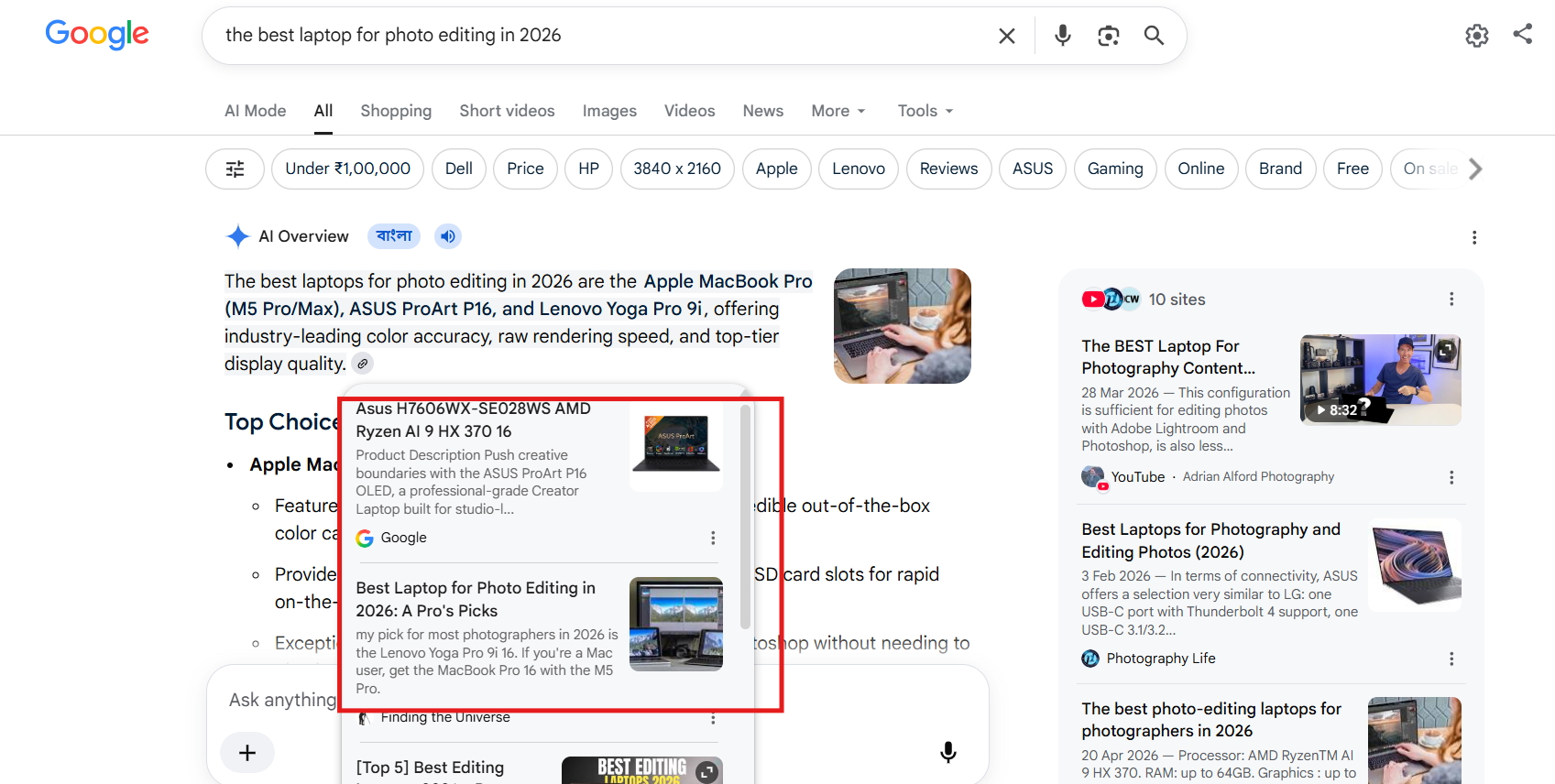
AI Overview Citation
As you can see in the picture, even though the AI Overview answers the question directly, the brand is tagged and mentioned. Even though it is not a guarantee that someone will actually click on the link, it is still a faint assurance that the world lives on.
This isn't a small side effect either. Search Engine Land broke it down in detail, with research showing that inside models like ChatGPT, the number of sources it cites and the number it uses without citing are almost identical.
The Ahrefs researchers found that when ChatGPT prepares an answer, it looks at around 33 sources in total.
Roughly:
- About 16.6 sources become cited (the AI shows or references them)
- About 16.6 sources are used behind the scenes but never shown to you
And if you talk about the specifics, nearly 68% of everything AI pulls without giving credit comes from Reddit alone. In other words, community threads, forum answers, real people typing real opinions—all of it gets absorbed into the answer with zero name attached. This way, ChatGPT or your favourite AI tool not only gives a precise answer but also cannibalizes your website as well.
AI Does Not See Your Brand, It Sees a Fact
To understand why AI cites your content and not your brand, you have to change your perspective a little. Think about AI as the brand itself. Now what does a brand want? The best for its users.
In other words, you will stop relying on ChatGPT or Claude the moment you see it is not giving you coherent or relevant answers. Thus, for the AI giants, it is all about giving exactly what their readers need.
Thus, it doesn’t care about the brand, the domain authority, or the type of product you are selling. If you are the one answering the question and addressing the search intent, you will be cited.
This, on the other hand, also means AI has no interest in promoting you or your brand. All it cares about if you have the perfectly curated answers for its readers’ queries.
So, if you see that your website is not being cited is simply because AI doesn’t wish to associate itself with your brand. Why? Because it is a matter of credibility and AI’s own brand image.
If you look at this from the AI perspective, it means you lack the trust factors or the credentials to be cited by AI. Think about it as how job referrals work on a real-time basis. Nobody would want to rally for an incompetent employee during the referral season. It is the same with AI; it would never recommend your content that is not upto the mark or lacks research.
Now, the question is why exactly does this happen? How does a brand unknowingly or knowingly become an incompetent employee or someone that AI actually despises?
Generic Content Never Gets the Credit
It won’t be an exaggeration if we say that for every topic there are ten different answers. Therefore, simply relying on the basic generic content won’t really help you rank. If you wish to be cited, say for example, for the query “Is SEO Dead?” you cannot really just write only about Google’s AI Overview.
You have to rely on thorough research, do a deep dive, and help your users understand what exactly is happening. Relying on generic answers or repeating what has already been said before doesn’t guarantee you a place at all. No matter how popular you are as a brand or the sales numbers you hit.
There is, however, one other thing you have to keep in mind before you start panicking or blaming your writers. Even when you do everything right -original research, a real point of view, a deep dive nobody else bothered doing- there is still no guarantee your name shows up next to it.
The Semrush Ghost Citation study points out that 62 percent of AI citations happen without any brand mention at all. As in AI used your content, research, and hardwork but never gave you the due credit. In other words, you become the ghostwriter for your own website. So, how does one stay relevant and convince AI that you deserve that citation?
How to Actually Get Cited, Not Just Used
Let us be honest, it is a brutal world out there. We live in a time where we might not be cited for our own hard work. But thankfully, there is another side to this story! Imagine the brand value once you get picked out of thousands of websites. Moreover, the trust signal it triggers for your next batch of writing or content.
Now, the challenge here is critical, which is true, but it is also very simple. All AI wants is the perfect answer to the query that understands the search intent. The point being, if someone asks for the best AI Humanizers that help with AI detection, you need to answer it in layers.
Only talking about the features of the tool will make it another generic article that is already flooding the internet. Instead, you need some precautionary yet simple steps which include:
- Answer the question in the first section directly. So that it is easy for the AI to crawl through your answers without any unnecessary buildup.
- Type in real questions in the H2 or H3, or write them in a way that people actually tend to search.
- Include original data, a stat, a number, or a finding that cements your claim and assures that you have done thorough research.
- Try to blend your brand name within the answer for AI to quote it whenever it is citing your answer. Think about it this way: if you do not give a shoutout to your own brand, AI won’t have a valid reason to do so either.
- If you get talked about outside other forums like blogs, review forums, and other websites, it acts as a bonus. This convinces the AI that you are trustworthy, you know what you are doing, and cites your content without hesitation.
The Real Goal Isn't Visibility, It's Credit
So, long story short, is AI stealing your work and taking away all your readers? In hindsight, not really. To begin with, you have to remember that there are no AI citations or AI Overviews without you and your website.
Most importantly, AI doesn’t sell products or is a competitor. It is simply doing what it was built to do: answer the question fast, and move on. It doesn’t care about credit or any other aspect of the content dynamic.
The point is, being used by AI means your content was good enough to solve someone's problem. But being cited means AI trusted you enough to put your name on that answer to the query.
Now, the first one happens by accident. The second one happens on purpose, and this is exactly where you come in. This is where you focus more on original content, research over recycled opinions, and a real, credible presence across the internet.
If you think about it, none of this is complicated; it is just being consistent and showing up by understanding and acknowledging the search intent. The secret to this is simple: produce content in a way that your brand is impossible to be simply left out.