
What is common between a content writer, a student, and someone who is doing their research? All of them worry about being wrongfully flagged by the AI detectors. You will find everyone trying to find various hacks on how to avoid AI detection in writing now and then.
But a situation like this demands more than a hack. These days, one wrongful detection can cost us life-changing opportunities. We have reached a point where we worry more about our credibility than about our creativity.
The thing is, this anxiety of not knowing how things might work out for us every time we write something is scary and affects our thinking and creative process directly. Needless to say, no one wants to go through this daily.
Therefore, to help you navigate this situation better and ensure nothing takes away the joy of writing, we have come up with a solution. Read along as we discuss a few quick and ethical ways to beat wrongful AI detection.
But before we dive into fixing what is broken, let’s first understand what exactly needs fixing.
What Are AI Detectors & Why Are They So Judgmental?
AI detectors were invented mostly because some setups only demand writing that’s original. Sometimes, relying on AI-generated work for research or even a new marketing brief can lead to real-life damage. Hence, a gap like this prompted the rise of detectors like Trutinin, ZeroGPT, and so on.
However, the detectors that were intended to help us became one of our biggest issues over time. They started flagging human content owing to its minimalistic or technical nature.
Not only that, it is yet to reach a point of finesse where it can distinguish between AI writing, an academic paper on deep scientific research, and a SaaS blog. Sadly enough, it’s all the same for them!
This is what is known as a "false positive," or AI dictators mistaking human-written content as machine-generated. The reason why this happens is quite simple: AI doesn’t understand the context of our writing; all it identifies are patterns and phrases.
They measure things like perplexity (how unpredictable your word choices are) and burstiness (how varied your sentence lengths are). If your writing feels too neat or too steady, the detector assumes it must be AI.
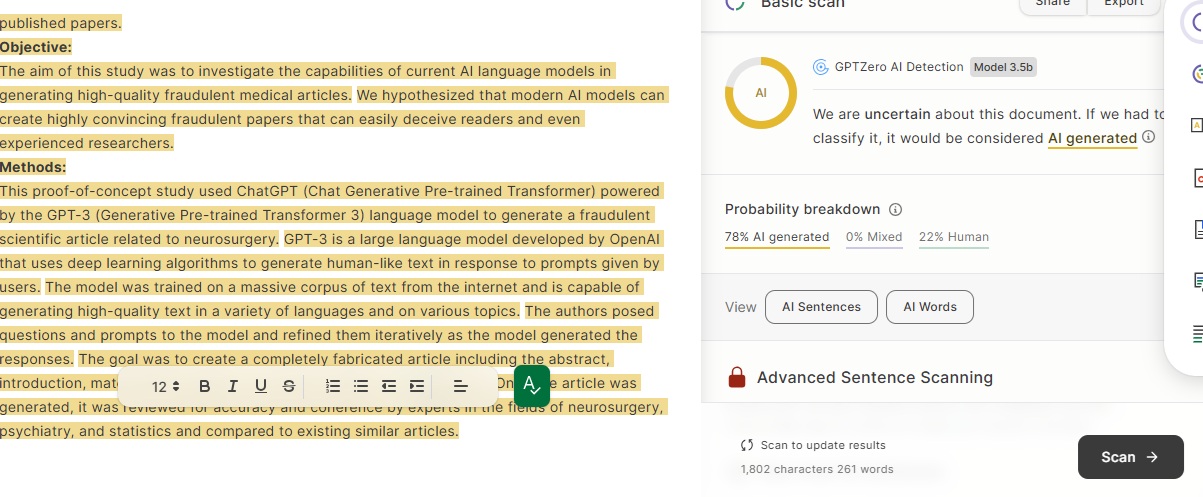
Let us understand this with an example. We copied an excerpt from the paper “Artificial Intelligence Can Generate Fraudulent but Authentic-Looking Scientific Medical Articles: Pandora’s Box Has Been Opened” by Martin Černý, (MD, PhD), Matěj Kasal (MD) and others, knowing that its to-the-point nature might trigger the detectors. Needless to say, it did and highlighted how precarious the situation is for all our writers.
Why Beating AI Detection Shouldn't Be About Deceit
The Business Insider reports that some universities have stopped relying on AI detectors altogether to save students from this conflict. But not all of us have that liberty; we have to be mindful of how we write.
So at this point, bypassing detectors is not about having an unfair upper hand but proving our credibility in the first place. As you have seen from the examples earlier and from multiple cases happening worldwide, the detectors tend to confuse human-written work with AI-generated content. On top of that, when we try to write directly or don’t add enough variety to our work, things tend to go haywire.
Our ability to write in a versatile way and at the same time simplify things for technical clarity seems to confuse detectors about the true origin of the content. So at this point, trying to bypass a detector is more about enhancing your work and highlighting your potential rather than hiding something.
We have reached a point in our professional setting where human-AI collaboration is the ultimate solution if you wish to survive.
I mean, we can't expect to return to a time without AI, without instant creative input, and without tools that help us write or manage our work just because the detectors aren't perfect. So instead of finding flaws in the detectors, we need to steer clear of the obvious giveaways.
Top AI Detection Red Flags: What the Bots Are Looking For
The moment you understand what the top AI detectors are looking for, it’s only then that you will be able to accept this human-AI collaboration and ensure that it works in your favour.
To put it in simpler terms, you have to understand what the internet now calls the vibe check. Does your write-up pass it?
Here’s the thing: AI detectors don’t understand meaning. They scan for patterns that feel robotic, regardless of what or who the writer is. So you have to know what the bots are looking for.
Formulaic Academic Transitions
Formulaic academic transitions used to structure ideas are one of the first giveaways for detectors to identify AI-generated writing. They see this as a sign of automation or machine-generated content, which instantly triggers the flag.
Lack of Emotion or Voice
AI-generated content lacks personality as it doesn’t show any emotion. It’s always neutral, impersonal, and emotionless because AI tries to cater to every opinion in the world. That’s why its writing lacks tone, humour, or perspective. So, the moment you write something technical with a neutral tone, detectors often mistake it for machine-generated writing.
Predictable Paragraph Structure
Our paragraphs don’t have the same structure in real writing. Sometimes there’s a change in rhythm or length, and sometimes bullet points show up unexpectedly.
But it’s different with AI—it usually sticks to a predictable structure and overly formatted content. This rigidity is another sign that highlights the possibility of machine-generated text.
Repetition Without Depth
If your content keeps repeating the same idea without adding anything new or insightful, detectors tend to catch on quickly. Humans typically elaborate, challenge, or build on different thoughts. But AI frequently loops around a single idea, which makes detectors think the content was generated by a machine.
How to Humanize AI Writing (Without Losing Your Mind)
An ideal solution in a situation where we can’t abandon AI but also can’t afford to get wrongly flagged by detectors is to humanize our AI writing. In other words, it's about working in a way that dials down the obvious signs of AI-generated writing. However, the intention here is not to deceive but to make sure your work reflects your thoughts and efforts. Even if AI helped you get started, the final version should feel yours authentically.
This helps us in many ways. For students and researchers, it gives them a free pass to present their papers as they want, without fearing the detectors.
Secondly, as marketers or content writers, we don’t have to worry about brainstorming with AI or relying on it for creative structure. In situations like this, all we have to care about is using AI responsibly, and that's it.
But coming back to our conversation, here are a few quick ways to humanize your content that will help you convince the detectors of your authenticity:
Add Storytelling and Personal Examples
Storytelling is one of the easiest and most effective ways to convince detectors that your content is human-written. It’s not just that your readers will connect more with stories and personal insights, it’s also that it immediately makes your content more relatable and less robotic.
For example, instead of saying that “This tool is helpful for productivity,” you can always say, “I started using it recently, and now I can’t imagine writing without it”
Use Rhetorical Questions
A bit of rhetorical questions or realistic clauses will help a detector understand that it’s a human that’s writing it.
For example, write like you talk. So instead of saying, “This approach is effective and widely used,”
You can always say, “Isn’t this exactly what we’re all trying to achieve?”
Mix Sentence Lengths and Vary Structure
You have to mix sentence lengths and vary structure to convince detectors that a human wrote it. Human writing is dynamic. Some sentences are long and descriptive. Others are short and punchy. You need to break that repetitive rhythm to avoid sounding flat and robotic.
Use Idioms or Cultural References
One of the most important giveaways of AI-generated writing is it fails to use idioms or cultural references, as it doesn’t want to sound biased or too specific. But as humans, we know how to use pop culture, inside jokes, or common expressions naturally without offending anyone.
Example:
Phrases like “spill the tea,” “not my cup of tea,” or “that’s a hard pass” make your content feel more alive and authentic.
🚨At this point, we have another problem.
These solutions work great when you’re writing a blog, a caption, or a marketing piece. But things become a bit tricky when it comes to academic or technical writing. In those cases, you’re often not allowed to express too much personality.
On top of that, going through everything you’ve written just to make sure it doesn’t get flagged by a detector can be incredibly time-consuming.
So what can you do?
Rely on HumanizeAI.io
Humanize AI helps you maintain your tone and voice, and it only takes a few seconds. All it does is quickly refine your content by fixing the obvious AI giveaways, ensuring it sounds like it was written by a real person, because it was.
You can consider it as having a human editor who is not only fast but also knows how to maintain your authenticity and voice.
Let’s Take a Robotic Paragraph and Make It Pass
Here’s a quick overview of how Humanize AI works. I asked ChatGPT to generate a generic robotic paragraph that was bound to get flagged by any given detector.
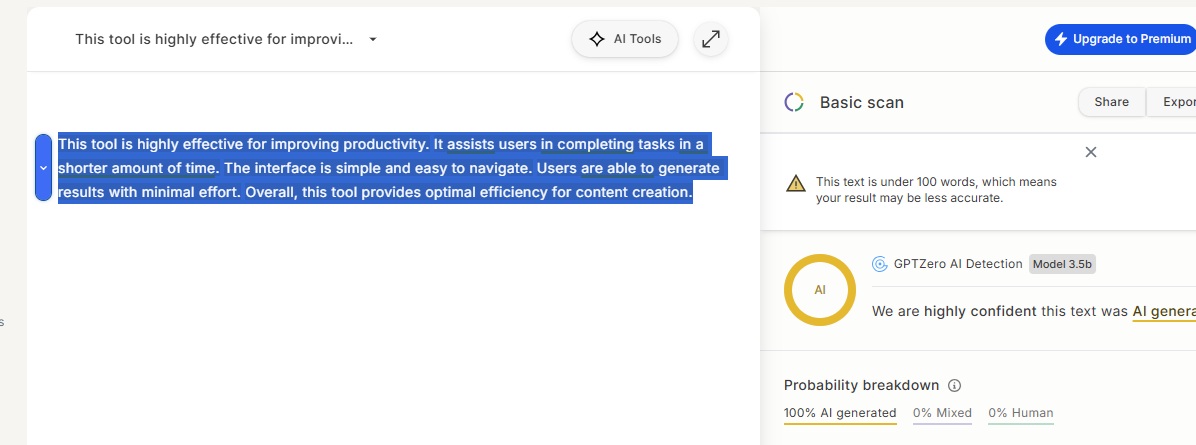
As expected, the detectors marked this paragraph as AI-generated. The reason is simple it is due to its flat tone, repetitive phrasing, and overly structured sentences. To test how well Humanize AI handles this, I then prompted it to refine the same text.
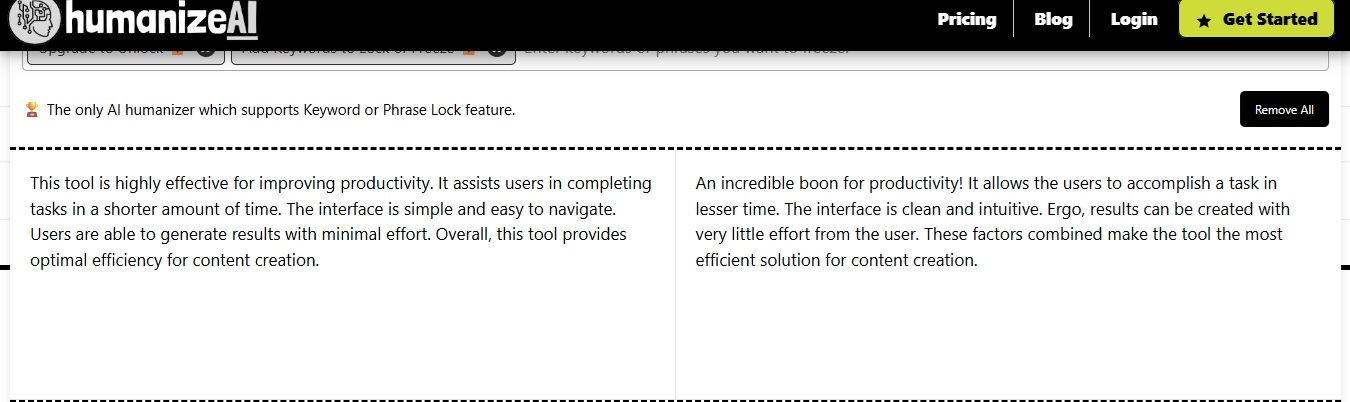
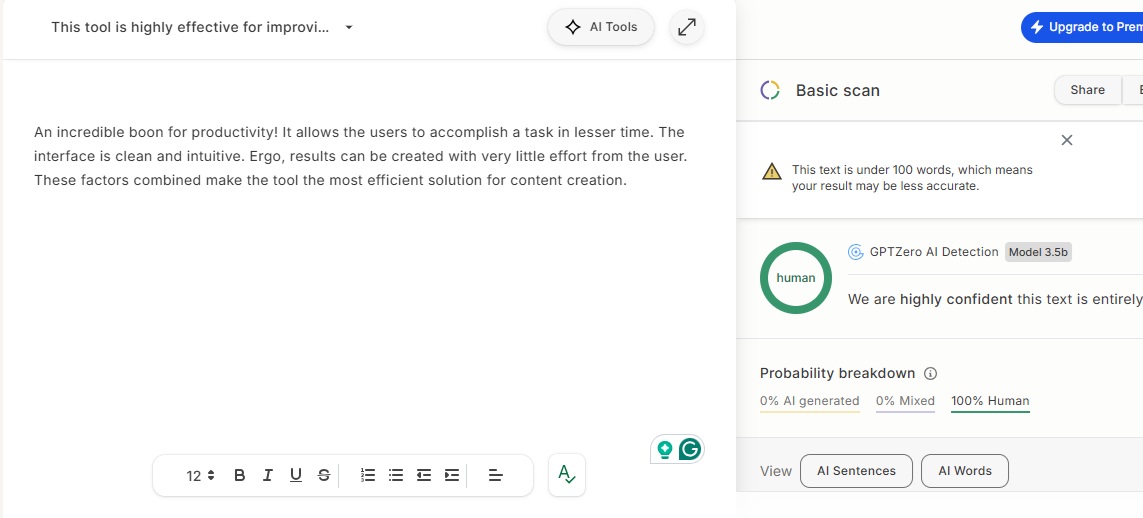
As you can see, the reason it is a credible solution is because it not only helps you with wrongful detection but also helps retain your original voice effortlessly.
Final Thoughts: Blend, Don’t Pretend
It is important as writers to remember that at the end of the day, the goal is not about the detector. It is about creating content, be it a research paper or a marketing copy, that feels authentic, that feels like you.
AI is a tool that you can use however you want, because the actual power of the voice lies within you. So instead of hiding the use of AI or manipulating the situation, the idea is to focus on blending it into your workflow with a certain purpose. Since the best content is always human. Even if it’s AI-assisted, it’s your ideas, your tone, and your intent that make it real.
AI is just there to help you with the speed, the structure, and sometimes the creative block.
Moreover, this unwanted panic around detectors can be avoided if you use the right tools, understand what the detectors are looking for, and take a smarter, more intentional approach to your writing.