
Before AI, there was a team of humans guessing demand forecasting, inventory optimization, warehouse automation, route planning, suppliers, etc. But now, AI can analyze millions of data points in seconds to make smarter decisions.
So, how big is this transition? Is everyone now relying on AI for supply chain duties? How is the market reacting to it? Let us find out.
Read along as we discuss AI in supply chain statistics, logistics, optimization, and market growth for 2026. We will look at the numbers to understand where to put your budget, whether AI is actually making money, whether enterprise adoption is moving fast, and what the future looks like for supply chain skills. 🤔
How Big Is the AI in the Supply Chain Market in 2026?
Is every company now relying on AI for its logistics? Or are we currently witnessing a new trend? Or have we transitioned to fully automated mode in 2026? Currently, the global AI in the supply chain market is valued at USD 13.81 billion in 2026. Let us see what the numbers have to say:
- In 2025, the market was sitting at USD 9.94 billion.
- By 2035, that number is expected to hit USD 236.42 billion.
- It is growing at a CAGR of 37.29% from 2026 to 2035.
- North America is the top contender, holding the fort at 39% market share in 2025.
- Asia Pacific is catching up fast, with the highest projected CAGR of 42.5% through the forecast period.
- In 2025, the software side of AI supply chain management took up 42% of the market.
- Supply chain planning held a 34% share in 2025.
- The automotive industry accounted for 18% of the market in 2025.
Sources:
AI in Supply Chain Market Forecast Through 2032
So what exactly does the future look like for an AI-controlled supply chain scenario? At the moment, the numbers are telling a convincing story. Let us look at another detailed study to understand this better. To begin with, AI in the supply chain market is expected to reach USD 50.41 billion by 2032.
- The market was worth 9.43 billion dollars in 2024. By 2025, it grew to 13.93 billion dollars.
- And it is expected to reach 50.41 billion dollars by 2032. That comes out to a 20.2 percent CAGR between 2025 and 2032.
- Right now, North America holds the biggest piece of that market, at 36.7 percent in 2025.
- Not to mention, the Asia Pacific is growing the fastest out of all the regions
Sources:
- MarketsandMarkets, AI in Supply Chain Market Size, Share Analysis
- PR Newswire, citing MarketsandMarkets, AI in Supply Chain Market worth $50.41 billion by 2032 (January 30, 2026)
AI Supply Chain Market by Software and Cloud Adoption
If we break down the overall impact of AI in patterns and numbers, we will see that the software segment held the largest share of the market in 2024. Moreover, it is expected to remain in that category for now. The reason? Simple. Companies are increasingly adopting AI-powered software for demand forecasting. To be honest, this is exactly where the very purpose of relying on AI lies.
Along with that, cloud deployment is projected to grow at a 21.8% CAGR from 2025 to 2032. A quick look:
- Businesses are using AI software to improve inventory optimization.
- Moreover, companies are relying more on AI to improve logistical efficiency.
- Not to forget, AI software is helping companies manage supply chain risks.
Sources:
- MarketsandMarkets, AI in Supply Chain Market Size, Share Analysis
- PR Newswire, citing MarketsandMarkets, AI in Supply Chain Market worth $50.41 billion by 2032 (January 30, 2026)
Fastest-Growing AI Supply Chain Applications
What exactly is making the noise for AI and supply chain applications? Is it just limited to inventory management, or is it something else? Let us look at the numbers:
- Warehouse management is projected to be one of the fastest-growing application areas.
- It's expected to grow at a 22.9% CAGR through 2032.
To answer the question, currently, AI is increasingly used for a list of things when it comes to supply chain management. Including:
| AI Supply Chain Use Case | AI Use |
| Real-Time Inventory Tracking | Tracks inventory levels in real time. |
| Warehouse Automation | Automates warehouse operations and workflows. |
| Route Optimization | Finds faster and more efficient delivery routes. |
| Logistics Planning | Improves transportation and logistics planning. |
| Supply Chain Visibility | Provides better visibility across the supply chain. |
Sources:
- MarketsandMarkets, AI in Supply Chain Market Size, Share Analysis
- Precedence Research, AI in the Supply Chain Market
Regional AI Supply Chain Market Statistics
From a local and regional lens, the numbers didn’t disappoint either. Apart from North America and Asia’s dominance, the other regions are slowly catching up as well.
For example, Europe is seeing growth due to logistics digitalization and warehouse automation.
- China, Japan, and India are investing heavily in AI-driven supply chain technologies.
- Brazil and Mexico are emerging markets for AI-powered logistics solutions.
- Saudi Arabia is increasing AI adoption through industrial development initiatives.
Sources:
- MarketsandMarkets, AI in Supply Chain Market Size, Share
- Precedence Research, AI in the Supply Chain Market
Notable AI Supply Chain Efficiency Statistics
Now the question is, is the system working or failing us? As in, how efficient is AI when it comes to reducing logistic costs or taking care of the inventory? A quick look:
- Studies say that AI-enabled supply chains can reduce logistics costs by 15%.
- AI can reduce inventory levels by 35%.
- For production delays, AI implementation in automotive manufacturing can reduce them by 20%.
- Amazon expects AI and robotics to reduce delivery costs and delivery times by 25%.
- Gather AI reports that its inventory monitoring solution can improve customer ROI by up to 5 times.
Sources:
Leading Companies in the AI Supply Chain Market
At this point, AI in the supply chain is not some scattered experiment or a random trend that we see. It is a systematic implementation of automation that is now being supported by all the big shots in the market. Here’s a quick look:
| Company | Market Position |
| SAP SE | Identified as a major player in the market |
| Oracle Corporation | Leading AI supply chain vendor |
| Microsoft Corporation | Key market participant |
| NVIDIA Corporation | Among the major companies in the sector |
| Amazon | Investing heavily in AI-driven supply chain technologies |
| FedEx | Notable logistics player using AI |
| DHL | Another global player that relies on AI |
| Alibaba | Among the prominent companies operating in the market that rely on AI for the supply chain. |
Sources:
- MarketsandMarkets, AI in Supply Chain Market Size, Share
- Precedence Research, AI in the Supply Chain Market
But efficiency numbers only tell half the story. The real question is where exactly AI is doing that work for these big brands and the smaller ones? What exactly does AI in supply chain management look like? Let us find out.
Who Is Actually Using AI in Supply Chains Right Now?
We have seen the names and the numbers, and needless to say, they are pretty impressive. A large section of the modern corporate workforce is now relying on AI for all their demand and supply needs.
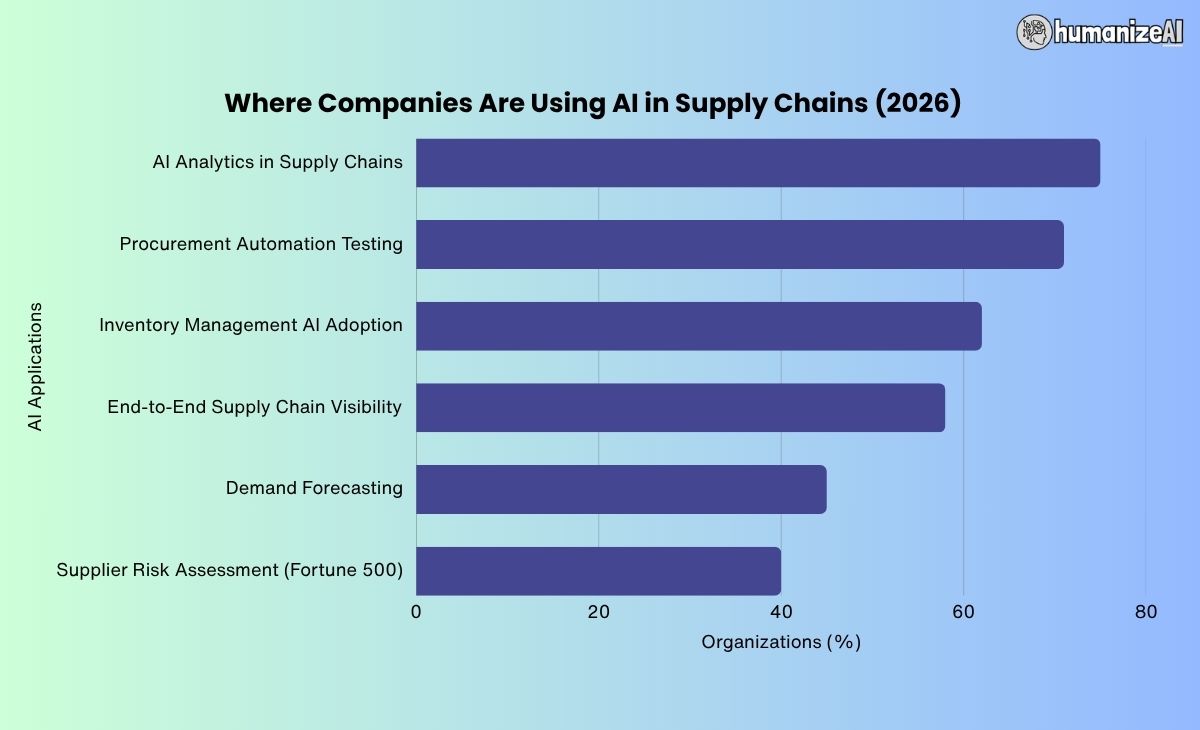
To begin with, McKinsey reports that 45% of supply chain leaders have implemented AI for demand forecasting. What else does AI bring to the table for them, and how is it being used? A quick look:
- By 2025, Gartner expects 75% of large enterprises to be using AI-driven analytics across their supply chains.
- Inventory management is where 62% of executives are putting their AI money first, according to Deloitte.
- 51% of supply chain firms across Asia-Pacific have already gotten AI tools up and running, PwC reported.
- IBM found that 4 in 10 Fortune 500 companies have brought AI into their supplier risk assessment process.
- 58% of supply chain leaders are using AI for end-to-end visibility, according to Gartner's 2024 Magic Quadrant.
- 71% of procurement leaders are actively testing AI in procurement automation, Deloitte reported.
Companies Are Using AI for Inventory and Warehouse Management
Deloitte found that executives are prioritizing AI for inventory management. And it is a global trend across all the big names:
- Capgemini reported that AI reduces inventory levels by 20% to 50% while maintaining service levels at 98%.
- Deloitte found that AI reorder point optimization lowers safety stock by 35%.
- McKinsey reported that AI dynamic slotting increases warehouse picker productivity by 25%.
- McKinsey also found that AI improves warehouse space utilization by 30%.
- IBM reported that AI robotic process automation speeds up order fulfillment by 40%.
- Accenture found that AI vision systems improve warehouse put-away accuracy to 99.9%.
Organizations Use AI to Improve Logistics and Transportation
BCG reported that 55% of automotive supply chains use AI for route optimization. It also reported that AI improves last-mile route optimization by 20% and reduces delivery time by 30%.
- Accenture found that AI route planning reduces freight expenses by 12%.
- Gartner reported that AI network optimization cuts transportation costs by 15%.
- Gartner also found that AI network optimization reduces emissions by 10%.
- Deloitte reported that AI vehicle loading saves 18% fuel.
- EY found that AI supplier portfolio optimization reduces risk exposure by 25%.
AI Is Being Used for Supplier and Risk Management
This is a global phenomenon at the moment as users gradually shift to a more AI-driven supply chain management routine. IBM reported that 40% of Fortune 500 companies use AI for supplier risk assessment.
Most importantly, Gartner forecasts that AI will prevent 50% of supply chain disruptions by 2028 through real-time monitoring.
- Accenture found that AI predicts supplier delays with 88% accuracy.
- EY reported that AI supplier portfolio optimization cuts costs by 12%.
- KPMG found that AI vendor scorecards improve supplier performance by 16%.
- McKinsey estimates that AI disruption detection reduces risk impact by 40%.
Businesses Use AI for Demand Forecasting and Planning
McKinsey reported that AI improves demand forecast accuracy by 50%. Along with that, Gartner stated that AI forecasting tools achieve 85% to 95% accuracy in volatile markets.
- Deloitte found that demand fluctuations are now predicted with 40% better precision when AI is in the mix.
- IBM Watson alone pulled off a 30% improvement in short-term demand forecasting.
- Forrester found something interesting: AI pushes forecast boundaries from one month all the way out to six months.
- Companies using AI are hitting 35% more accurate supply chain forecasts, per KPMG.
- EY found that businesses are catching demand changes 50% faster with AI.
- By 2030, Gartner expects 70% of large organizations to be running AI-based supply chain forecasting.
Sources:
Original Sources Referenced by Gitnux
- McKinsey
- Gartner
- Deloitte
- PwC
- IBM
- BCG (Boston Consulting Group)
- Accenture
- Forrester
- KPMG
- EY
- Capgemini
The Supply Chain Is Not Waiting for Anyone
When we see the numbers, the one thing that comes to mind is that the AI supply chain train is not stopping for anyone. People have already jumped in and have started to realize the many advantages of an AI-run setup.
And as we have seen all throughout this blog, the numbers are there to support this claim even more so. For example, the warehouses using robotics are not just faster. They are hitting 99.9% accuracy while manual operations sit at 4% error rates. Whereas the logistics teams are cutting transportation costs by up to 15% and so on.
In other words, every single number in this article points to the same thing. AI is not helping supply chains perform better with a little support or at the margins. Instead, it is changing what a well-run supply chain even looks like.
The point is that AI is already in the warehouse, and the market is expected to cross $236 billion by 2035.