
Let us be honest, search as we know it has now changed forever. And yes, it is because of AI. We all know that! But here is a fresh perspective for you. AI didn’t really change search; it simply exposed low-effort content. Interesting, isn’t it?
Read along as we understand how AI’s impact on search isn’t a secret anymore. But most importantly, what it means for us writers, marketers, and even users. Don’t worry, we will not randomly list ten things and ask you to figure it out. We are going all in with some real-life examples. Hold tight!🤭
To Begin With, How Was Search Before?
Every article you read will take you on a trip down the memory lane of the blue links search era. You know, when you had to click on multiple links, do your research, spend a good few hours, and then buy your product. We do not do that anymore. AI ensures we get the best possible option in seconds.
This is the exact change that you have to understand to assess AI’s impact on search. Initially, the search was:
- You searched for something on Google
- Google matched the relevant keywords and checked the domain authority.
- It listed the possible results.
But now, with AI, things are way more advanced and refined:
- You initiate a search on Google
- AI scans the intent of your query
- Ranks results as per the one that matches the search intent, sounds human and natural
- Also summarizes the entire thing in a quick overview.
Before you ask, yes, domain authority, expertise, and everything else are now more relevant than ever, but so are context, clarity, and relevance. In simpler terms, Google is leaving no stone unturned to answer your query.
This is why it takes a lot of real-time effort for a blog to make its mark on the first page these days. Most importantly, this is what the panic is all about! Simply adding keywords, a bit of expertise, and optimizing the website for mobile friendliness doesn’t really work anymore.
Because AI doesn’t ask the obvious question, “Does this page match the query?” Instead, it is about “Does this page resolve the question?”
So, What Is Search Now?
Let us understand this by searching for something random and analyzing it part by part:
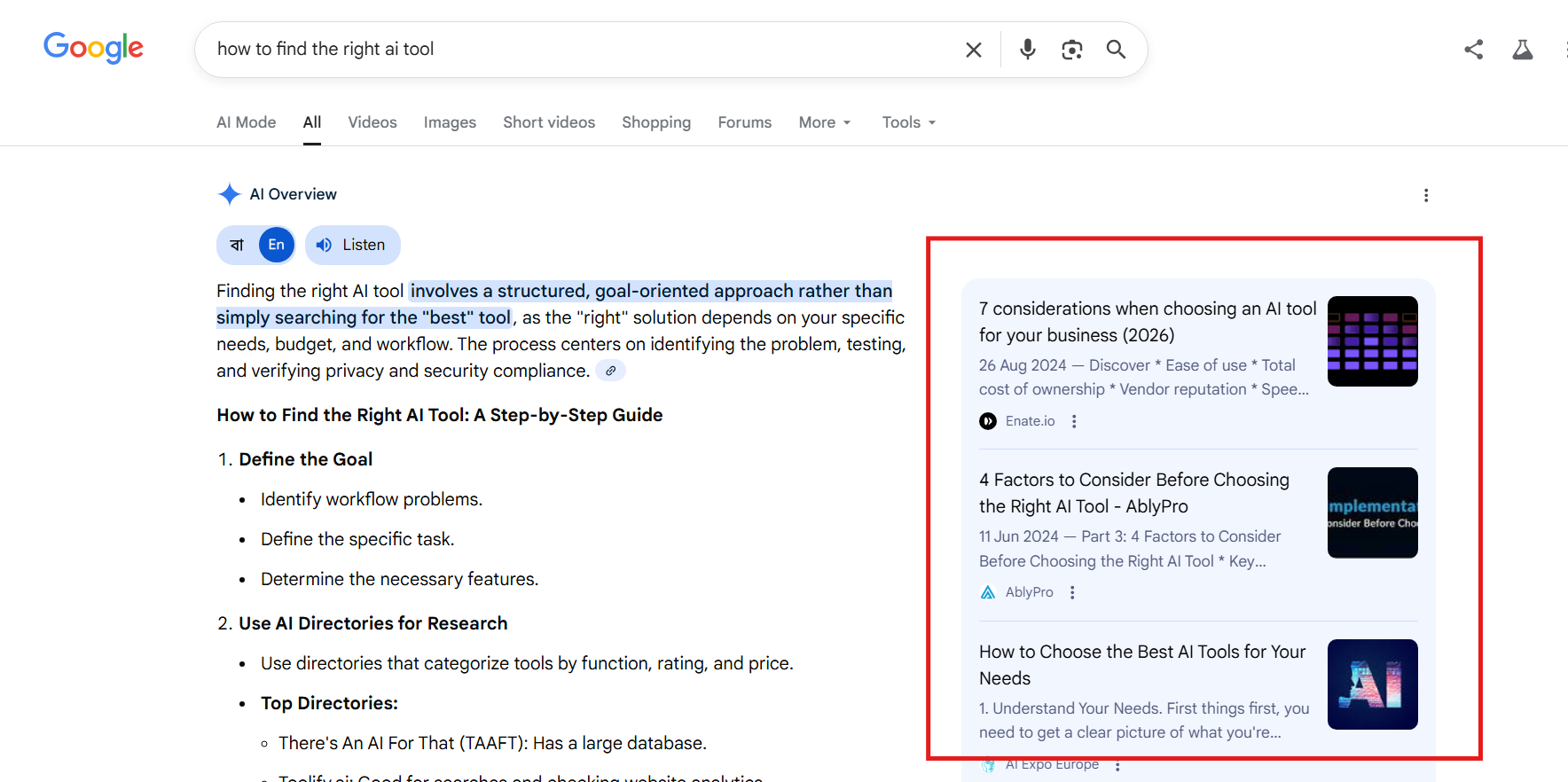
This is what the search looks like in 2026. So what exactly changed with AI?
- Technically, we no longer have to look for an answer anymore. It is handed to us with AI overviews.
- It answers the query precisely to the point so that you do not have to browse further.
- Interestingly enough, AI doesn’t care about domain authority. The websites cited in the results can vary from 26 to 92. All it cares about is relevance.
But you already know all this. Let us talk about this from a business or a marketer's perspective. In today’s AI overview world, search is also about:
Keywords are important, true! But so is context or the relevance of your topic.
With AI taking over the picture, it doesn’t matter what sets of words you use. As long as the implied sense is the same, and you are answering the question.
Personalization and clarity are the only two metrics that AI acknowledges. You can have a technically perfect website with a 95 or so domain authority and still fail to impress AI.
In other words, AI’s impact entirely changes what we know about search. The intent is resolved even before the journey begins. Data from the Pew Research Center says that “users click traditional search links much less when AI summaries appear, only 8% of the time with an AI summary vs. 15% without.” From a marketing perspective, it can be listed as:
- Solving a given query instead of stretching it.
- Explaining what exactly is going on instead of stuffing it with keywords.
- We are no longer competing to be number one; instead, we are focused on being the number one source that AI trusts and refers to.
In short, AI’s impact has not changed what people search for. What’s changed is how search understands intent and chooses which answer deserves the top spot.
Why Being ‘Visible’ No Longer Guarantees Being Chosen
Initially, the process was far less complicated. Ranking on the first page of the SERP almost guaranteed traffic, engagement, and eventually a purchase. Visibility meant success, as in that if the users saw you, they clicked and eventually converted.
However, this simple flow doesn’t really exist anymore. Presently, with search, you do get brand impressions, exposure, and visibility, but they are all fleeting. Since AI resolves the curiosity or intent the user has, they no longer click to explore further. This is precisely what the data published by Digiloft says: “The number 1 organic Google result sees a 34.5 % lower CTR when AI Overviews are present.”
All they do is ask a question, get instant results on the overviews, and they bounce.
This is the exact shift the brands are struggling with right now. AI doesn't let us select the options, but it does it for us. It lets us know which one deserves more attention and is a perfect fit for our query. Therefore, from a marketing perspective, success means:
- Referenced by AI
- Trusted enough to be summarized
- Clear enough to end the search journey
Otherwise, you are just another website waiting to be scrolled past by users. In simple terms, only content that genuinely resolves the user’s question wins the race.
What Marketers Still Get Wrong About AI Search
Many marketers think that AI search is simply old wine in a new bottle. And this is where things backfire for them. AI search is not only about a simple change in the interface.
This is also why many marketers are still struggling to make their mark with AI. They think if:
- Rank on page one
- Optimize aggressively
- Keep adding more keywords
- Improve technical SEO scores
They will eventually “win back” all their traffic. But that is what they don’t understand. All AI cares about is precision, accuracy, and details in the content.
Secondly, the “SEO is dead” brigade needs to stop. It is nothing but another misstep and a blunder in the making. Yes, AI indeed loves content with relevance, but nowhere does it say it is okay with a broken website.
Moreover, SEO right now is not only about fixing the technical glitches. But it is also about making content more understandable, human, and, most importantly, trustworthy.
Another important aspect in this entire discussion is how some marketers cannot move past their obsession with content volume. They think more content and more pages = more coverage.
This rarely works with AI because when multiple pages say the same thing in slightly different ways, AI doesn’t see authority; it sees repetition, clutter, and confusion.
Lastly, we are yet to come to terms with the fact that AI doesn’t measure success by how long a user stays on your site. It sees if your content addresses the query and helps resolve it. So, even after your user bounces midway, AI will still consider it a success.
This is the uncomfortable truth many brands are resisting:
Being helpful now matters more than having significant traffic.
How AI Decides Which Content Deserves to Be Trusted
So, if AI doesn’t care about domain authority and is okay with users bouncing midway, how does all this work? How does it know which content is coming from a trustworthy source? And, most importantly, how can it lead the entire operation with such vagueness?
The answer is simple: AI approaches search results like you and I would. It reads and analyzes the content to assess the trustworthiness.
- The first thing it looks for is the clarity of the answer: Does the content directly respond to the question being asked? Or is it taking a lot of time to come to the point? That’s why pages that slow-cook their content sometimes lose out on visibility even with a technical upper hand.
- AI wants contextual depth: Now, AI doesn’t want the quote-unquote definition of things. If we go to the previous example, the websites being cited by the AI Overview for the "ideal AI tools" deal with the query in many layers rather than just handing a list.
Instead of stopping at what, these pages go deeper into why and how. And this is exactly what AI trusts more than anything else
- AI loves content that also covers the follow-up thought: There is a fine line with AI-generated content. It doesn't push for the content that sounds correct, but that feels helpful. So, if someone is searching for the best AI tools, they are also searching for:
> What am I doing wrong while using AI?
> Which tools can actually fit into my workflow and needs?
> Why do most tools not work the way I expect them to? And AI rewards content that acknowledges all this, and not just an answer that relies on keyword stuffing.
So, What Is Search in the AI Era All About?
Search in the AI era is finally living up to its name and is about giving the users exactly what they want. AI didn’t change why people search, but it came and showed us what exactly they look for.
It also changed it from being a ranking competition to a legitimate outlet that answers any given query with assurance, clarity, and accuracy. To sum it all up, it can be accurately divided into three distinctive stages:
> Understand and analyze the user intent
> Evaluate explanations across various sources
> Deliver an answer that resolves queries as per the confusion and not the keyword.
This is also why traditional metrics no longer feel useful for us. Since rankings, clicks, and traffic cannot measure the actual intended purpose of search, these days. It is only about assessing if the question was answered properly to properly conclude the user journey.
Final Takeaway: AI Didn’t Change Search, It Changed the Outcome
All of us still run to Google the minute we have a doubt or confusion. Nothing can change that. But what changed was how Google now chooses to shape a query. Our users still look for answers, reassurance, and clarity. But search no longer waits for them to explore it on their own.
It is now efficient and smart enough to evaluate, interpret, and deliver the entire thing. This is why Search now feels shorter, faster, and more alert to help find us a way. To put all this in one simple line, with AI, the goal is no longer discovery but certainty. Or, rewarding a voice that is not loud but clear and offers a solution.