

Let me guess, you are here because you have a number of blogs that have stopped doing what they are supposed to do. Yes, they initially did dominate the SERP, but now they are lost in the abyss of the second page, or worse, the third page.
Before you spend more time wondering how to maximize ROI from your existing blog content, let us get right into it. But don’t worry, we will not give you a random list that you already know about. With AI overviews in the picture and our growing dependence on AI search tools, we need to go all in.🧐
But before that, let us quickly understand what exactly is happening with AI and zero-click searches so that the discussions make more sense.
How AI Overviews & LLMs Choose Content?
At this point, traditional SERP ranking matters way less than before. It is no longer a secret that Google’s AI Overviews is quoting from low-authority websites and pages that never see the light of day. All it cares about is content that can solve the problem at hand. Or in simple terms, it is now about visibility, crawlability, and contextual relevance.
Therefore, for you, it means understanding a few key points before you jump into blog optimization:
- Ranking on the first page is not really that important compared to answering what exactly the user is asking.
- Optimizing the blog means refining its structure, content, and edges that are best suited to AI’s understanding.
- However, all this doesn’t mean you let go of Google’s approach towards helpful content or content that comes from a place of expertise. All AI needs is helpful content that answers the query and, most importantly, is personalized and human.
If you do a quick scan of Google’s guide to AI search ranking performance, you will have further clarity on what you need to do. Here are some notable points:
- If you wish for your content to be cited, referred to, or quoted, it needs to be unique and also satisfy the exact query of your user.
- Your content should have a defined structure so that it can be crawled, indexed, and understood properly.
- Most importantly, high-quality visits are always more important than the traffic metric. Track engagement, signups, sales, and reader actions to understand true ROI.
Things changed for Google, us marketers, and users ever since Google launched its AI Overviews in 2024. The SEO or optimization as we knew it no longer works.
It has evolved into something entirely different, and Google wants us to catch up with it soon enough. Let us now begin and understand what optimizing old blogs means in the age of AI overviews.
And to be honest, it is not some new idea that we have discovered somehow. Optimizing existing blogs for better returns has always been around with every update and change in our search behavior. In fact, data published by Optin Monster points out that a whopping “34% of bloggers say that updating content produces strong results.”
How to Pick Which Blog Posts Are Worth Optimizing First
To begin with, it is absolutely critical for you to remember that not every blog deserves to be optimized. You begin with the ones that show signs of life or deal with content that can be updated with new information. For example, a blog on SEO is worth revisiting because the field evolves constantly. You can surely talk about AI overviews, the change in traditional parameters, etc. Let us understand this in detail:
Blogs that have a decent ranking of 6–20
- Even though ranking has lost its relevance with the AI overview, you can still do a lot with it.
- The pages that rank between 6 and 20 are close enough to visibility.
- They somewhat match the user’s intent.
- And they are also technically sound; it's just that all they need is a little push.
Pages with high impressions but low click-through rate
- This is when Google is showing your content. But your users are choosing someone else.
- It can be due to weak H2s.
- Outdated information or several other factors.
- In short, this is your low-hanging fruit right here when it comes to optimization.
Evergreen topics that can match the current search intent
- Evergreen topics don’t really mean that the content never changes.
- It is about you keeping on adding relevant context after each update.
- For example, the topic “Why Your Content Isn’t Converting” is still being searched today. However, the answer now goes beyond analytics or traffic metrics.
Content that aligns with a product, tool, or service page
These are blogs that talk about a problem your product is designed to solve. For example, imagine you sell an AI writing tool. Updating that blog with today’s context, such as AI Overviews and how they affect content quality, makes it easier for both readers and Google to understand and consider its relevance.
How To Improve Blog Structure For Better Visibility And Engagement
Now that you are ready with your list, it is time to discuss what exactly needs to be done with the blogs. I mean, you cannot really start editing a random H2 or the FAQs that won’t really make any sense. The ideal checklist, if nothing else, is basic and organized. Here’s how:
- Make the main answer/ theme obvious: Both your users and AI prefer content that is direct and to the point. This is your missing aspect that can help with your optimization. Simply add a TLDR section or two lines on what the main content is about, and you are good to go!
- Improve Structure, So Content Is Easy to Read: AI loves bullet points, structure, and a specific roadmap to actually understand what is happening. A great way to resuscitate old blogs is to add a few layers to them. Here is a quick example:
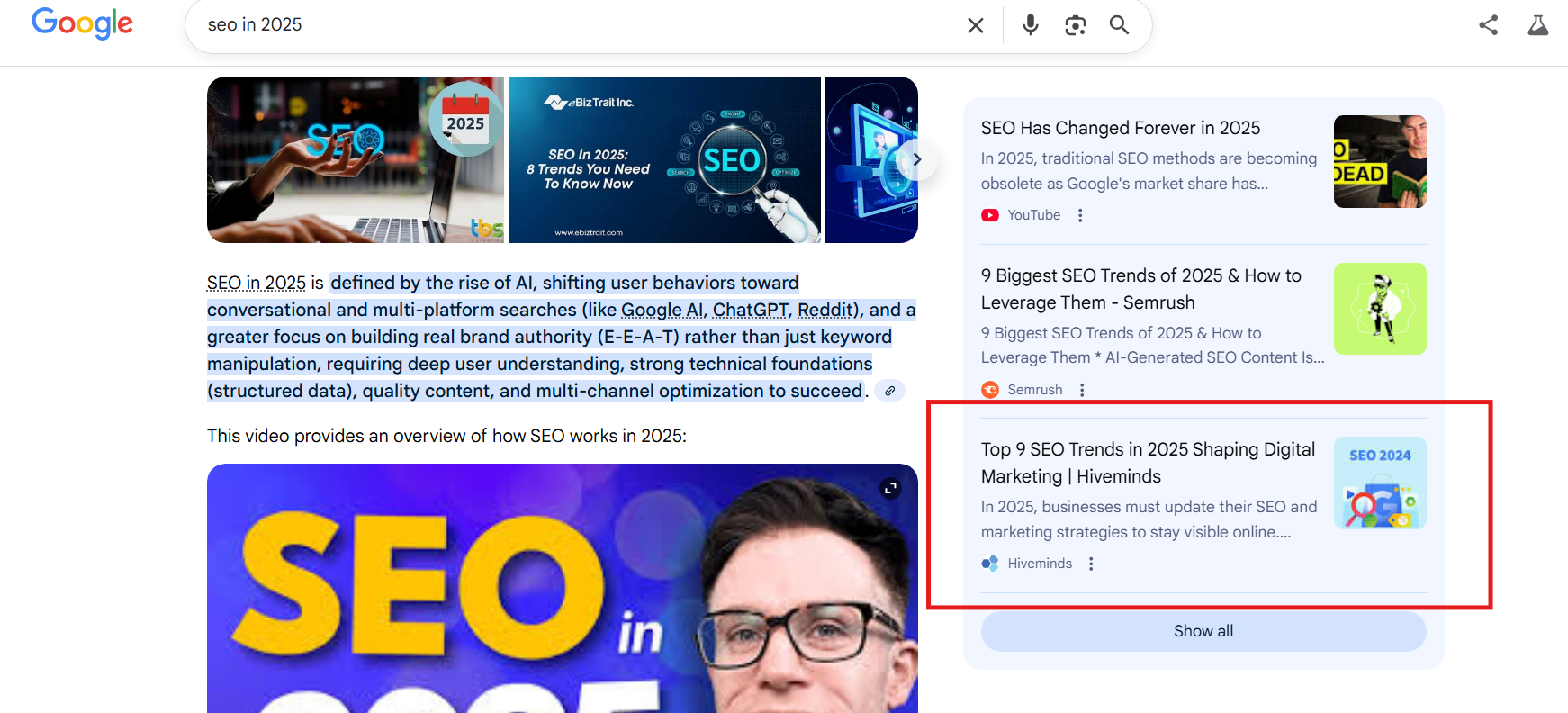
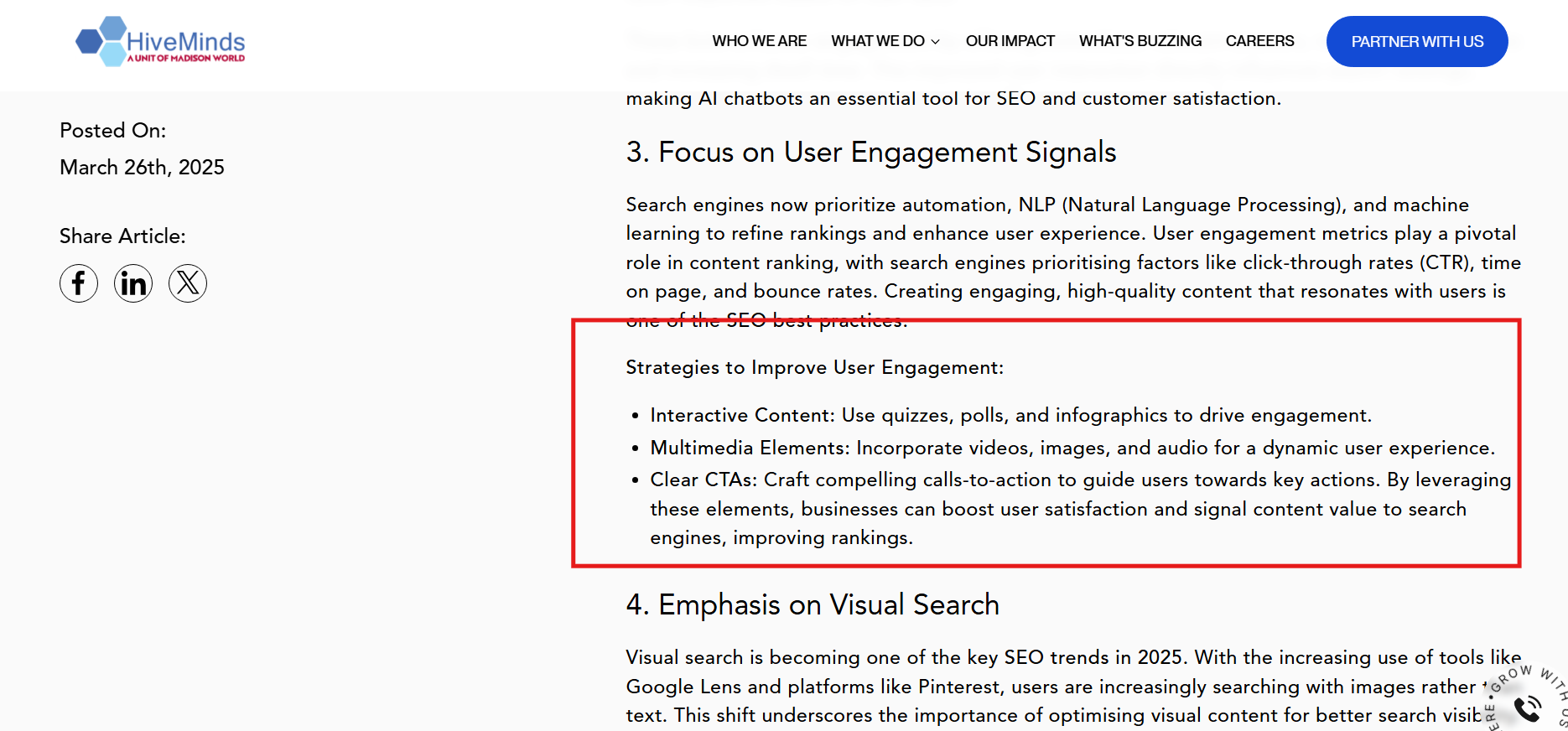
This is a screenshot of the website called HiveMinds (Domain Authority 29), which is ranking along with a big name like Semrush. The reason? It has clear, structured, to-the-point content that answers or addresses all the aspects of SEO in 2025 or the given query.
- Add Clear Section-Level Takeaways: This makes it way easier for a machine or your user to skim through your content. The idea here is simple: instead of them struggling and trying to figure out the point you are trying to make, you guide them to it clearly.
- Avoid Overloading a Single Section: Please keep coming back to this point each time you sit to optimize your blogs. Maximizing ROI for existing blogs is never about adding as much information as you can. The thing is, if you keep adding everything under one section, it will reduce clarity and confuse your readers. Not only that, but it also makes summarizing and citing content for AI difficult.
- Make Supporting Information Easy to Identify: Your users are already overwhelmed, and AI doesn’t know what exactly it should look for. So it is your responsibility to show them the way. Highlighting definitions, separating examples, or clearly labeling supporting information helps both your users and AI understand what you are trying to establish.
- Reinforce Freshness Without Forcing Updates: Sometimes a freshness signal can be something as simple as a date change. Or a change in some data numbers, facts, figures, and so on. You don't really have to interfere with content that doesn’t need any extra refinements.
TL;DR (Before We Get Technical)
At this point, if you think this is too much information, I understand. But here is quick relief for you: we have almost covered all the major aspects. However, before we get too technical, here is a quick recap of all the things we discussed so far:
Optimizing is all about careful planning, where you choose a few blogs that still have a lot of unexplored potential. All it takes for you is to add clarity, clear takeaways, and relevant context or simple updates that tie all the loose ends.
On another note, here is something that will help you sailthrough the technicalities: data published by Hostinger says that “consistently interesting blogs influence purchasing decisions for 55% of users.” In short? All the effort that you are planning to put in will surely be rewarded.
Technical Checks You Must Not Ignore While Optimizing Old Blogs
Needless to say, maximizing ROI also means taking care of the technical aspects. Every so often, it can be a broken link, an image that doesn’t load, or so many other things. Here is a quick check on the same:
Ensure the Page Is Crawlable and Indexable
This is the simple process of you checking if AI can actually scroll through your website without any interruption. Which means:
- Verifying that you haven’t unknowingly blocked your webpage (robots.txt or noindex tags).
- Making sure no important piece of content is hidden behind heavy JavaScript or endless scrolling.
- To keep a watch that each page is properly indexed in Google Search Console.
Fix Broken Links and Missing Assets
These are small steps that can have big impacts, especially in today’s time when AI is constantly looking for structured results. This is where you make sure you:
- Check for broken internal and external links
- Replace or remove outdated references
- Ensure that each image loads correctly.
Ensure Mobile Friendliness
As a marketer, you must always remember one simple truth. The performance of your website directly affects engagement. To add to that, a study published by Elementor Blog shows that over 63 percent of blog traffic comes from mobile devices, making mobile friendliness a non-negotiable. Therefore, you must:
- Check page load speed on mobile and desktop.
- Avoid popups that cover the main content on mobile.
- Make sure that text, images, and buttons are easy to read, identify, and interact with.
Review Metadata After Updates
Lastly, don’t forget to add the changes you made to your metadata. This will accurately represent what your page now offers without misleading your users or the search systems.
Conclusion: Maximizing ROI From Existing Blogs Is a Process, Not a One-Time Fix
As we conclude our discussion, here is an honest take for you to remember. Maximizing ROI is not some magical fix or a button that will instantly help you rank. But it is a long-term investment and process that requires your constant attention and care.
As you move past chasing rankings and look into things that actually matter in the age of AI, you will realize one simple thing. It is about working smarter with what you already have. By choosing the right blogs, making the required changes, and adding the necessary technical refinements, old content can add value. Even when the search behaviour is going through a massive change.
It is also about you understanding that how clearly you answer a given query is more critical than your SERP ranking. In other words, it is not really about vanity anymore, but you being serious about the user search intent. The moment you realize this, you eventually start building content that stays relevant, visible, and useful over time.