
What do you see when you Google “best editing tool for writers”? A bunch of blue links, of course, but also a dedicated AI overview that tells you everything. This is exactly what has taken the marketing world by storm, leading to the concept of GEO or Generative Engine Optimization.
So when you ask SEO vs. GEO what’s the difference, you have to start from scratch and understand how things have evolved. Read along as we break down these important concepts in this comprehensive guide with easy-to-understand examples.
But, before that, let us take a quick sneak peek and see what exactly changed and why it is indispensable to know about GEO.
Why Search Feels So Different Now?
To be honest, over the last year, Google has changed everything about marketing as we know it. We are no longer just chasing keywords, but are also aiming for a place in the AI search overviews. This is what it looks like:
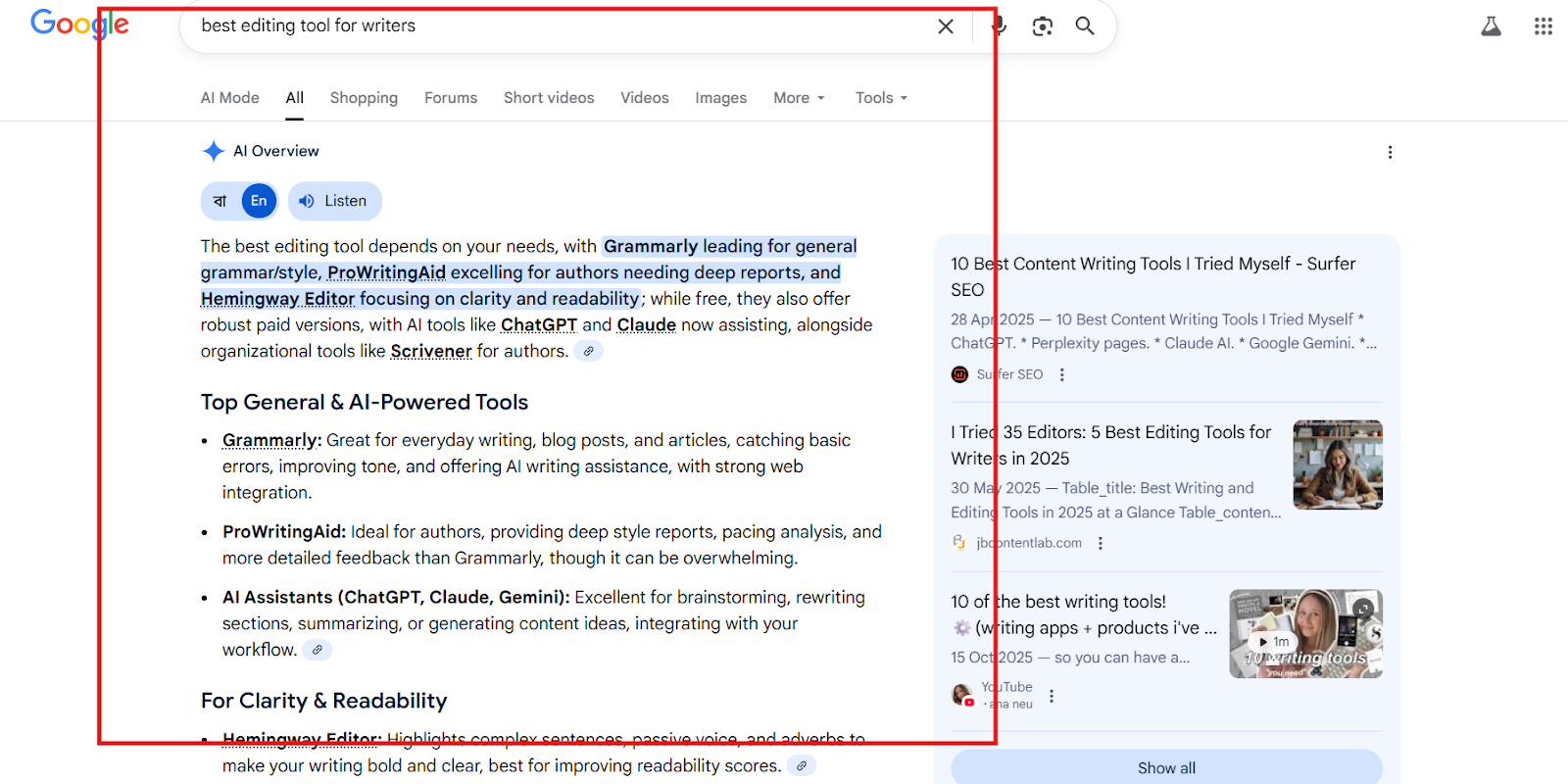
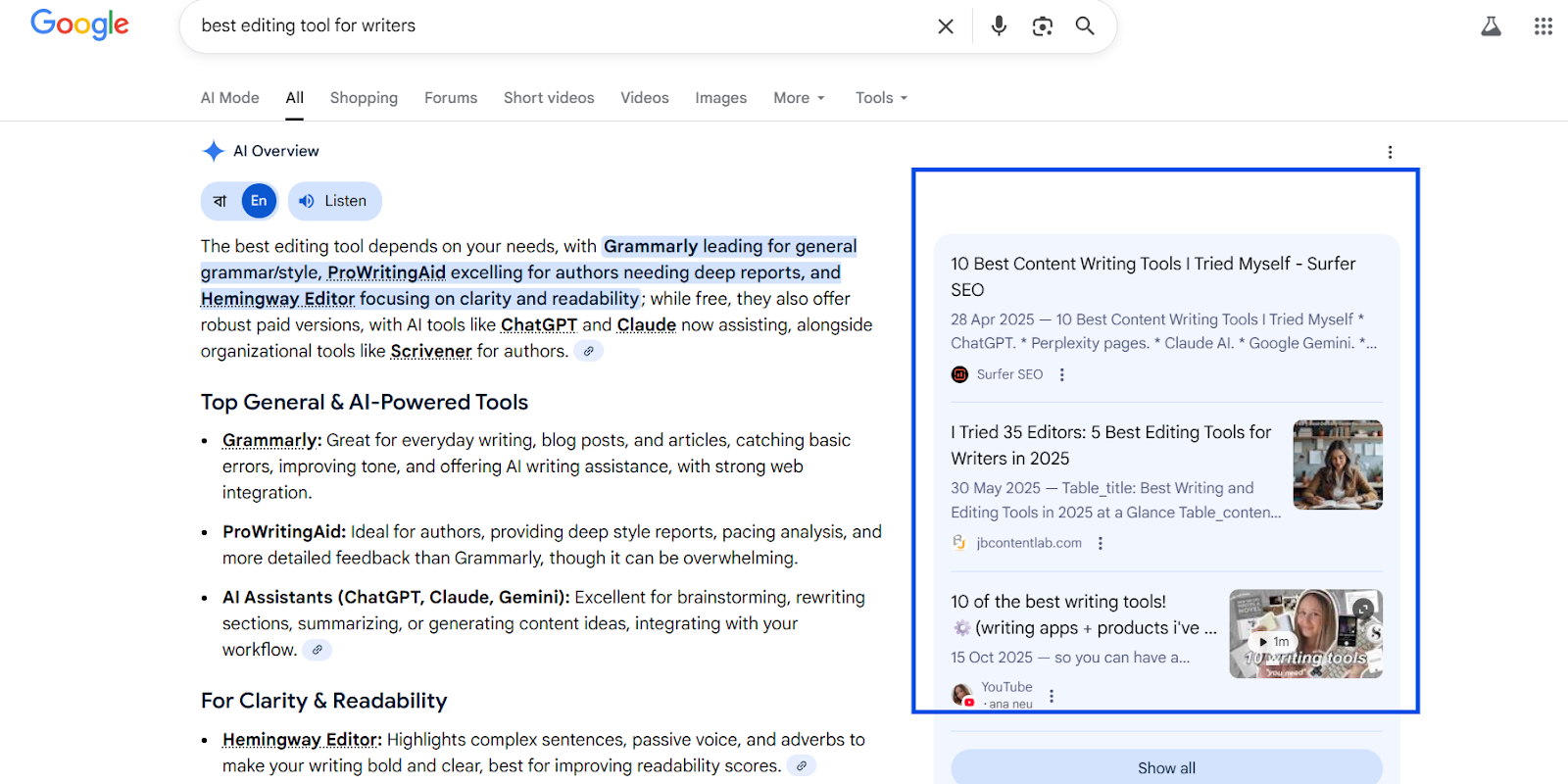
Ever since the new Generative AI in Search update, Google does all the searching for us. We no longer have to scroll through various websites to find the answer; it is all readily available in one place. This is where things have become a bit tricky for the marketers, as no clicks on the websites means no inflow of traffic.
Or, in other words, only relying on keyword optimization and standard SEO practices resulted in a shortfall, and we needed more. This is where the search space opened up to the concept of GEO, or the process of focusing on how to get featured in Google’s AI overviews and in other AI search tools.
Let us understand this in a better way by rewinding what we already know and tallying it with what has now changed.
What Is SEO in Simple Words?
SEO or Search Engine Optimization, in the simplest terms, is implementing steps to ensure your content is ready for Google. It is a series of processes that ensures your content ranks the highest when someone starts a search. And, no, it is not only a set of keywords or a few quick hacks that does the trick. It can be distinctly divided into three easy ideas:
- What happens on the page: Doing a quick overview of what you are writing on, the keywords you use, whether you are pushing content that is coming from a place of expertise, and so on.
- Clean Basics: A properly functioning website is one of the basics of SEO, where you check: ✅fast loading pages
✅ mobile friendliness
✅ clean URL structure
✅ working internal links
✅ easy navigation
✅ no technical errors
These two ideas are collectively known as On-Page SEO, or everything that happens on your website. The concept behind it is simple, it is you telling Google that your content is the perfect match for your user’s query that is backed by a flawless user experience.
Think about it this way, you know when you are supposed to have guests in your house so you make sure every corner of your house is clean and taken care of? SEO is something like that, it is making sure your website is ready for the guests.
However, another important aspect of SEO is trust signals. It is when other people convince Google to visit your house, or in this case website.
- Signals of Trust: This is what happens outside your website, or popularly known as Off-page SEO that convinces Google you are trustworthy. It includes strong signals like:
- Backlinks from other websites
- People mentioning your brand
- Shares on social media/ Online conversation
- Reputable sites linking to your guides
- Users spending more time on your website and so on.
Remember:
✅You clean the rooms → your content
✅You fix the lights and doors → your website basics
✅Your friends recommend your home → trust signals
Lastly, SEO is a vast concept in itself, but these are the few quick and easy touchdowns that will help you understand it better. But to sum it all up, SEO is aout Google checking if your content is relevant, is coming from a place of experience, and is trustworthy to decide how high you should rank.
However, as we have seen earlier, this integrated system is now falling short; we need something more.
What Exactly is GEO?
GEO is convincing AI (whether it's the AI search tools like ChatGPT, Gemini Perplexity, Claude, and others, or Google’s AI overview) that your content is good, trustworthy, and answers the user’s query in every aspect.
With AI, things are a bit different compared to Google when it comes to ranking content. You can think about it this way: AI is that skeptical foodie who will only visit the restaurant if the reviews are good, and GEO is that one friend who convinces them that it is.
In technical terms, GEO is your new content strategy that helps shape your content to be cited by search engines and large language models (LLMs) like ChatGPT, Gemini, Perplexity, Claude, including Google’s AI overviews and so on.
At this point, we do not have structured layers of distinction for GEO. However, some important aspects of it include:
- How You Write for AI: This is everything that you present in your content. How you write it, address the search intent, and so on. Some basic aspects include the following points:
✅Giving short, clear answers
✅Writing in a language everyone understands
✅ Explaining things directly
✅ Adding small definitions and etc. - How You Structure for AI: Here is the thing, AI loves structure, and the more your content is organized, the better your chances of being cited. Arranging the information in a proper order makes sure AI is able to break it down. This is what it looks like:
✅ FAQ blocks
✅ Step-by-step explanation
✅ Small lists
✅ Examples that are short and specific
✅ Headings that match how people actually talk
- GEO Trust Signals: Or, in other words, certain indicators that convince AI that you are speaking from a place of experience. Ironically enough, these are usually “human signals” that convince the LLMS that your content is safe to cite. Some noted examples include:
✅ real example
✅ honest tone
✅ experience-based writing
✅ clear, confident explanations
✅ no robotic keyword stuffing
This is where a tool like HumanizeAI.io also comes into the picture. It is designed to not only roughen the robotic edges of your content but also add a personalized tone, maintain your brand’s voice, cater to your users’ search intent, and so on.
SEO vs. GEO: The Actual Difference
We have seen how both of these concepts look individually. Now, let us do a quick scan, finally talk about the real difference. To begin with, it is safe to say that the difference is not really that technical. It is about where your content actually shows up. Or,
SEO = “Can users find my page?”
GEO = “Will AI use my page?”
This is also where all the marketers are struggling, as our priority has now expanded from ranking to also being cited. Here is how this difference looks like :
SEO is for the page. GEO is for the answers
SEO strategies target Google ranking and ensures you are always on the first page of SERP. Whereas GEO targets the position inside the answer box, summary, or AI-generated explanation.
Think about it this way:
In the old days, users searched → clicked a link → visited your site.
Today, users search → read the AI answer → maybe click (or maybe not).
This is why GEO is so crucial in today’s time, since even if the users do not click on your content, you get a significant level of brand exposure. Moreover, it also builds a bond of trust with your users when they see your brand being handpicked by AI.
SEO Speaks to Google. GEO Speaks to Google + Every Other AI Tool
With SEO, you only take care of Google’s set standards and demands, but with GEO, you expand beyond Google. It prepares your content for:
- Google AI Overviews
- ChatGPT
- Gemini
- Perplexity
- Claude
- Any LLM-powered search assistant
This is why structuring and focusing on the quality of your content is so crucial for GEO. Since the more it is neat, clear, and structured, the higher the chance of being cited.
SEO Optimizes for Clicks. GEO Optimizes for Citations
The metrics for both of these concepts are also vastly different. With SEO, the success metric is simple:
Did people click on my link?
However, with GEO, it is more about: Did AI tools pick up my content and cite it or rewrite it?
Now this changes the entire content dynamic as we know it because:
- Even when you aren’t ranking, you can be cited in AI overviews.
- You get to influence user decisions even before they click on your website.
SEO focuses on “Where Should This Page Rank?” and GEO asks“ How Should “AI Cite This?”
✅ SEO is about placement, ranking, and a simple formula.
☑️ GEO is all about context, understanding, search intent, and personalization.
✅ SEO checks keywords, links, structure, and loading speed.
☑️GEO checks clarity, tone, examples, and how directly you answer a question.
✅ SEO tells Google:
“This page follows all the set standards to rank”
☑️ GEO tells AI models:
“This page is safe, clear, and useful to be included in your answer.”
SEO is Page-Centric, GEO is Sentence-Centric
With SEO, you focus on the overall viability of your page. Not only that, but you also take care of the loading speed, mobile friendliness, and other aspects. But with GEO, things are completely different; it focuses solely on the nature of your content.
SEO looks at the entire page:
- Titles
- Metadata
- Links
- Keywords
Whereas GEO looks at:
- Is this sentence helping with a direct, clean answer?
- Can this line be lifted and reused directly?
- Does this explanation feel human?
- Is the explanation helpful? Etc
SEO vs GEO: Quick Difference Table
| Element | SEO | GEO |
| Main Goal | Can users find my page? | Will AI use my page? |
| Visibility | Appears as a blue link on Google | Appears inside AI answers and summaries |
| Focus | Page-centric (overall structure, performance, keywords) | Sentence-centric (clarity, tone, direct answers) |
| Audience | Google’s ranking system | Google AI + ChatGPT + Gemini + Perplexity + Claude |
| Optimization Style | Keywords, links, metadata, page speed | Clear answers, human tone, clean structure |
| Success Metric | Did people click on my website? | Did any AI tool cite, lift, or rewrite my content? |
| Works Best For | Ranking high on SERP | Getting included in AI search overviews |
| Content Requirement | Follows Google’s set standards | Understandable, trustworthy, easy to quote, humanized content |
| Type of Visibility | Traffic | Exposure |
| Core Purpose | “Where should this page rank?” | “How will AI retell this information?” |
Conclusion: Do You Need SEO or GEO? (Or Both?)
Now it is time to ask the most important question of the hour: Should you invest more in GEO or SEO? Here is the thing that no one really understands: taking care of your GEO automatically takes care of an important aspect of your SEO, which is your content.
That said, SEO is still non-negotiable. As it tells Google that your content is ready to be found. Moreover, if you wish to have long-term visibility, stability, and so on.
GEO, on the other hand, becomes crucial when the search behavior itself changes. And that is exactly what is happening right now. GEO matters more when:
- People ask full questions to AI tools instead of typing short keywords
- Your category depends on clear explanations, definitions, or step-by-step guidance
- Your audience needs quick answers and ready-made answers.
To sum up this entire thing, it can be safe to say that:
✔️SEO brings people to your website.
✔️GEO brings your information to people.
Now, in the present time, you need to have a balanced approach that helps you keep your brand visible. Your idea of optimization should not be about choosing one over the other. In fact, it should be the exact opposite.
You need to think of ways to bring both SEO and GEO together in a sustainable setup, so you get the best of both search worlds.