
Is AI replacing us or making us more productive? Well, you have heard countless accounts of how AI is trying to take our jobs. In fact, the entire internet currently seems like an anxiety-inducing debate.
But, amidst all this chaos, there’s good news. AI is also helping a great deal with productivity in the workplace. Things are now moving at a faster pace than ever, and we get hours of work done in seconds.
Read along as we discuss this in detail and look at the numbers for AI productivity tools in the workplace. We will understand the recent adoption trends and how exactly it is efficient. Let us find out!
How Many People Are Actually Using AI Tools at Work?
This is where things get interesting, and the tension is evident in the numbers. It is not just that the companies are using AI to replace the workers. But the workers are themselves relying on AI to make their workload lighter. Let us understand this with the help of a few detailed studies:
Source: Pew Research Center
To begin with, now about 21% of U.S. workers say at least some of their work is now done with AI. If you look at the numbers, when it comes to workplace usage, AI saw an increase from 16% in 2024 to 21% in 2025. Needless to say, that is one significant jump in just one year.
- Currently, about 19% of employees have some or the other portion of their daily work done with AI tools.
- But there are also some contradictions. Nearly 65% of workers still say they only use somewhat or next to little AI.
- On the other hand, the percentage of workers who were not aware of how AI was being used at work has now dropped to 12% (from 17% in a single year).
- The numbers tell another interesting story: 36% of users who do not use AI believe that it can help them with their work. Last year, that number was around 31%.
- Another interesting thing is that employees under 50 are currently the most likely group to be using AI at work.
- Workers with a bachelor's degree or higher saw the biggest jump in AI usage compared to any other group.
- And yet, after all this change and disruption, only 2% of workers say most or all of their work is being done by AI.
Citation: Pew Research Center, About 1 in 5 U.S. Workers Now Use AI in Their Jobs
How Education Levels Influence AI Adoption
Source: Pew Research Center
There is another interesting pattern that the research points out. It highlights how the education level of a particular employee can be a deciding factor in using AI. A quick look:
- AI use among workers with at least a bachelor's degree jumped from 20% to 28% over the past year, a pretty big leap.
- Workers with a college education or less moved up too, just slower, going from 13% to 16%.
- The report makes it clear that higher education levels are driving most of the growth in workplace AI adoption right now.
Citation: Pew Research Center, "About 1 in 5 U.S. Workers Now Use AI in Their Job"
Enterprise AI Adoption Statistics
Source: McKinsey Global Survey 2025
Before we discuss more on the productivity aspect, let us understand how our workplaces are actually approaching AI. Currently, nearly 88% of organizations report using AI in at least one business function.
- If you look at the numbers, enterprise AI adoption increased from 78% a year earlier.
- Approximately one-third of organizations have begun scaling AI across the business.
- Nearly two-thirds of companies are in the experimentation or pilot stage.
- More than two-thirds of organizations use AI in multiple business functions.
- Around 50% of companies use AI across three or more ways.
- Nearly half of the companies generating more than $5 billion in annual revenue have organised AI initiatives.
- Only 29% of organizations with less than $100 million in revenue have reached the scaling stage.
AI Agent Adoption in the Workplace
Source: McKinsey Global Survey 2025
At the moment, AI agent adoption is most commonly reported in IT and knowledge management teams. If you look at the numbers, you will see that around 62% of organizations are either experimenting with or scaling AI agents. Therefore, it has now become a standard work practise and not just a quick follow-up with the recent trends.
- Approximately 23% of businesses have already started scaling agentic AI systems.
- Another 39% of organizations are actively experimenting with AI agents.
- In individual business functions, fewer than 10% of organizations have scaled AI agents.
How Much Time Do AI Tools Save Employees?
Source:
- SQ Magazine (citing Federal Reserve Bank of St. Louis and McKinsey)
- Fortune (citing McKinsey and executive survey findings)
- Microsoft Work Trend Index 2024
- Mckinsey
The internet says that AI can make our jobs easier in seconds. Well, most of it. But, what does real-time research actually say? Is AI actually saving time, or is it just another unnecessary tab?
The time savings are real
- AI users save an average of 5.4% of their working hours.
- That equals roughly 2.2 hours per week for employees working a 40-hour schedule.
- Around 27% of AI users save more than 9 hours per week using AI tools.
- A survey of CEOs and senior executives found that AI saves an average of 5.7 hours per employee per week.
But here is where it gets interesting
- Contrary to popular belief, of those saved hours, only 1.7 hours per week are currently used to improve other business outcomes.
- On top of that, 90% of AI users say it actually helps them save time.
- About 85% of employees say AI lets them focus on the work that really matters.
- Surprisingly, almost 84% of users feel AI makes them more creative.
- And 83% of workers say it just makes their jobs more enjoyable overall.
What Microsoft Copilot data specifically shows
- The heaviest Copilot users summarized 8 hours of meetings in a single month, equivalent to an entire workday.
- Microsoft found that Copilot users read 11% fewer emails overall.
- Employees using Copilot spent 4% less time interacting with emails.
- In organizations with the strongest impact, employees spent 25% to 45% less time reading emails.
- Copilot users edited 10% more documents in Word, Excel, and PowerPoint.
- Some organizations reported document creation increases of up to 20% after adopting Copilot.
The bigger picture
About 82% of business leaders think AI agents will help their teams get more done within the next year and a half. And on a bigger scale, McKinsey estimates that within five years, 57% of all work hours in the U.S. could be handled by AI tools that already exist today.
- Current AI technologies could automate activities that consume 60% to 70% of employees' time.
To sum this up with the numbers supporting these exact claims, McKinsey estimates that generative AI could contribute up to $4.4 trillion annually in global productivity gains.
The Productivity Gap: Why Most Companies Are Not Seeing ROI
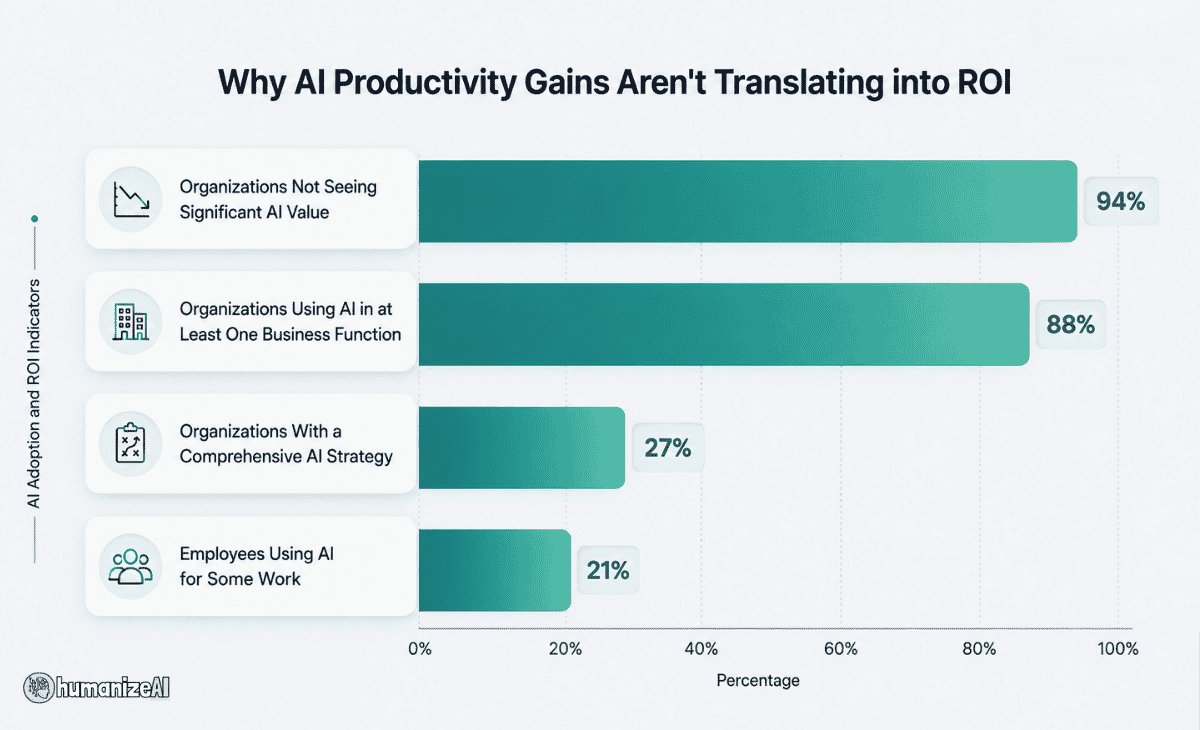
Even though these numbers are convincing enough to make us realize that AI is helping with productivity gains there is another aspect. As of the end of 2025, almost nine out of ten companies had relied on AI for at least one business function. However, 94% of respondents report not seeing significant value from those investments! Let us look at the numbers:
Source:
Gartner (2026)
Deloitte State of AI in the Enterprise (2026)
McKinsey (2026)
To begin with, about 19% of employees say AI has not saved them any time at work at all. Secondly, approximately 88% of employees who have access to enterprise AI tools also use personal AI tools to get work done. A quick look:
- Only 27% of executives say their company actually has a clear AI strategy. And get this, just 20% of leaders think their teams are truly ready to work alongside AI.
- The point is, things don't look much better when it comes to actually putting AI to use. Only 25% of organizations have managed to move somewhat 40% of their AI experiments into real production. Most are still stuck with testing.
- In fact, around 37% of companies are just using AI to see how it looks, more like a fancy add-on than something that actually changes or impacts how the business runs day to day.
- Most importantly, Gartner says that by 2027, companies that don't build their AI strategy around their people could lose half of their best AI talent. That is a big deal.
- Right now, AI is mostly a leadership thing. 73% of the people actually using AI well at work are managers or executives, not the people on the ground.
- When employees use AI across more than one task regularly, they are 2 times more likely to be highly productive. That is not a small difference.
- Those same people are 2.3 times more likely to consistently put out high-quality work.
- And they are 3.2 times more likely to actually spot and fix the processes that are slowing everyone down.
Citation: Gartner (2026); Deloitte State of AI in the Enterprise (2026)
AI Productivity by Industry: Who Is Actually Winning?
Source:
Deloitte State of AI in the Enterprise (2026)
PwC (2025)
World Economic Forum (2025, 2026)
Reports say that companies expanded employee access to AI tools by 50% in one year, increasing coverage from fewer than 40% of workers to around 60%. So, is this working? What do the numbers say? Let us see what exactly AI and productivity look like in real terms.
- About 34% of organizations are using AI to deeply transform their business models.
- Another 30% are redesigning key business processes around AI.
- Around 37% of companies are still using AI at a surface level, with little to no change to how their core business actually runs.
Where the productivity gains are showing up
- Industries with higher AI dependence reported nearly 3 times greater revenue per employee growth compared to those with less exposure.
- PwC reports that AI agents are delivering productivity gains of up to 50% in several business functions.
- Employees with a positive outlook toward AI are 3.4 times more likely to be highly productive.
The people side of the equation
- In the United States, 70% of workers completed AI training when their employers made it available.
- AI represented 67.5% of learning priorities across industries and markets surveyed as of September 2025.
What is coming next
To sum it all up, around 73% of executives believe AI agents will provide a significant competitive advantage within the next 12 months.
- About 88% of executives say their organizations plan to increase AI-related budgets over the next year owing to agentic AI.
What 2026 Actually Looks Like for AI at Work
Here is the honest takeaway from everything you just read.
AI productivity tools are real, and the time savings are real. Workers are getting hours back every week. Copilot is cutting down email time. Generative AI is handling tasks that used to take almost the entire workday.
But here is the catch. Saving time and using that time well are two completely different things. McKinsey found that out of 5.7 hours saved per week, only 1.7 hours actually go toward work that needs to be done. The rest somehow just vanishes.
And then there is the bigger problem. Nearly nine out of ten companies have deployed AI in some form. Yet 94% say they are not seeing significant value from it. But here’s the thing, it is not a technology problem. The gap really lies in training, execution, and planned dependency.
If you look at the numbers, the workers winning with AI are not necessarily the most technical ones. They are the ones whose companies actually trained them. In other words, AI is giving results to those companies that treat it as a business upgrade and not just another subscription!