
AI Content Detectors are our go-to option to “protect” ourselves from AI. At this point, it’s a billion-dollar industry that promises trust, security, and digital assurance.
But the statistics say otherwise. AI detectors have become notorious for jeopardizing original work. They flag original content and sometimes risk someone’s entire career or client proposals.
Read along as we deep dive into AI content detection statistics, focusing mainly on false positives and user feedback. Let the numbers help you decide if investing, trusting, or following an AI detector is a wise choice and what it means for your content space.👀
Key Takeaways:
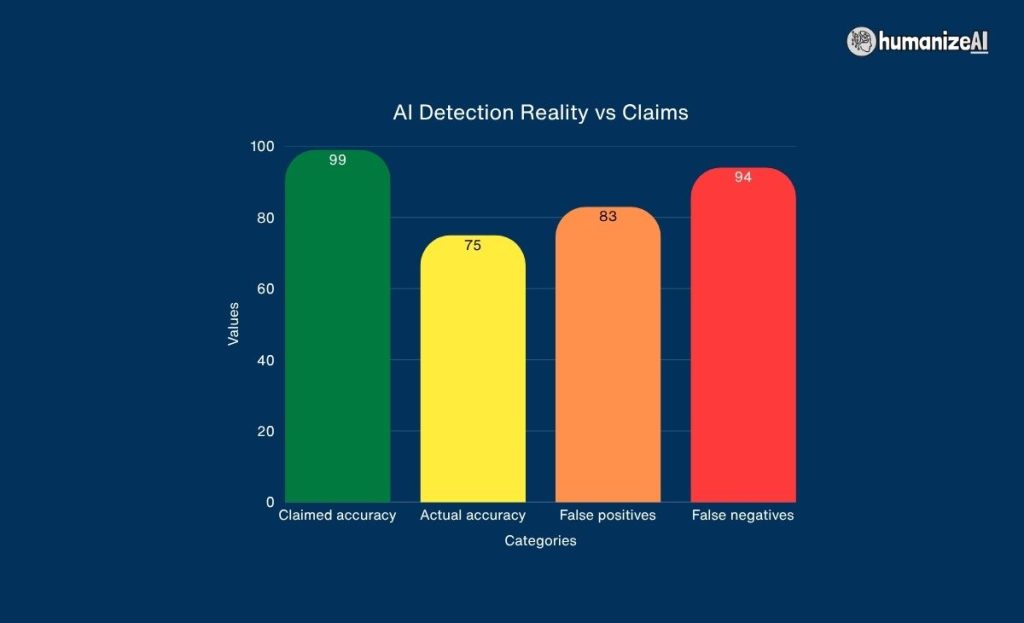
- AI detectors can flag up to 83% of genuine student writing as AI-generated in worst-case scenarios.
- Even a 1–2% error rate can result in hundreds of students being wrongly accused in large institutions.
- 61.3% of non-native English writing is misclassified as AI, showing a clear bias in detection systems.
- Improving vocabulary alone can reduce false positives from 61.3% to 11.6%, proving that detectors rely heavily on writing style.
- The AI detection accuracy ranges between 65% and 90%, far below what most tools claim.
- Detection systems can fail to catch AI content in up to 94% of cases, especially after minor edits.
- AI detectors correctly identify AI-generated content only 39.5% of the time, dropping to 22.1% after simple rewriting.
- More than 50% of students use AI for academic assistance, but only 5% admit to cheating, highlighting the gap between usage and misuse.
- There is a 15-fold increase in cheating cases with the rise of AI tools.
- Even tools with less than 1% error can produce thousands of false positives when applied in a mass setting.
AI Detection Is Now a Billion-Dollar Industry For A Tool That Keeps Failing
Before we dive deep into the details, let us look at a report from Stanford HAI to help you understand this better. It points out how AI detectors are unreliable, especially for non-English speakers:
- More than half (61.22%) of TOEFL essays written by non-native English students were incorrectly flagged as AI-generated.
- 19% of essays (18 out of 91) were flagged as AI-generated by all seven AI detection tools.
- 97% of essays (89 out of 91) were flagged as AI-generated by at least one detector.
The numbers don’t lie. It clearly points out how a subtle change in the style of writing can most definitely trigger the detectors. But still, it is a multi-million dollar industry. A report by Markets and Markets says that
- The AI detector market is projected to grow from $0.58 billion in 2025 to $2.06 billion by 2030 at a CAGR of 28.8%.
- The academic integrity segment holds the largest market share. Meaning the universities are the largest buyers.
- Another critical aspect of AI detection, as pointed out in this report, is for government usage. In 2024 alone, AI was used in elections across 80% of countries worldwide, with 90% of those incidents involving AI-generated content.
- AI-generated audio and voice detection is the fastest-growing segment, fueled by voice cloning and deepfake threats.
- Turnitin is rated a "Star" player in the market, while Reality Defender is flagged as an emerging leader.
- North America controlled 33.48% of the global market in 2025, making it the leading consumer.
Looking at all these numbers, you might feel like the AI Detector market is heading in the right direction. Until you realize that it isn’t. Even though there is a steady growth prediction, the reality says otherwise.
AI Content Detection Accuracy Statistics: What the Numbers Actually Show
Initially, relying on AI detectors felt like the right choice to protect ourselves from the undue advantage of using AI. We never wanted to compromise on our integrity. Therefore, the AI content detection trend became our saviour. Until it started to flag our original work.
To begin with, OpenAI itself discontinued its AI detector back in 2023 due to inaccuracy. (ARS Technica) And it is not a one-time instance or a company-specific thing. AI detectors have been failing massively when it comes to accuracy. Here’s a quick look at a report published by the National Library of Medicine:
- 75%–85% of human-written manuscripts were flagged as AI-generated after being polished using ChatGPT.
- 15%–25% of those flagged cases were labeled with high confidence as AI-generated.
- The report further highlights how even light AI-assisted editing (like improving readability) can drastically increase the chances of human-written content being mislabelled as AI-generated.
Now, let us look at another perspective. A 2024 study published in Frontiers in AI found that AI detection accuracy ranges between 65% and 90%, depending on the tool used.
This means when it comes to AI Dectectors, we are dealing with two critical challenges:
- As the report by NIH suggests, “Turnitin claims 98%, Copyleaks says 99.1%, GPTZero advertises 99%, and Winston AI goes even further at 99.98% is a myth.
- AI detectors tend to lose their direction the moment they are presented with writing that varies in style. A simple example of this dilemma would be if you are using em-dashes or being more technical with your content, you will be flagged.
Here’s another study published by NIH, in which seven widely used GPT detectors were tested on 91 TOEFL essays written by non-native English speakers. Here are the key findings:
- They incorrectly labeled more than half as AI-generated, with an average false positive rate of 61.3%.
- 19.8% of the human-written TOEFL essays were identified as AI-generated by all seven detectors. This means nearly 1 in 5 genuine student essays was flagged as AI by every single tool.
- At least one detector flagged 97.8% of all TOEFL essays as AI-generated. Only 2.2% of essays were completely cleared by all tools.
- When ChatGPT was used to improve the vocabulary of TOEFL essays to sound more like native speakers, the average false positive rate dropped by 49.7%, going from 61.3% to 11.6%.
To sum this up in one simple line
👉Detectors rely on perplexity (predictability of text)
- Non-native writing = simpler → looks like AI
But this is not where this story ends. There is another aspect that makes relying on top AI detectors challenging.
The Bypass Problem:
- When ChatGPT was asked to rewrite its own work using more of a literary language, the bypass detection for AI-generated content dropped near zero across all seven detectors.
🚨 This creates a trust issue and exposes the double standard of all the top detectors in the market. Moreover, it also highlights how misleading the “99% accuracy” claim is. This is also why researchers have clearly warned against using GPT detectors in academic or evaluative settings.
AI Detector False Positive Rates: Who Is Getting Flagged the Most?
You must be thinking the false positive pattern is just a glitch and happens with only certain types of writing. But unfortunately, it has now become a tradition when it comes to AI detectors. Here’s a quick look at some of the concerning data points:
- A 2026 study testing commercial AI detectors on 192 texts reported a false positive rate between 43% and 83% for real student writing. In the worst cases, 4 out of 5 genuine essays were flagged as AI-written.
- This means even with a low 1–2% false positive rate, a university with 20,000 students could still see 200–400 students wrongly flagged for being accused of using AI.
- Trutin itself has acknowledged that an approximate 4% false positive rate per sentence in its documentation.
- The University of Missouri estimated that using Turnitin’s AI detection across all submissions in 2024 would result in at least a few hundred false positives.
Sources:
- AI Content Self-Detection for Transformer-based Large Language Models.
- A Practical Examination of AI-Generated Text Detectors for Large Language Models.
- K-12 Dive News.
The problem is that AI detectors are designed to flag anything straightforward or technical. This is exactly why AI detectors have even flagged the U.S. Constitution as 100% AI-written, reports Binance.
But, at this point, this is not a conversation we have for intellectual stimulation. Being flagged for academic misconduct can have serious real-world repercussions. Here’s a detailed analysis by The Guardian that sheds light on this problem:
- Students are being called into misconduct hearings
- Given zero marks immediately
- Required to defend their work in an anxious formal panel.
This has not only impacted their learning process but also affected them mentally as well.
- Many students report mental health concerns.
- Reduced confidence in their own writing
- Sceptical about even using basic tools like Spellcheck.
But, there is more. AI detectors have created complete chaos in our learning process. Here are a few more key insights from the report:
- More than 50% of students now use generative AI to assist with assignments, while around 5% admit to using it to cheat.
- Now, universities are bearing the brunt of the blow, and some institutions have reported a 15-fold increase in cheating cases since the rise of AI tools.
- Now, to get ahead of this, Turnitin has scaled massively. It processed over 130 million papers and flagged 3.5 million as AI-generated.
🚨But even a less than 1% error rate can result in thousands of false positives when applied at this scale.
- At the same time, we have seen that detection systems are far from reliable. One study found that AI detectors correctly identified AI-generated content only 39.5% of the time, dropping to 22.1% after simple edits.
- In another test, 94% of AI-generated exam submissions went undetected and even scored higher than human-written responses.
All these imposing numbers raise two big fundamental questions. Firstly, the setup with AI detectors, needless to say, is messy. It needs more structure, uniform rules, and so much more. So, in the meantime, how do we decide which student to penalize?
Secondly, when we have ample receipts about how AI Detectors are faulty and are not reliable, are we doing enough to protect academic integrity?
So, Should You Trust AI Detectors in 2026?
At this point, our major problem is not AI but how we are trying to detect it. One thing that we can be sure of is that detectors in the market have a lot of catching up to do when it comes to modern writing.
Secondly, they never acknowledge that writing style can differ. Being technical or to the point doesn't always mean it is written by AI. This results in a setup that is designed to fail.
We are looking at tools that can flag up to 83% of genuine student work, miss up to 94% of AI-generated submissions. And this is not only concerning but demands our immediate attention or maybe intervention.
PS: This is exactly why a platform like HumanizeAI.io exists. Our entire setup is built on how problematic, concerning, and unfair AI detectors can get.
Because at the end of the day, the goal is not to outsmart AI detectors or have an unfair upper hand. It is about ensuring genuine work is not punished for sounding too technical, structured, or maybe too correct.
The fun part? Our blog is flagged 15.7% AI on ZeroGPT. Apparently, numbers are the detector’s worst enemy! 😆