
Something interesting is happening with our e-commerce spaces. Every user is getting exactly what they want with a feed curated for them. More than anything else, it is now all about high-intent buying. As in, you will only see the things that you want or, most importantly, might want.
This is exactly why Adobe reports that generative AI traffic has exploded to 4,700% YoY in July 2025. At this point, the discussion is not just about this abnormally high growth rate. But also a realization that relying on AI in e-commerce has become a new channel to unlock traffic.
Read along as we discuss this in detail, understand the traffic, conversion rates, and user data for AI in E-commerce 2026. 😯
TLDR; Key Insights
- Generative AI traffic grew 4,700% YoY
- Conversions are 42% higher than traditional traffic
- Engagement is 12% higher for these visitors
- Users spend 48% more time on-site
- Page views increase by 13% per visit
- Revenue per visit is 37% higher
- Conversion rates are 4.4× higher than organic search
- 58% of Millennials already use or plan to use AI for shopping
- 95% of Millennials say it improves their experience
- 44% of Gen Z already use AI, with 10% planning to adopt
- 90% of Gen Z users report better shopping experiences
- 58% of consumers use AI instead of traditional search
- 27% of purchases happen through AI-generated links
How AI is Driving Traffic Growth For E-commerce In 2026
To begin with, the phrase AI in e-commerce is now being used so loosely that we tend to believe it’s some kind of magic. But the use of AI in e-commerce comes in various layers.
Using it inside your website to drive growth
- Product descriptions (“you might also like…”)
- Personalizing homepage, prices, and offers
- Predicting what you will buy
- Chatbots helping you decide
Outside the website (Discovery Side)
- This is when you ask ChatGPT or any generative AI tool about any recommendation, and it helps with direct links → that’s your traffic
👉 So AI is:
- replacing Google search partially
- acting like a shopping assistant + search engine combined
Now this ease of access has changed how we look at online shopping completely. Search Engine Land reports that nearly 30% consumers believe the main benefit of using AI is efficiency, as it speeds up the shopping process.
But to put things into perspective, AI in e-commerce is not just about having quick access. It has evolved and become a way of how we exist online. Here are the key points from a study published by Demandsage:
- Nearly 89% of retailers are either using AI for their daily use or experimenting with it on pilot programs.
- With this growing adoption, the global AI in the e-commerce sector is valued at $9.01 billion and projected to reach $64.03 billion by 2034.
- Around 50% of businesses are already actively using AI in e-commerce today.
But here is the thing: AI adoption is not the only thing that drives traffic. There are a few more detailed aspects which can be something as critical as:
- To begin with, AI is changing the top of the funnel. Nearly half of all retail companies, say about 48.9%, are now using AI for marketing automation.
- At the same time, 47% of companies are investing in personalized recommendations. As it is not just helping to shop but also shaping what you see first.
- Another important aspect that is rarely discussed is Image search. Around 24% of e-commerce companies have adopted visual search. Meaning the traffic does not always come from traditional website pages.
- In addition, about 31% of businesses are using virtual agents and chatbots. As in, when the chatbot creates a new traffic doorway with the product link on some social media platform.
- Most importantly, these numbers are a clear indication of how our E-commerce environment is now shifting. Companies that rely on an AI-based e-commerce setup report 20% increase in revenue, along with an average cost reduction of 8%.
- Moreover, AI-powered bots are also improving lead conversions by 25%.
👉Simply put, AI is not just a good-to-have feature. It has now evolved into a backbone of how users discover products, interact, and ultimately convert.
AI and Conversion Rates in E-commerce
Now it is time to ask some important questions to help understand the presence of AI in e-commerce better. To begin with, traffic doesn’t really mean much if you do not see actual conversions. So, the obvious question is: the numbers are growing, but are visitors actually buying?
The answer to this question in 2026 is a definitive yes. According to Adobe Business for the USA (April 2026), traffic from generative AI platforms such as ChatGPT, Perplexity AI, etc., converted 42% better than traditional non-AI traffic in March 2026. Here are a few more of the key findings in the report:
- Initially, AI traffic was at its worst. In fact, in March 2025, it converted 38% worse than traditional channels, but things eventually fell into place.
- Secondly, top retail websites perform much better than others. While the average score is 75%, the best sites reach 82.5%, and the lowest drops to 54.2%. This is exactly what establishes that faster adoption leads to better results.
🚨The report further suggests how this shift is partly driven by rising consumer trust in AI. With 66% of users trusting the AI-generated results to shape and influence their buying decisions.
This significant influence of AI in the e-commerce space is driving user behaviour as well:
- Users arriving from AI-driven sources show a 12% higher engagement rate compared to traditional traffic.
- Most importantly, these users also spend 48% more time on-site and view 13% more pages per visit.
But here is what makes this even more interesting. The 42% figure from Adobe is the aggregate story. When you zoom into individual AI platforms, the numbers get sharper:
- An AI search visitor converts at 4.4 times the rate of a traditional organic search visitor. In other words, say your product currently converts at an organic traffic at 1.5%. But with AI-referred visitors, the same product pages will convert at roughly 6.6%. The same product, same website, same strategy, it's just the traffic that changes. (Semrush)
The reason why the AI-driven traffic numbers are so high is that it comes with a credibility stamp. People tend to better accept a product that is directly referred to by AI. This means lower bounce rates and, in turn, more conversions. Here’s a quick look at another report published by Adobe.
- 27% of consumers make purchases directly through AI-provided links.
- Interestingly enough, the report also suggests how 69% of users report they are less likely to return a product recommended by AI.
Lastly, and most importantly, the report highlights that every single visit coming from an AI source ( ChatGPT, Perplexity, any generative AI tool) generates 37% more revenue.
Who Is Actually Shopping With AI? User Data in 2026
We have a fair idea now about the traffic numbers when it comes to AI. But now it is time to give those numbers an identity or a direction. Or, in simple terms, it lets us dive in and understand the people behind the clicks.
A report published by Search Engine Land, based on research by Exploding Topics, says that nearly 77% use AI to shop. Now this is not some random number but a habit that is reshaping our online shopping experience.
A detailed study by Capital One Shopping helps us understand this better. Here’s a quick look:
- 72% users now prefer to rely on AI to research products and brands.
- This explains the generational shift, as now 58% of consumers use generative AI instead of traditional search.
But as you break down this report further, you will understand who is actually driving this shift:
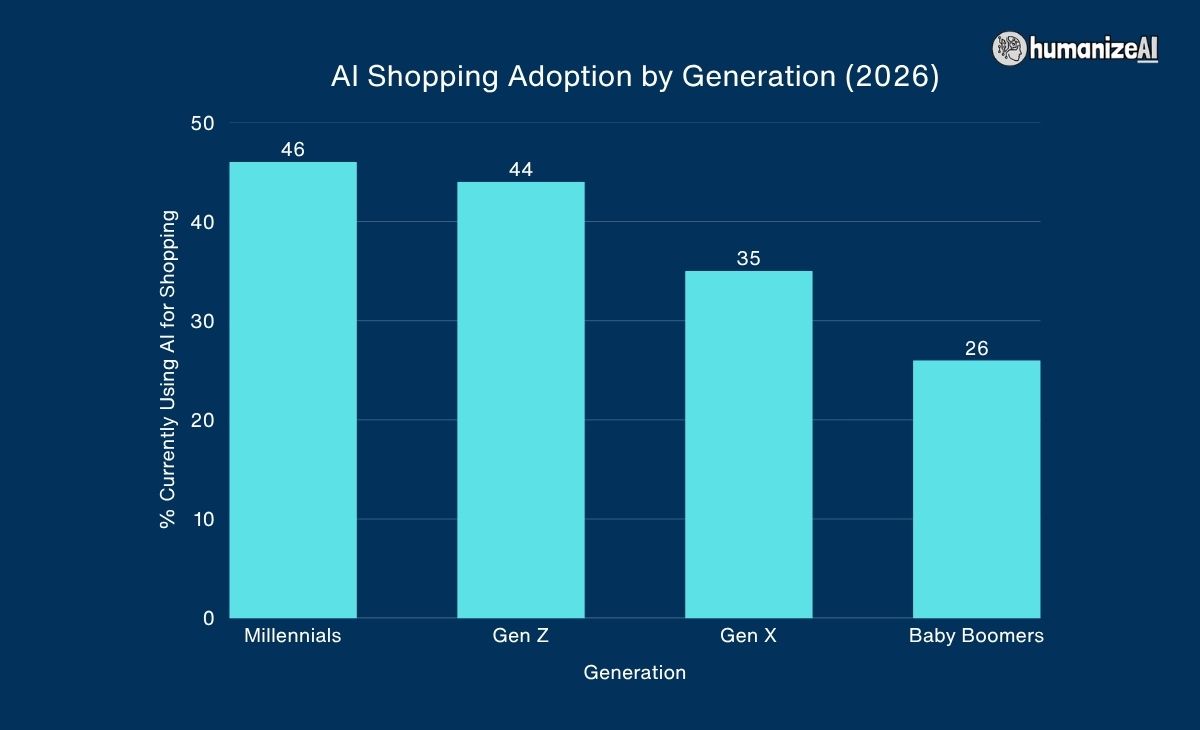
- At this point, 58% of Millennials are either already using AI or plan to use it for shopping. With 46% of them are actually using it.
- What makes this even more interesting is that 95% of Millennial users say AI improves their shopping experience, a sharp increase from 79% in 2024.
When it comes to Gen Zs, they are also catching up with the trend:
- About 44% of Gen Z already use AI for shopping, and another 10% plan to adopt it soon. More importantly, 90% of Gen Z users report that AI improves their shopping experience.
At the same time, adoption is expanding across older demographics as well.
- Around 53% of Gen X consumers either use AI or plan to use it, with 35% already shopping through AI tools.
- Interestingly enough, 92% say AI improves their experience, projecting a 33% increase in satisfaction within just one year.
Even Baby Boomers, traditionally slower and more resistant to adopting new technologies, are catching up.
- 44% of baby boomers have either used AI for shopping or are interested in doing so.
- While only 26% actively use it today, 87% of those users say it improves their experience.
Lastly, the report made another interesting observation. AI in the e-commerce space is now a practical and accessible upper hand that makes life easier. For example, 55% of consumers with multiple children under five use AI to create shopping lists, compared to just 8% of those without children.
Conclusion: AI Is Reshaping the Entire E-commerce Funnel
As we scroll through these numbers, there is one thing that we can agree on. AI is changing how we approach, interact, and live in our online shopping spaces. It is no longer an emerging trend but an established pattern that is changing the entire funnel.
Be it your traffic growth, conversion rates, or user behavior, AI is now influencing it every step of the way. And, it is not just about bringing the users to the website. But it is way more layered, including shaping what they see, how they interact, and how quickly they make decisions.
Now, if we talk about the numbers that we saw up until now, it is safe to say that AI is:
- Converting better
- Engaging more deeply
- Generating higher revenue per visit
- Making users of all age groups trust it more.
So, to sum it all up, it can be said that AI in e-commerce has moved beyond tools and automation. It is no longer optimizing the funnel. It is becoming the funnel.