
Next time, when you seek financial advice or say you plan to invest, you might reach out to a robot. Yes, our days of trusting that one Instagram account or YouTube video are now finally over.
Interestingly enough, users are now leaning towards AI to help make financial decisions and investments. But this change has now raised questions that demand immediate answers. Like, how exactly big is the wealth management industry? And what does all this mean for big-shot names like JPMorgan, Morgan Stanley, etc.? Most importantly, is it feasible to trust AI with our finances?
Read along as we help you answer these questions, but minus the fear and panic. We will see adoption rates and traffic statistics, and picture the future of fintech with AI wealth managers, all through detailed data points. 😎
Key Takeaways:
- The robo advisory market could reach $102 billion by 2034.
- Robo advisors are growing at 28.1% every year.
- Vanguard Digital Advisor manages $311 billion in assets.
- Robo advisors charge around 0.20% yearly fees.
- Traditional advisors usually charge 1% to 2% yearly fees.
- 81% of wealth tech firms say AI is their most important technology.
- Only 35% of financial advisors currently use AI tools daily.
- 95% of wealth firms plan to increase AI spending.
- Only 27% believe wealth management is leading in AI adoption.
- 71.8% of users made financial decisions using AI advice.
- 73% of Millennials said AI improved their financial confidence.
- 67% trust AI for fraud detection.
- 66% trust AI for spending tracking.
- 66% trust AI for calculating credit scores.
- AI answered 35% of financial questions incorrectly in one 2025 study.
- 56% still prefer humans for retirement planning.
The AI Wealth Manager Market Is Bigger Than You Think
AI wealth management has gone beyond a quick chat box that you see on some random website. Now they are a part of a major financial investment and decision-making. It is now known as the robo-advisory market, and it uses AI to handle financial tasks and investment decisions for users.
First, let us trace the extent of its growth with the help of a report published by Fortune Business Insights.
- The global robo-advisory market was worth $10.86 billion in 2025.
- The market is expected to grow to $14.08 billion in 2026.
- By 2034, the robo-advisory industry could reach $102.03 billion.
- The market is growing at an impressive rate with an annual growth rate of 28.1%.
- North America was the biggest market with a global share of 4.75% in 2025.
- The reason this industry is getting popular is that users are choosing automated investment apps for low-cost and easy financial management
Now the report also highlights some interesting key points that will help you paint a more diverse picture. Here’s a quick look:
- According to Refinitiv, financial advisors using digital technologies saw a 77% increase in client retention.
This suggests that technology-driven wealth management services could grow strongly in the coming years.
- Pure robo-advisors are also expected to grow rapidly because they are more affordable and cost-effective.
The reason why AI in Fintech is seeing growth right now because Generative AI is having a major impact on the robo-advisory and wealth management market.
- Financial companies are increasingly using generative AI to build smarter investment tools.
- Many firms are developing AI systems that can provide automated investment advice to users.
But let us now deep dive and understand what all this looks like from a user perspective. How big are we actually talking when we say AI in Fintech or talk about robo-advisors? Here’s a quick look:
- By 2034, the same market is expected to hit $102 billion. That is roughly the size of the entire GDP of a mid-sized country, growing at nearly 28% every single year (CAGR of 28.10%). ( Source: Grand View Research)
Now, from a user’s perspective, the numbers appear to be way more intense. To understand this, we have to look into the AUM or the total money these platforms are managing for people. A detailed report published by Investingintheweb comes with a detailed insight:
- Vanguard Digital Advisor alone manages $311 billion in assets. That is larger than the GDP of many countries.
- Vanguard Digital Advisor → $311 billion AUM
- Empower → $200 billion AUM
- Schwab Intelligent Portfolios → $80.9 billion AUM
However, this is where things get more interesting. It is not just about how fast these robo-assistants are growing. The report further highlights the cost disparity between the traditional advisors and robo- advisors. And, this is exactly where things will start making sense for you.
Usually, traditional financial advisors charge 1% to 2% of your portfolio every year. In comparison, robo advisors charge an average fee of just 0.20% annually, according to Mordor Intelligence.
On a $100,000 investment portfolio, that works out to roughly:
- $200 per year with a robo advisor
- $1,000 to $2,000 per year with a traditional financial advisor
At this point, we can say that the numbers aren’t just growing or showing an increase; they are accelerating at full throttle.
Who Is Actually Using AI Wealth Managers Right Now?
Whenever we think about AI wealth managers, we tend to think every other big firm or tech giant is heavily dependent on them. But a sneak peek into the numbers tells a different story.
- As Fintech Global reports, 81% of wealth tech companies consider AI their most important technology. However, only 35% of financial advisors currently use AI tools in their daily work.
- Just 10.5% of advisors use AI tools every single day. Therefore, it is clear that there is still a gap when it comes to actual adoption as compared to the growing investment.
Now, let us look into a report published by MSCI on wealth trends in 2026 to deep dive into this situation better:
- 95% of wealth management firms say they plan to increase their AI spending, yet only 27% believe the industry is actually leading in AI adoption.
- Only 5% feel the wealth segment is significantly leading the broader financial industry in AI adoption.
- Around 72% overall still believe the wealth management industry is not leading AI adoption.
- Even though firms are heavily investing in AI, many advisers still feel their industry is falling behind competitors.
However, there is one thing that you have to keep in mind, as the report accurately points out. Wealth management firms measure AI success differently from asset managers and other financial sectors. They focus mainly on:
- Personalization
- Client engagement and involvement.
- Efficiency
- Expanding and scaling client services
- Customization of investment proposals
But as wealth management firms are still trying to figure out how to measure success with AI, the startups are actually living the reality of it.
According to Modor Intelligence’s report, Fintech companies held 51.65% of the global robo advisory market revenue in 2025. Here are a few more detailed insights:
- Banks and credit unions are also growing rapidly, with a projected CAGR of 34.40% through 2031.
- Individuals with high net worth accounted for 54.60% of robo advisory demand in 2025.
- The retail investor segment is growing even faster, with a projected CAGR of 33.10% by 2031.
- North America dominated the robo-advisory market with a 37.75% revenue share in 2025.
- The Asia Pacific region is expected to see the fastest growth, expanding at a CAGR of 32.90% through 2031.
Therefore, it is evident that the robo-advisory adoption is expanding beyond wealthy investors and becoming more mainstream among retail users.
Can You Actually Trust AI With Your Money? Here's What the Data Says
Now, if you are still wondering if you can trust AI with your money, here is a simple way to understand what you just read. Ten years ago, quality financial advice was for people with enough money to afford it. You needed a minimum account balance. You needed to book an appointment. You needed to be the kind of person a financial advisor thought was worth their time. In short, financial advice was considered a privilege.
But now with AI in the picture, things have changed for the better. Planadviser reports that 71.8% of users who relied on AI for financial guidance said they made real financial decisions based on that advice.
- Among Millennials, 65% reported improved financial well-being after using AI financial tools.
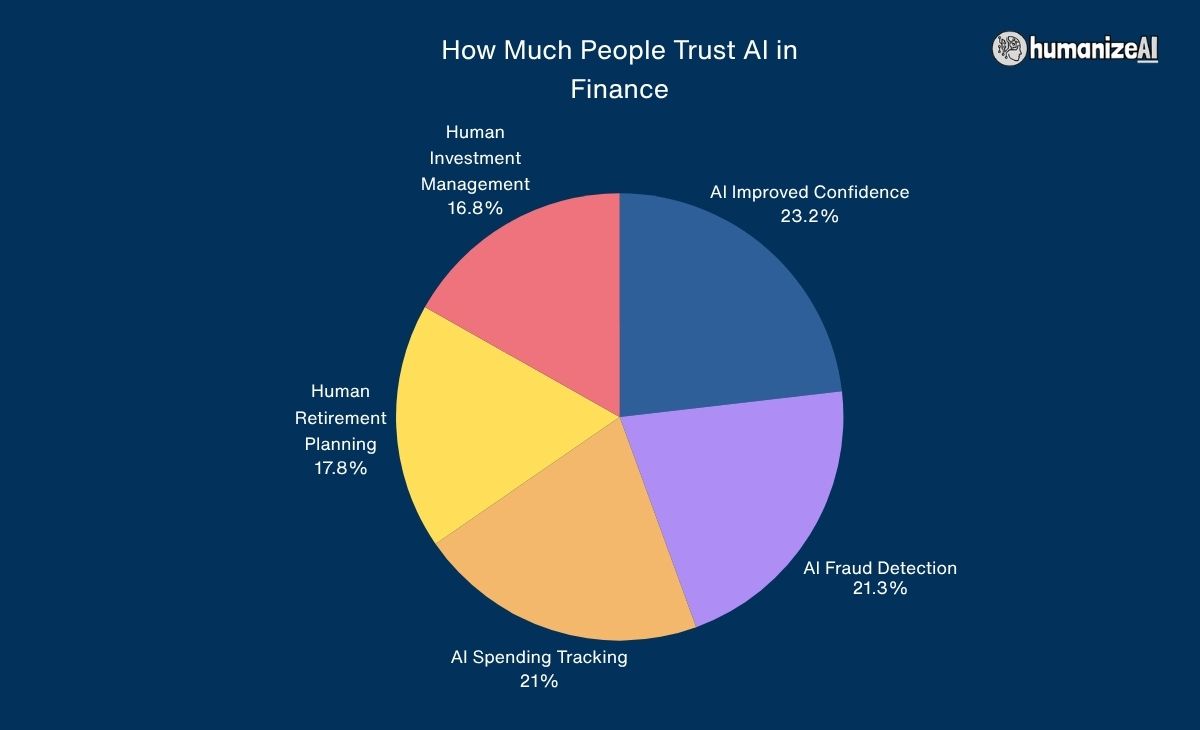
- Around 73% of Millennials said AI increased their confidence in managing money and financial decisions.
However, this is where things get complicated. A 2025 study tested AI using 100 financial questions and found that the system answered 35% of them incorrectly. Around one in three responses were identified as hallucinations, where the AI generated false or made-up information.
Because of these risks, FINRA’s 2026 regulatory oversight report warned brokerage firms to create systems that are not vulnerable. The ones that can detect AI hallucinations and bias in financial operations.
So what are people actually comfortable letting AI handle?
According to a TD Bank survey reported by ABA Banking Journal, the answers to this question are supported by solid data points. Here’s a quick look:
- 67% are comfortable with AI handling fraud detection
- 66% trust AI for tracking spending and expenses
- 66% are comfortable with AI calculating credit scores
However, trust drops sharply when people are asked whether AI should independently handle complex or high-stakes financial decisions. Therefore, the answer to this question is simple: you can always trust AI with the routine stuff. But, for the big decisions, it is better to rely on a human.
And, it is not some random internet anecdote but real-time numbers. To sum it all up, a report published by ASPA will help you understand all this better. It says that most Americans still prefer human financial professionals over AI for major financial decisions. Here’s a quick looK;
- 56% prefer humans for creating retirement plans.
- 55% trust humans more when asking financial questions.
- 53% prefer humans for building personalized financial plans.
- 53% trust humans more for managing investment portfolios.
- Less than 15% of respondents said they trust AI more than humans across financial planning tasks.
- Around 21% said they trust humans and AI equally for financial services
The Future of AI Wealth Managers Depends on Human Trust
Therefore, to sum it all up, and all the numbers that you have read so far. AI has already entered finance, and it is here to stay. But the real confusion lies in knowing how much financial decision-making people are willing to hand over to algorithms.
AI wealth managers are no longer a futuristic fintech experiment. They are already managing hundreds of billions of dollars, reshaping how younger investors approach money. But, they are yet to have that overall brand credibility and assurance like the traditional institutions.