
AI is transforming rapidly as we speak. And this change is not just about how many people are adopting AI. But how are we adopting it. To begin with, it is no longer a simple chatbox or a setup that runs on a prompt.
Now we have automated AI agents that take care of the daily tasks, especially repetitive ones, and help with shopping recommendations, conversations, and do so much more.
Read along as we discuss the growth of autonomous AI agents, the currency market size, and how exactly users are adapting to it. We will look at some detailed numbers and statistics and see what the experts in the field have to say. 🤔
Key Takeaways
- The AI agents market is expected to grow from $7.63 billion in 2025 to $182.97 billion by 2033.
- By 2026, 40% of enterprise applications are expected to include AI agents.
- 51% of large companies have already implemented agentic AI in their operations.
- Businesses are increasingly using AI agents in customer support, IT operations, finance, healthcare, and cybersecurity.
- AI automation is helping companies reduce their costs by up to 30%.
- Financial AI agents are achieving fraud detection accuracy rates of up to 90%.
- More than 85% of Fortune 500 companies already use Microsoft AI tools.
How Big Is the AI Agents Market in 2026?
To understand this, let us begin with a prediction by Gartner. It says that by 2026, 40% of business apps are expected to use AI agents designed for a specific task. (Up from less than 5% in 2025)
As in most of the major apps or tools we use, they will be incorporated with an AI agent. Now, if you look around, this is no longer a prediction. Half of the apps, tools, and businesses now rely on an AI agent for one task or the other. Here’s a quick look at the numbers to help you understand this better:
- The agentic AI market was worth $6.96 billion in 2025 and is expected to grow to $57.42 billion by 2031.
- Experts estimate the market will jump from $9.89 billion in 2026, growing at an annual rate of over 42%.
Now, the reason why we are seeing these numbers growing on such a massive scale is simply because of three main reasons:
- Businesses are shifting toward automated AI systems.
- Significant improvements in large language models (LLMs).
- The efficiency of multi-agent frameworks to be able to handle more complex workflows.
Source- Mordor Intelligence: Agentic AI Market
Another detailed study by Grand View Research helps us understand this growth better. Agentic AI’s story is not about an instant rise to fame, but of consistency and widespread use. Here’s how:
- The global AI agents market was valued at $7.63 billion in 2025 and is projected to reach $182.97 billion by 2033.
Ps: You will notice that this number varies from the study published by Mordor Intelligence. Simply because firms have their own projection and calculations. But what is interesting is how both reports predict a steady growth.
- Experts put the CAGR of the AI agents market at 49.6% from 2026 to 2033
- Single-agent systems made up 59.24% of all market revenue in 2025, which tells you most businesses are still starting simple, one agent doing one job.
- The industrial sector is expected to grow at the fastest CAGR of 49.2% between 2026 and 2033
- Machine learning made up for 30.56% of the global AI agents market revenue in 2025.
- AI agents are increasingly being used in e-commerce for real-time product recommendations and customer support.
- Most importantly, healthcare is becoming a major growth area for AI agents, especially in patient management.
- The report further suggests that the Asia-Pacific is expected to record the fastest AI agents market growth. Simply because of its digital transformation and increasing AI adoption.
- A quick throwback: North America held the largest AI agents market share at 39.63% in 2025.
- The study pointed out another interesting trend. Build-your-own AI agents are gaining popularity as businesses now look for a more customised and personalised experience. This is exactly what a report published by Precedence Research also highlights, along with a few other key points:
- By product type, build-your-own AI agents are expected to grow the fastest in 2025, with a CAGR of 18.40%.
- By agent role, productivity and personal assistant agents recorded the strongest growth in 2025, with a CAGR of 29.50%.
- Multi-agents are expected to grow at the fastest rate, with a CAGR of 19.10%.
The research report further highlights the top companies that are now evolving and exploring agentic AI. It includes some big shot names like Alibaba Group Holding Limited, Amazon Web Services, Inc., Apple Inc., Baidu, Google, IBM Corporation, Meta, Microsoft, and many more. Now, if you are someone who believes in signs and patterns, you know what this means!
Where Are Businesses Using AI Agents in 2026?
At this point, agentic AI is not just about you and me having a personalised shopping experience. Or, say one healthcare agent helping us with instant resolution. It is a business strategy, a new workflow, and most importantly, a much-needed upgrade. And the business knows this and is using AI agents upto their full potential. Let us understand this with the help of a detailed report based on multiple studies published by Demandsage:
Enterprise Adoption
This is where you will realize that businesses are way past the experimenting phase with agentic AI. It is now the core part of any business, and the numbers hint that it is the start of a new AI era:
- 51% of large companies have already implemented agentic AI in their operations.
- 35% of businesses plan to do so within the next 1–2 years.
- Only 3% of companies say they have no set plans or strict timeline for AI agent adoption.
- 89% of CIOs consider agent-based AI a strategic business priority.
AI Spending & ROI
Businesses are now spending more to ensure their agentic AI is always ready. They want better productivity, reduce operational cost, and pitch their hopes on long-term returns.
- 43% of tech leaders say over half of their AI budgets are now going toward agentic AI.
- 88% of senior executives plan to increase AI-related budgets within the next 12 months.
- Nearly 62% of companies investing in agentic AI expect a 100% ROI.
- Another interesting aspect is that businesses expect an average ROI of 171% from AI agent investments. Not only is that a fairly high standard, but it also asserts how confident the businesses are when it comes to AI automation.
Where Businesses Are Deploying AI Agents
From customer support to sales and IT operations, businesses are integrating AI agents at every step of the way. More than a new venture, it has become a safety net to improve productivity, efficiency, and so on.
- Customer service and support lead the AI agent conversation, with 56% of organizations expecting a total integration within the next year.
- 51% of businesses expect AI agents to become part of IT workflows in the next 12 months.
- 47% of companies are planning AI agent implementation also in sales operations.
- Operations is expected to become one of the largest AI agent adoption areas in the next 1–3 years.
- The agentic AI adoption in Human resources is expected to rise from 21% to 28% over the next three years.
Fortune 500 & Enterprise AI Expansion
It is the big enterprises and the Fortune 500 companies that are leading the way for us. They are using agentic AI to have an automated approach across multiple departments.
- More than 85% of Fortune 500 companies already use Microsoft AI tools.
- Nearly 70% of Fortune 500 companies are using Microsoft 365 Copilot.
- 19% of Fortune 500 companies have fully automated specific tasks using agentic AI systems.
- Over 230,000 organizations are using Copilot Studio to build custom AI agents.
Challenges & Concerns
But the report also highlights what most people forget to acknowledge. The road to agentic AI is filled with challenges. Mainly because it is a huge load on a setup that rarely understands the real-life implications and risks.
- Only 16% of organizations currently have a formal set plan for AI agent implementation.
- 61% of organizations report that their employees are sceptical and anxious with agentic AI in the picture.
- 62% of organizations prefer partnering with a provider instead of setting up their in-house AI agent.
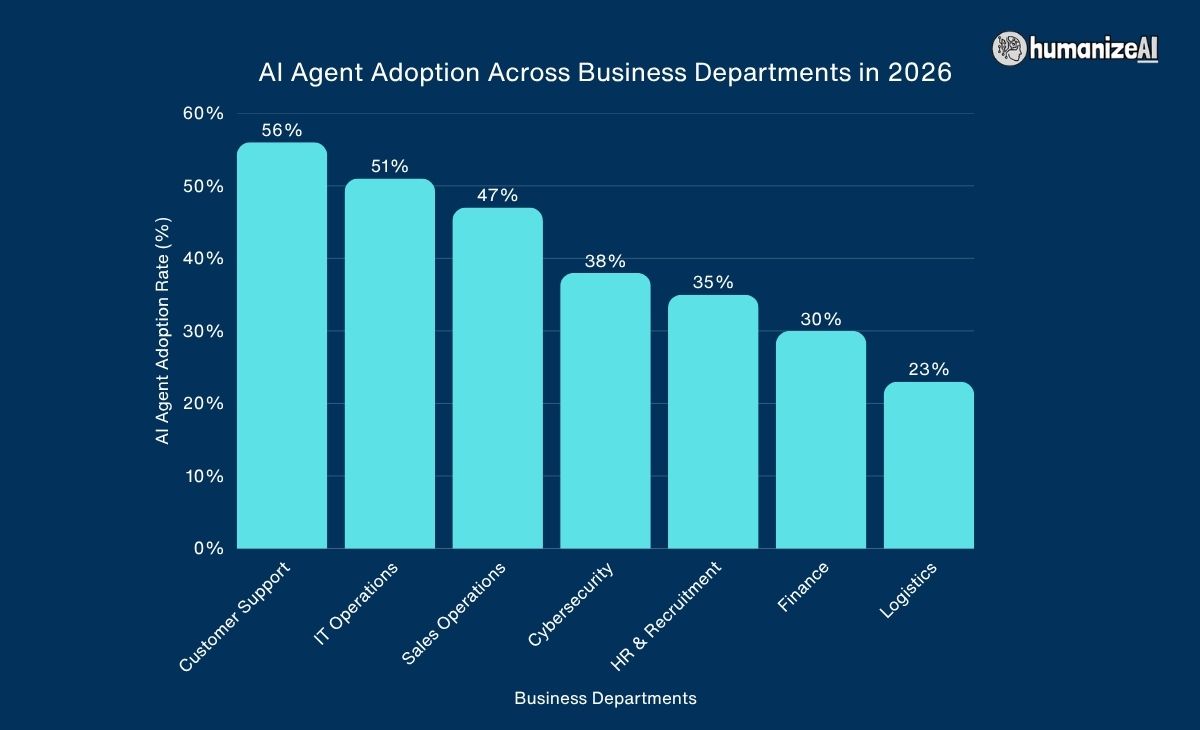
Industry Breakdown: Where AI Agents Are Making the Biggest Impact in 2026
Looking at these numbers, you can be sure of one thing: the future is all about AI agents and automation. Even though there are significant challenges, the businesses are on a road to efficient automation. A quick look at the report published by SQ Magazine will help you understand how it has been perceived by various industries. Let us break it down:
Customer Support & IT Operations
- 47% of customer service operations now use AI agents for ticket resolution and support routing.
- 40% of businesses use AI agents for IT service management and automating troubleshooting.
- Interestingly enough, automated customer support AI agents now achieve resolution rates above 70% without human intervention.
Finance & Banking
- Financial AI agents are achieving fraud detection accuracy rates of up to 90%.
- Finance teams using AI agents have achieved 30% faster invoice processing and reporting workflows.
- Around 70% of agentic AI use cases are involved in banking, retail, and manufacturing industries.
Healthcare
- Healthcare AI agents are reducing administrative workload by up to 30%.
- AI agents are increasingly being used in patient management and healthcare support systems.
Retail & E-commerce
- Retail businesses are seeing 20% higher conversion rates using AI recommendation agents.
- 54% of retail shoppers now use AI agents for product recommendations.
Manufacturing & Logistics
- Manufacturing AI agents are reducing downtime by 15%–20% through repetitive maintenance.
- AI agents are helping supply chains reduce delays by 20%–25%.
- Logistics AI routing agents improve delivery efficiency by 10%–15%.
HR, Marketing & Business Operations
- 35% of organizations are already using AI agents in HR for recruitment screening and onboarding.
- Marketing AI agents are delivering up to 25% higher ROI through real-time campaign plans and implementations.
- AI automation is reducing operational costs by up to 30% when it comes to repetitive workflows.
Cybersecurity
- 38% of organizations are using autonomous AI agents in cybersecurity for threat detection and monitoring.
- Another important aspect: autonomous cybersecurity agents detect threats 2x faster than traditional systems.
Conclusion
Many of us might think that an AI agent in 2026 is still a dream project or a prediction for the future. But these numbers tell you otherwise. They tell us that AI agents are now actively becoming a part of how our business operates.
From customer support and finance to healthcare, logistics, and cybersecurity, companies are now relying on AI agents to handle repetitive tasks, improve efficiency, and take better decisions.
But at the same time the industries are still figuring out various concerns about trust, security, governance, the growing anxiety of the employees, and so much more. But despite these hurdles, one thing is clear: AI is now shifting from the role of an assistant to an agent, and that too with continuous effect.